










Solex says validation could create 2 GW module opportunity
Key highlights
- Solex says it supplied more than 200 MW of modules to Welspun and Zelestra through its LONGi relationship.
- A third leading Chinese solar brand audited and cleared Solex’s facility, with potential demand of about 2 GW of modules.
- Solex achieved 4 GW of module production capacity in November 2025.
- Solex expects capacity utilisation above 80% in the second half of financial year 2027.
powered by IRIS
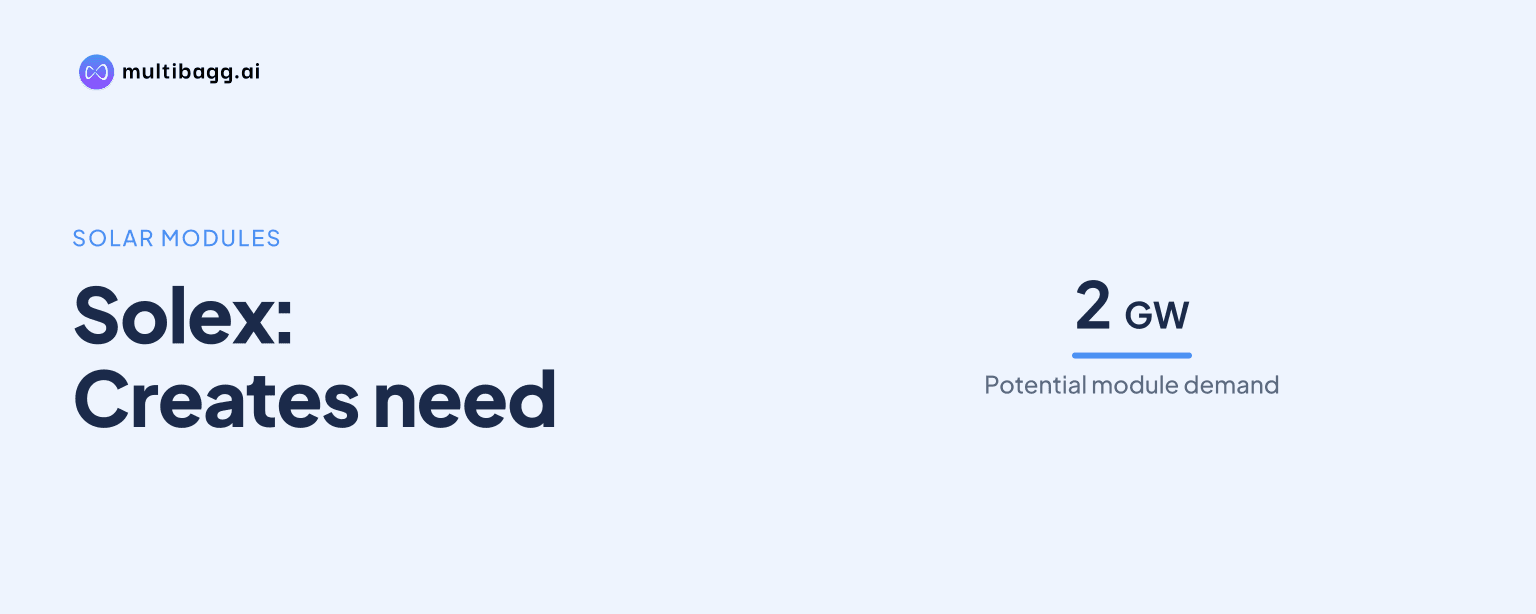
Solex Energy says a third leading Chinese solar brand has audited and cleared its factory, creating potential demand of about 2 gigawatts (GW) of modules after more than 200 megawatts (MW) were supplied to Welspun and Zelestra through its LONGi relationship. Solex does not disclose the third brand’s name, an order, delivery period or contract value.
Know Solex Energy inside out
Results, valuation, peers and who's buying, in one view.
What did LONGi validate at Solex?
LONGi audited and approved Solex as a registered manufacturing partner for its Indian customers. From 2022 to 2025, Solex says it manufactured modules for Indian and global brands including Tata, Adani, Jinko Solar and LONGi, using Chinese manufacturing processes, quality-assurance-plan compliance, breakage-ratio controls and global factory-audit standards.
Under the LONGi arrangement, LONGi specified the cells and bill of materials (BOM), while Solex manufactured modules under the Solex brand. Solex says it was the first non-Chinese manufacturer to supply LONGi’s Indian customers. The company reports a three-layer inspection process involving the customer, LONGi and an independent testing agency.
Solex identifies Welspun and Zelestra as marquee customers served through the LONGi relationship, with more than 200 MW of modules supplied to the two customers. The presentation also says LONGi’s international quality team visited Solex’s factory and adopted process learnings from Solex at its Chinese factories, without providing a date or an operating measure for that exchange.
How large is the module opportunity Solex identifies?
Solex identifies potential demand of about 2 GW from another leading Chinese solar brand after that company audited and cleared its facility. The stated opportunity is ten times the more than 200 MW supplied to Welspun and Zelestra, using 200 MW as the minimum disclosed delivered volume, but Solex describes it as potential demand rather than a purchase order.
The presentation describes the new counterparty only as a leading Chinese solar brand. It does not say whether the 2 GW would be supplied in one year or across several projects, nor does it identify a module format, cell technology, end customer or manufacturing agreement connected with that potential demand.
Solex achieved 4 GW of module production capacity in November 2025, placing the prospective 2 GW opportunity at half of that reported capacity. The company does not link the potential demand to a capacity reservation, utilisation forecast, revenue contribution or production schedule, so the presentation does not establish when, or whether, the volume would be manufactured.
Got a follow-up? Ask IRIS
Why does Solex say OEM work helps it reach IPPs?
Solex says its original equipment manufacturer (OEM) credentials can enable access to large independent power producers (IPPs) with stringent quality and financing requirements. Its stated mechanism is that audits, inspection procedures and process compliance for global brands become manufacturing credentials when Solex seeks utility-scale and IPP module business.
The company says its plant serves IPP and utility-scale projects and complies with the Approved List of Models and Manufacturers and Bureau of Indian Standards requirements. Solex reports fully automated high-speed production using artificial intelligence and automated optical inspection, and expects utilisation above 80% in the second half of financial year 2027. The presentation does not attribute that utilisation expectation to the possible 2 GW demand.
Solex also cites its manufacturing execution system (MES) as a customer-inspection mechanism. It says the live-production MES links machine data for every module, including cells, materials, process parameters, line speed, breakage and rejection ratios. According to Solex, IPP inspectors can inspect individual module parameters on a laptop rather than relying only on physical line-side checks.
The company pairs these systems with its product range and certifications. Tapi R modules are rated at 595 to 640 watts and use N-type tunnel oxide passivated contact (TOPCon) technology, while Tapi RC and Tapi RQ modules are listed at up to 700-plus watt-peak. Solex says its portfolio reaches efficiency of up to 24.6% and holds certifications required for the United States, including California, and Europe.
What capacity and technology plans has Solex disclosed?
Solex plans to expand module capacity from 4 GW achieved in November 2025 to 10 GW by 2030, while adding cell and ingot-wafer capacity. Its first listed manufacturing step is commissioning a 2.2 GW N-type TOPCon cell line in 2027, followed by an additional 3 GW of cell capacity in 2029 and a planned 2 GW ingot-wafer foray by 2030.
The company’s roadmap also lists 5 GW of battery energy storage systems in 2028 and 5 GW of battery energy storage system manufacturing in 2030. For the 2030 module target, Solex names advanced rear-contact and heterojunction technologies. These are management plans, and the presentation does not give capital expenditure, funding sources or milestones beyond the listed years.
Solex presents G12R as an example of its technology rollout. It launched G12R modules in October 2024 after about one year of testing and says it started GW-scale supply to KPI in September 2025. Solex says most peers, including companies with more than 10 GW of capacity, launched G12R in October 2025, though it provides no comparative sales or performance data.
Conclusion
Solex’s disclosed evidence shows that its global-brand manufacturing work has produced more than 200 MW of supplies to Welspun and Zelestra under the LONGi relationship, alongside a three-layer inspection process. The company says another Chinese brand’s audit clearance could create about 2 GW of demand, but that figure remains a potential opportunity rather than a confirmed order.
What to watch next is whether Solex names the third brand, discloses an executed order or gives a delivery schedule for the possible 2 GW volume. Management has also set an expectation of utilisation above 80% in the second half of financial year 2027 and plans a 2.2 GW TOPCon cell-line commissioning in 2027, followed by a 10 GW module-capacity target for 2030.