










Solex Energy Limited halted buying as ALMM uncertainty cut utilisation
Key highlights
- Solex Energy deferred fresh inventory procurement from end-May until mid-July because of ALMM List-II uncertainty.
- Solex Energy reported Q2 FY27 total income of Rs 274.3 crore, up 77.4% year on year.
- Solex Energy's Q2 FY27 EBITDA margin was 10.4%, down 133 basis points year on year.
- Solex Energy reported more than Rs 4,000 crore of order-book visibility as of September 30, 2026, including more than Rs 1,050 crore of confirmed orders.
powered by IRIS
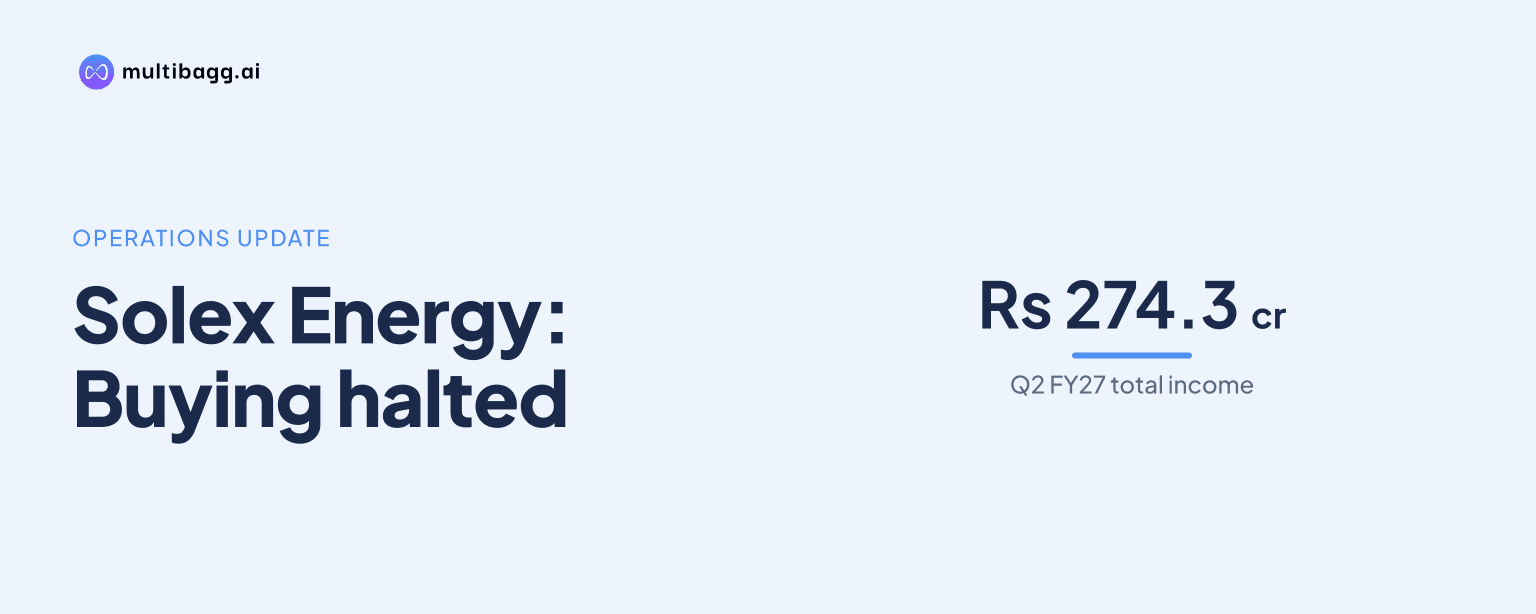
In Q2 FY27, Solex Energy Limited said uncertainty over Approved List of Models and Manufacturers (ALMM) List-II prompted it to defer fresh inventory procurement from end-May until clarity emerged in mid-July, reducing machine utilisation while fixed costs remained unchanged; it reported total income of Rs 274.3 crore for the quarter.
Know Solex Energy inside out
Results, valuation, peers and who's buying, in one view.
Why did Solex Energy pause fresh inventory procurement?
Solex Energy paused fresh inventory procurement because ALMM List-II lacked clarity, despite the company having new orders in hand. Chairman and Managing Director Dr. Chetan Shah said procurement was deferred from the end of May, resumed after clarity emerged in mid-July, and the resulting inventory was received by September.
Management described Q2 FY27 and H1 FY27 as a transition period for the solar-module industry, citing ALMM developments and changes in customer delivery schedules that affected market visibility. The company chose to wait for regulatory direction rather than purchase fresh inventory immediately, even as it reported more than Rs 4,000 crore of order-book visibility as of September 30, 2026.
The presentation does not provide the date on which procurement restarted, the value of inventory deferred, or the specific regulatory clarification received in mid-July. It does establish the sequence of the event: new orders were in hand, buying paused at end-May, clarity came in mid-July, and inventory arrived by September.
How did the procurement pause affect Solex Energy's factory operations?
The procurement pause reduced machine utilisation while fixed costs remained unchanged, according to Solex Energy's operational highlights for Q2 FY27. The company had a 4 gigawatt (GW) module-manufacturing platform, but it did not disclose utilisation percentages before, during or after the end-May-to-mid-July buying pause.
The timing placed the delivery of newly procured material late in the quarter. Although procurement resumed after the mid-July clarity, inventory was received only by September, meaning the supply interruption extended into the period in which the company reported Rs 274.3 crore of Q2 FY27 total income.
Solex Energy also linked the quarter's performance to the lack of ALMM List-II clarity and referred to changed customer delivery schedules. However, the presentation does not quantify the number of affected customer orders, production volumes not manufactured, or revenue delayed by the lower utilisation.
How did Solex Energy's Q2 and H1 FY27 results compare?
Solex Energy reported Q2 FY27 total income of Rs 274.3 crore, up 77.4% year on year, while earnings before interest, tax, depreciation and amortisation (EBITDA) rose 56.0% to Rs 28.4 crore. Q2 profit after tax was Rs 39 lakh, and EBITDA margin was 10.4%, down 133 basis points year on year.
For H1 FY27, total income was Rs 539.9 crore, an increase of 29.9% year on year, while EBITDA was Rs 62.2 crore, up 2.1%. The H1 FY27 EBITDA margin was 11.7%, down 303 basis points year on year; a basis point is one-hundredth of a percentage point.
The reported comparison shows that Q2 income growth of 77.4% exceeded H1 growth of 29.9%, while Q2 EBITDA growth of 56.0% exceeded the 2.1% H1 increase. Margins declined in both periods, and Solex Energy identified lower utilisation with unchanged fixed costs as an operational consequence of the procurement pause, without assigning a rupee effect to that factor.
Got a follow-up? Ask IRIS
How did ALMM uncertainty change Solex Energy's working-capital mix?
Solex Energy said utilisation of fund-based limits increased and utilisation of non-fund-based limits, backed by letters of credit (LCs), reduced during the period affected by the end-May procurement pause. The company did not disclose the rupee amount of either type of limit, total borrowings, or any change in funding cost as of September 30, 2026.
Management explained that non-fund limits normally rotate when LCs are repaid in about 90 days and fresh LCs are opened. This identifies the mechanism behind the non-fund working-capital facility, but the presentation does not state whether the mix shift was temporary after the mid-July procurement resumption or how it affected cash flows in Q2 FY27.
The disclosed working-capital change occurred alongside the supply timing issue: fresh buying was deferred from end-May, resumed after mid-July clarity, and inventory reached the company by September. Solex Energy therefore reported a change in the form of limit utilisation, rather than a quantified increase or decrease in aggregate working-capital funding.
What order visibility and manufacturing plans does Solex Energy disclose?
Solex Energy reported more than Rs 4,000 crore of order-book visibility as of September 30, 2026, of which more than Rs 1,050 crore comprised confirmed orders supported by advance payments. Management said the remaining roughly Rs 3,000 crore was at the final stage of closure, with factory audits completed and pricing and production schedules still being finalised.
The order-book figure and H1 FY27 income of Rs 539.9 crore measure different things: management's current order visibility and reported income for the six-month period, respectively. The company did not disclose delivery dates, product-level margins, or a timetable for converting the approximately Rs 3,000 crore of potential orders into confirmed orders.
Solex Energy said its 4 GW module platform includes automated production lines and a Manufacturing Execution System supporting traceability for engagement with large independent power producers. It is also progressing a planned 2.2 GW N-type tunnel oxide passivated contact (TOPCon) solar-cell line, which its roadmap lists for commissioning in 2027, while targeting 10 GW of module capacity by FY30.
Conclusion
Solex Energy's disclosure connects ALMM List-II uncertainty with a defined operating sequence: fresh inventory procurement stopped from end-May, machine utilisation fell while fixed costs stayed unchanged, procurement resumed after mid-July clarity, and inventory arrived by September. The company nevertheless reported Rs 274.3 crore of Q2 FY27 total income, although its EBITDA margin declined 133 basis points year on year to 10.4%.
The next disclosed items to watch are execution of more than Rs 1,050 crore of confirmed advance-backed orders, progress in finalising pricing and production schedules for roughly Rs 3,000 crore of other order visibility, and commissioning of the planned 2.2 GW N-type TOPCon cell line in 2027. Solex Energy also targets module capacity of 10 GW by FY30, compared with 4 GW currently.