










Spandana says asset sale aided bad-loan fall; new book 0.5%
Key highlights
- Spandana said an ARC transaction in a subsidiary contributed to the reported GNPA decline.
- Spandana reported 2.6% overall GNPA, versus 0.5% on disbursals from April 1, 2025.
- Management said gross GNPA increased by Rs 15 crore in absolute terms.
- Spandana said technical write-offs occur after 455 days without collection, following 90 days past due.
powered by IRIS
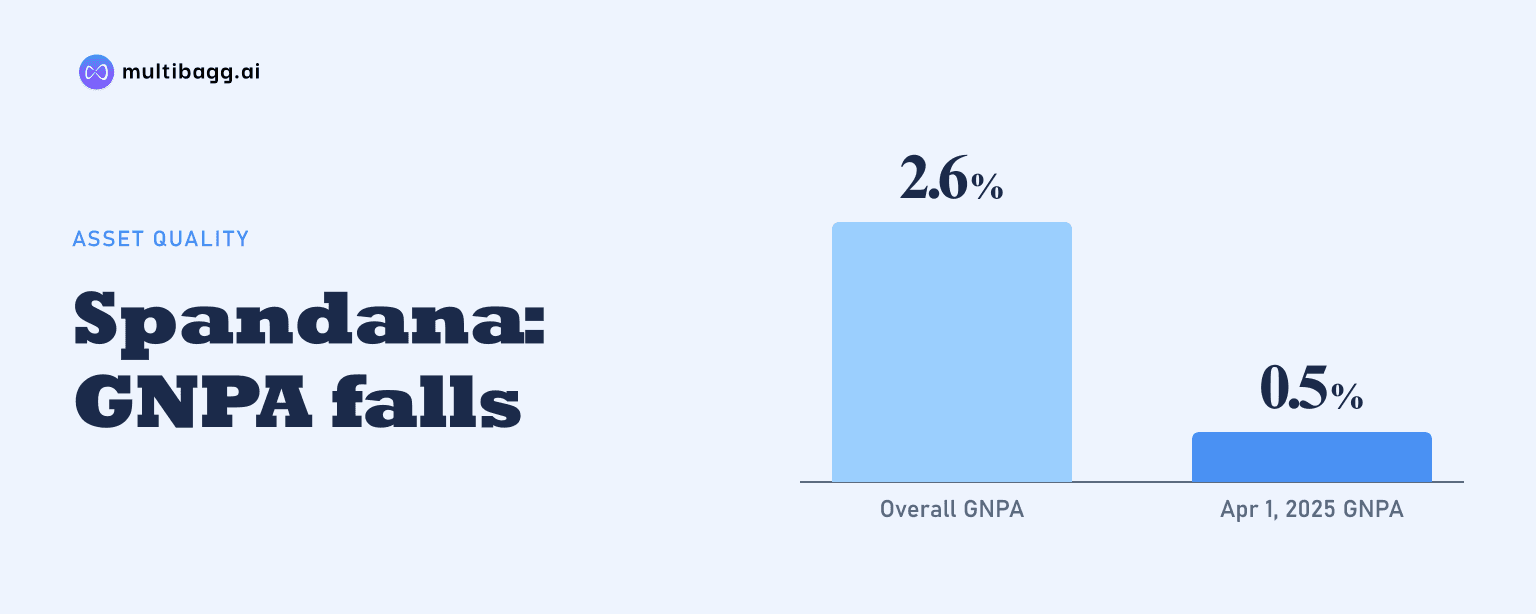
Spandana said on October 30, 2026 that a sale to an asset reconstruction company contributed to its reported gross non-performing assets (GNPA) decline, while GNPA on loans disbursed from April 1, 2025 stood at 0.5%, against 2.6% for the overall portfolio.
Know Spandana Sphoorty Financial Ltd Partly Paidup inside out
Results, valuation, peers and who's buying, in one view.
What caused Spandana's gross bad-loan ratio to decline?
Spandana said the reported GNPA decline was partly caused by a transaction with an asset reconstruction company (ARC) in its subsidiary, which sold a loan book already classified as GNPA. Ashish Damani gave that clarification after an analyst referred to a 31% fall in GNPA and asked whether borrowers had instead moved from loans overdue by more than 90 days into earlier delinquency buckets.
Management said the ARC sale was not the sole reason for the change. It said GNPA as a percentage of the loan book would still have declined from the previous quarter without the sale, although the reduction would not have been as steep as the reported movement. The transaction therefore removed identified bad loans from the reported GNPA stock, rather than establishing that the full decline came from collections.
Spandana also distinguished between percentage and absolute movements in bad loans. When asked about an apparent reconciliation with gross provisions, Damani said gross GNPA had increased by Rs 15 crore in absolute terms. The call did not provide the underlying loan-book amounts needed to reconcile that increase with the reported ratio movement and the ARC sale.
How clean is Spandana's new loan book?
Spandana said GNPA in the new book was 0.5%, and defined that book as all disbursals made from April 1, 2025. Management confirmed that the balance of the 2.6% overall GNPA ratio was in loans disbursed before that date, separating recent underwriting performance from the older loan pool.
The new-book ratio was 2.1 percentage points below the overall 2.6% GNPA ratio. This indicates that reported stress was concentrated in earlier disbursals rather than spread evenly across the loans made since April 2025. Management did not quantify how much of that earlier stress may be recovered, sold through an ARC transaction, or technically written off.
Spandana said its lending rule engines apply a maximum fixed-obligation-to-income ratio (FOIR) of 50%, in line with requirements of self-regulatory organisations (SROs). Management said the company would not ordinarily exceed that ceiling, except for a possible one-off system error, and that it is normally a borrower's first, second or at most third lender.
When does Spandana technically write off a loan?
Spandana said it technically writes off a loan after 455 days, comprising 90 days past due followed by 365 days in which it has been unable to collect anything from the borrower. Management said any such write-offs would arise from the current 2.6% GNPA pool.
The 455-day policy means that a loan crossing the 90-days-past-due GNPA threshold is not immediately subject to a technical write-off. It remains in the collection process for a further year if there has been no repayment, leaving time for recoveries from the existing delinquent stock before the technical write-off point is reached.
Management did not disclose what portion of the pre-April 1, 2025 portfolio is close to the 455-day threshold. The 0.5% GNPA figure for the new book cannot therefore be used on its own to estimate future technical write-offs, because the policy depends on duration without collection and not solely on the year of disbursal.
Got a follow-up? Ask IRIS
What has Spandana said about credit costs?
Spandana said gross credit cost could hover between 2.5% and 3%, but it did not provide a firm outlook for net credit cost in the second half. Management said recoveries could bring net credit cost to nil or marginally positive, while cautioning that conditions in certain states made guidance premature.
Management illustrated its gross-cost range using collection efficiency of 99% to 99.5%. It said a 0.5% monthly delinquency flow would amount to 6% over a year and that recovery of 50% of that flow would leave gross credit cost of roughly 2.5% to 3%. The explanation links the range to both fresh delinquency formation and later recoveries.
Spandana did not present the ARC sale as a recurring source of recoveries for credit-cost purposes. It described a specific sale of a GNPA book in a subsidiary, while its 2.5% to 3% gross credit-cost comments relied on collection efficiency, delinquency flows and recoveries. The recurring collection outcome and the effect of portfolio sales are therefore separate factors in interpreting asset-quality ratios.
What could affect Spandana's asset quality next?
Spandana said November should provide the first signals on rainfall and drought-related conditions, with clearer visibility expected by December and January. Management said it was not seeing significant stress as of October 30, 2026, although Maharashtra required somewhat greater collection effort.
Management said its microfinance customers are not lent to for farming, although some earn income from agriculture-related or allied activities. It said borrowers commonly have multiple income streams, but acknowledged that stress could cause missed equated monthly instalments (EMIs). Its view was that natural calamities have not historically been the principal reason for sustained sector-wide stress, while stating that the present situation needed another one to two months of observation.
Spandana said it does not currently insure loans through the CGFMU scheme, though management may consider that option in the coming year. Separately, it said the incremental cost of debt was 10.6% including the CGS scheme and 10.8% excluding it, disclosures that do not change the 2.6% GNPA ratio but identify funding and risk-management matters under consideration.
Conclusion
Spandana's reported GNPA reduction was not solely a collections-led outcome because management said an ARC sale of a GNPA book in a subsidiary contributed to it. The 0.5% GNPA ratio on loans disbursed since April 1, 2025, compared with 2.6% across the portfolio, shows a marked gap between recent disbursals and the older stressed pool.
The next indicators are the collection signals management expects in November and the clearer assessment it expects by December and January. Also relevant are whether gross credit cost remains within the stated 2.5% to 3% range, recoveries from the 2.6% GNPA pool before the 455-day write-off point, and any further ARC transactions affecting reported ratios.