










Spandana targets Rs 1,000 crore micro-LAP within 3 years
Key highlights
- Spandana aims to increase its micro-LAP book from about Rs 305 crore to Rs 1,000 crore within two to three years.
- Spandana is shifting its micro-LAP focus to Rs 5 lakh to Rs 15 lakh or Rs 5 lakh to Rs 20 lakh loans from Rs 1 lakh to Rs 5 lakh.
- Management indicated pricing of 19% to 22%, loan-to-value of about 60% and tenures of seven to 10 years for revised micro-LAP lending.
- Spandana plans to reduce dedicated LAP branches from 86 to about 70 to 75 over the next couple of months.
powered by IRIS
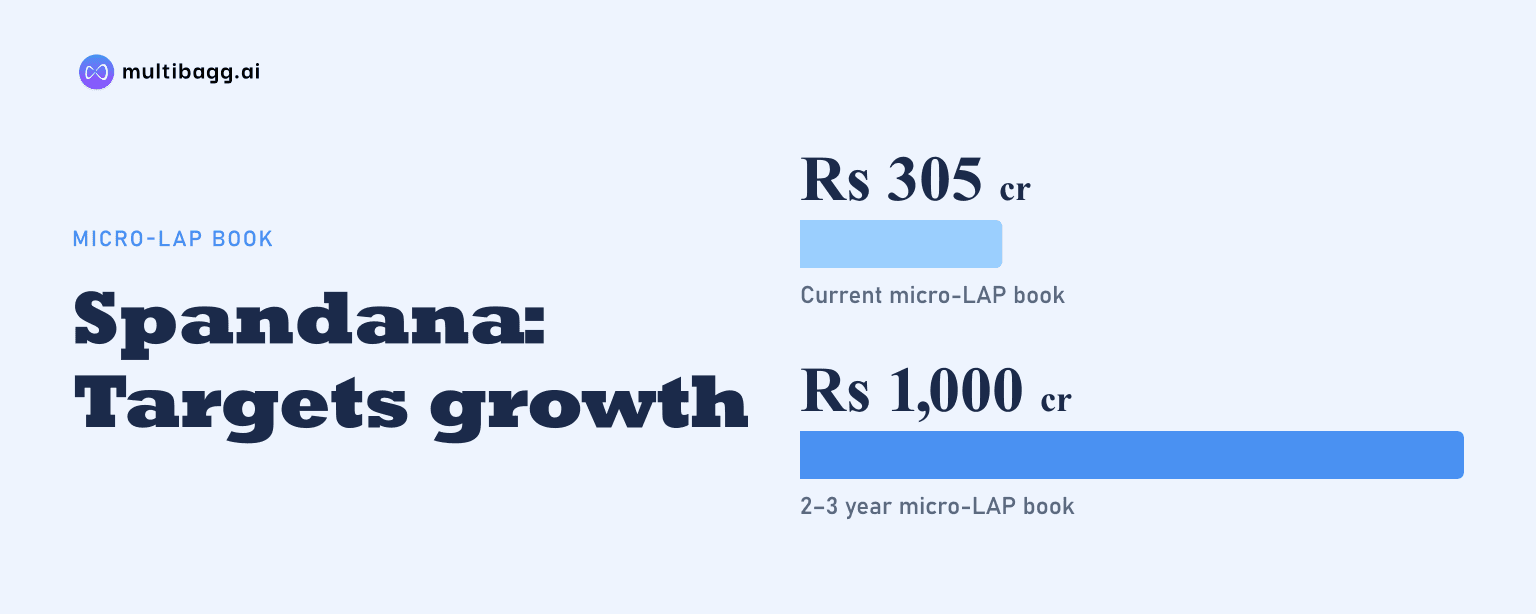
Spandana said on its October 30, 2026 earnings call that it aims to increase its secured micro-loan against property, or micro-LAP, book from about Rs 305 crore to Rs 1,000 crore within two to three years by shifting toward loans of Rs 5 lakh to Rs 20 lakh in six existing states.
Know Spandana Sphoorty Financial Ltd Partly Paidup inside out
Results, valuation, peers and who's buying, in one view.
What is Spandana’s micro-LAP growth target?
Spandana’s stated ambition is to take its micro-LAP book from about Rs 305 crore to Rs 1,000 crore within two to three years. Management described micro-LAP as the secured third business line it intends to retain after the subsidiary merger, alongside joint liability group, or JLG, lending and individual loans.
The plan does not involve immediate geographic expansion. Spandana said it already offers the product in Rajasthan, Madhya Pradesh, Andhra Pradesh, Telangana, Karnataka and Tamil Nadu, and does not plan to add states for at least the next year or so. Growth is therefore intended to come from deeper operations in the six current markets.
Management said it wants three businesses after the merger: JLG lending as the main activity, individual loans as a smaller and better-underwritten book, and secured micro-LAP. This separates the Rs 1,000 crore target from Spandana’s core microfinance activity, rather than presenting it as a broad expansion of its existing JLG book.
How will Spandana change its micro-LAP product?
Spandana is moving its micro-LAP focus from loans of Rs 1 lakh to Rs 5 lakh toward loans of Rs 5 lakh to Rs 15 lakh or Rs 5 lakh to Rs 20 lakh. Management said the previous Rs 1 lakh to Rs 5 lakh range mirrored the profile of its microfinance customers, while the revised range is aimed at a different borrower profile.
The proposed structure is a seven- to 10-year tenure, with seven to eight years as the preferred range and eight to 10 years used in exceptions. Management said loan-to-value, or LTV, should be about 60%, with some cases reaching 65%, while pricing is being considered in a range of 19% to 22%.
The comparison shows a change in both loan size and borrower segment. Spandana did not disclose a separate historical pricing or tenure for the earlier Rs 1 lakh to Rs 5 lakh product, so the 19% to 22% pricing and seven- to 10-year tenure are management’s parameters for the revised focus rather than a period-on-period comparison.
Where will Spandana distribute the larger loans?
Spandana has 86 dedicated LAP branches and plans to reduce that number to about 70 to 75 over the next couple of months. Management said all of the retained branches will be exclusive LAP branches, meaning the micro-LAP product is currently distributed through a separate network rather than the company’s microfinance branches.
The planned reduction from 86 branches to about 70 to 75 indicates a more concentrated specialist network as the book is targeted to reach Rs 1,000 crore. Management also said it is revamping the team by bringing in more experienced staff, including people with affordable-housing experience rather than only micro-housing or micro-LAP backgrounds.
After the merger takes effect, some Spandana branches may refer leads to the LAP business, management said. That would add a potential sourcing channel while maintaining the approximately 70 retained LAP branches as exclusive locations. Management did not provide a date for the merger’s completion or a target for lead referrals.
Got a follow-up? Ask IRIS
How large could micro-LAP become in Spandana’s portfolio?
Spandana expects JLG loans to remain the principal business after the merger, with JLG accounting for 60% to 70% of the portfolio and micro-LAP for 8% to 10%. Management indicated that cash could account for about 20%, while individual loans could make up 1% to 2% of the post-merger mix.
This proposed mix places the Rs 1,000 crore secured-lending ambition within a portfolio where JLG remains dominant. Management called JLG its “bread and butter” business, while individual loans are expected to be a small book despite being better underwritten. Micro-LAP is intended to complement, not replace, those two lending lines.
Management said JLG would remain the bulk of loans unless regulation around qualifying assets changes further. It noted that the qualifying-asset requirement had been reduced from 75% to 68%, but did not provide an estimate of the effect of any future regulatory change on the targeted 8% to 10% micro-LAP share.
What controls apply as Spandana scales micro-LAP?
Spandana said its rule engines set a maximum fixed-obligation-to-income ratio, or FOIR, of 50% across its loans. Management said the company is generally the first, second or, at most, third lender to a borrower, and said the 50% ceiling should not be breached other than in a possible one-off system error.
The FOIR framework is relevant as Spandana moves from Rs 1 lakh to Rs 5 lakh loans toward a Rs 5 lakh to Rs 20 lakh focus. However, management did not disclose a separate credit-cost target, delinquency ratio or FOIR distribution specifically for the micro-LAP book on the October 30, 2026 call.
For the broader lending business, management said gross credit costs could hover between 2.5% and 3%, while the net result would depend on recoveries and conditions in certain states. It also said an ARC transaction in the subsidiary reduced reported gross non-performing assets, although the gross non-performing asset ratio would still have declined from the previous quarter without that transaction.
Conclusion
Spandana’s micro-LAP strategy is a defined secured-lending expansion rather than a near-term push into new states. The company is targeting a rise from about Rs 305 crore to Rs 1,000 crore in two to three years, using larger Rs 5 lakh to Rs 20 lakh loans, pricing of 19% to 22%, loan-to-value of about 60% and typical tenures of seven to eight years. JLG is still expected to form 60% to 70% of the post-merger portfolio.
The next developments to watch are the planned reduction in dedicated LAP branches from 86 to about 70 to 75 over the next couple of months, the completion of the subsidiary merger and the potential use of Spandana branches for LAP lead referrals. Management’s stated aim to reach Rs 10,000 crore in assets under management by March 2028 also provides a broader benchmark for the planned Rs 1,000 crore micro-LAP book.