










Spandana Q2 profit reaches Rs 18 crore as NIM rises to 13.6%
Key highlights
- Spandana reported Rs 18 crore PAT in Q2 FY27, compared with Rs 12 crore in Q1 FY27.
- Net interest margin rose 110 basis points sequentially to 13.6% in Q2 FY27.
- AUM increased 10% quarter-on-quarter to Rs 5,364 crore at September 30, 2026.
- GNPA declined to 2.5% from 3.6% at the end of June 2026.
powered by IRIS
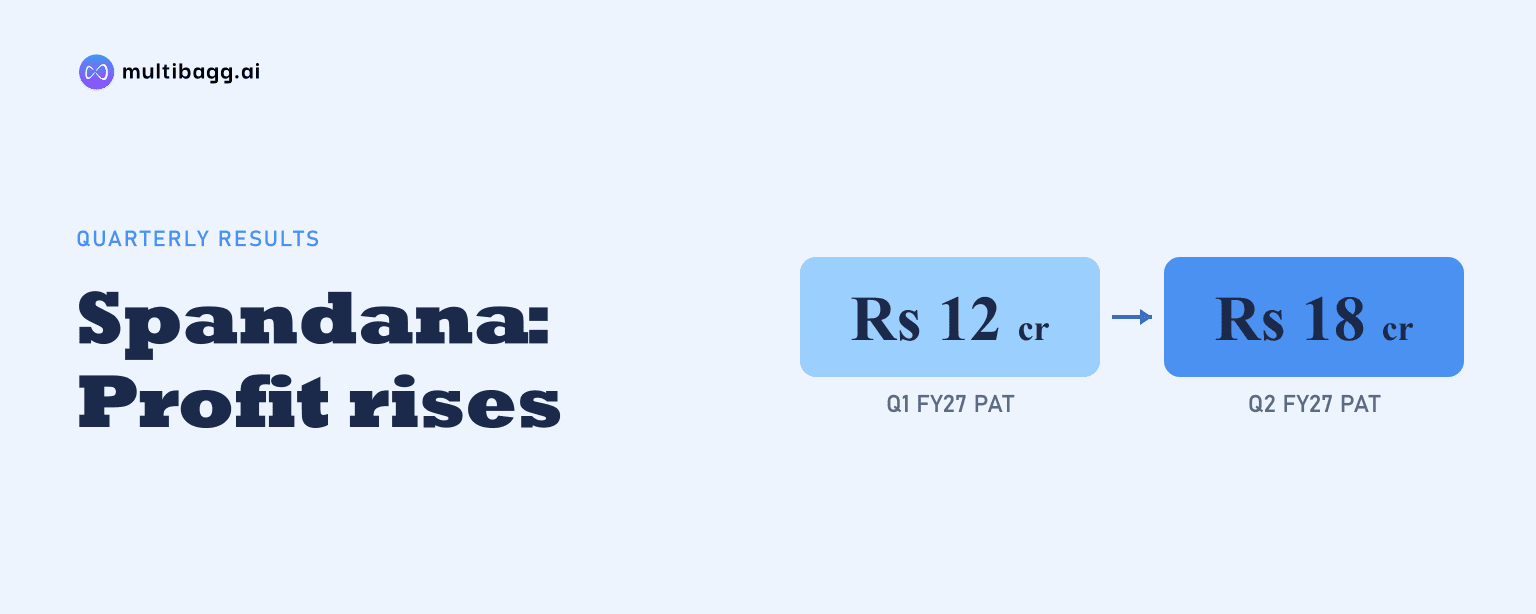
Spandana Sphoorty Financial Limited reported Rs 18 crore profit after tax in Q2 FY27 as net interest margin (NIM) rose to 13.6% from 12.5% in Q1. The increase came with a 24.9% yield and a 10.6% marginal borrowing cost, although a Rs 7.9 crore one-time deferred tax asset reversal reduced reported profit.
Know Spandana Sphoorty Financial Ltd Partly Paidup inside out
Results, valuation, peers and who's buying, in one view.
Why did Spandana's Q2 profit increase?
Spandana's reported profit increased through higher pre-provision operating profit, improved lending yield and lower financial costs. Profit after tax (PAT) was Rs 18 crore in Q2 FY27, Rs 6 crore above Rs 12 crore in Q1, while pre-provision operating profit (PPOP) was Rs 52 crore before write-backs, compared with Rs 16 crore in the preceding quarter.
Management said PPOP was Rs 79 crore in Q2 FY27 including write-backs, compared with Rs 40 crore in Q1. It attributed the sequential increase to a 24.9% yield, up from 24.6% in Q1, alongside lower financial costs. Assets under management (AUM) reached Rs 5,364 crore at September 30, 2026, a 10% quarter-on-quarter increase.
The reported PAT did not fully reflect the operating increase because Spandana reversed a Rs 7.9 crore deferred tax asset (DTA) ahead of its planned merger with subsidiary Criss Finance Limited. Chief Financial Officer Ashish Damani said a DTA outstanding before the appointed date would not be available to the merged entity. Management said standalone PAT was Rs 35 crore in Q2 FY27, compared with Rs 16 crore in Q1.
What changed in Spandana's margins and funding costs?
Spandana's NIM rose by 110 basis points sequentially to 13.6% because yield increased and its marginal cost of borrowing declined. The 24.9% yield in Q2 FY27 was 30 basis points above Q1's 24.6%, while the 10.6% marginal borrowing cost was 260 basis points below the level in Q3 FY26.
The funding mix included about 57% bank borrowings during the quarter. Management said Spandana raised Rs 1,622 crore in Q2 FY27, including Rs 995 crore of scheme funding, and closed September 30 with Rs 1,379 crore of liquidity. The borrowing cost excluding that scheme funding was 10.8%, compared with 10.6% including it.
Spandana also said it had raised Rs 7,485 crore of debt over the period discussed on the call and completed a Rs 400 crore partly paid rights issue. The second tranche raised Rs 194 crore, and management said 97% of subscribers that participated in the first tranche also participated in the second. Management presented these actions as measures to reinforce lender confidence and reduce funding costs.
Got a follow-up? Ask IRIS
Has Spandana's asset quality improved?
Spandana's reported asset-quality measures improved in Q2 FY27, with gross non-performing assets (GNPA) declining to 2.5% from 3.6% at the end of June and net non-performing assets (NNPA) falling to 0.5% from 0.68%. Management separately described GNPA as 2.6%, compared with a historical peak of 5%, reflecting rounding between the presentation and commentary.
AUM in the 31-to-90-days-past-due bucket declined to 0.55% on a consolidated basis at September-end from 0.73% at the end of June. X-bucket collection efficiency held above 99.6%, versus a low of 96.2% at an earlier point over the prior two years. Management also said the 31-to-90 delinquent bucket had declined to 0.4% from 9.8% at its earlier peak.
Newer underwriting accounted for most of the microfinance portfolio. Spandana said 96% of the microfinance book had been originated under its strengthened guardrails or new underwriting framework. During Q2 FY27, it disbursed Rs 1,481 crore: 54% to new customers, 11% to reactivated dropout borrowers and 35% to existing customers that met its guardrail principles.
What risks and growth plans does Spandana face?
Spandana identified Maharashtra and Karnataka as areas to monitor for weather-related stress, although management said collections and business were steady through October 30. Its combined book in the two states was about Rs 600 crore, of which management said 96% was current and 3% was GNPA. In Maharashtra, 18 of roughly 127 branches were classified as critical for added attention.
Management said it was avoiding new-to-credit customers in some stressed branches, tightening norms for new-to-Spandana customers and requiring timely repayment from existing borrowers seeking repeat loans. It said Andhra Pradesh, Telangana and Karnataka had not shown significant issues as of October 30, while Maharashtra required more collection effort. Management expected early signals in November and greater clarity by December or January.
Alongside the core joint-liability-group (JLG) business, Spandana plans to grow its micro loan-against-property (micro-LAP) book from about Rs 305 crore to Rs 1,000 crore over two to three years. The product operates in six states and management said it would not enter new states over the next year or so. The revised focus is on loans of Rs 5 lakh to Rs 15 lakh or Rs 20 lakh, with indicative pricing of 19% to 22%, loan-to-value of about 60% and tenures generally of seven to eight years.
Conclusion
Spandana's Q2 FY27 result combined a Rs 5,364 crore AUM base, a 110-basis-point sequential NIM increase and lower reported delinquency measures. The Rs 18 crore PAT included a Rs 7.9 crore one-time DTA reversal, so the rise in PPOP to Rs 79 crore including write-backs was larger than the reported PAT movement alone.
The next issues to watch are management's expected December-to-January assessment of weather-related stress, particularly in Maharashtra, and regulatory approval for the Criss Finance Limited merger, which management expects in the next three to four months. Management also expects to complete migration of branches to its new loan origination system over the next couple of months.