










Spandana says new-book GNPA is 0.5%, legacy drives stress
Key highlights
- Spandana said GNPA on loans disbursed from April 1, 2025 was 0.5%.
- Spandana reported overall GNPA of 2.6% at the time of the call.
- An ARC transaction contributed to the GNPA-ratio reduction, although management said GNPA would have declined even without it.
- Spandana’s technical write-off policy applies after 455 days, comprising 90 days past due plus 365 days without collection.
powered by IRIS
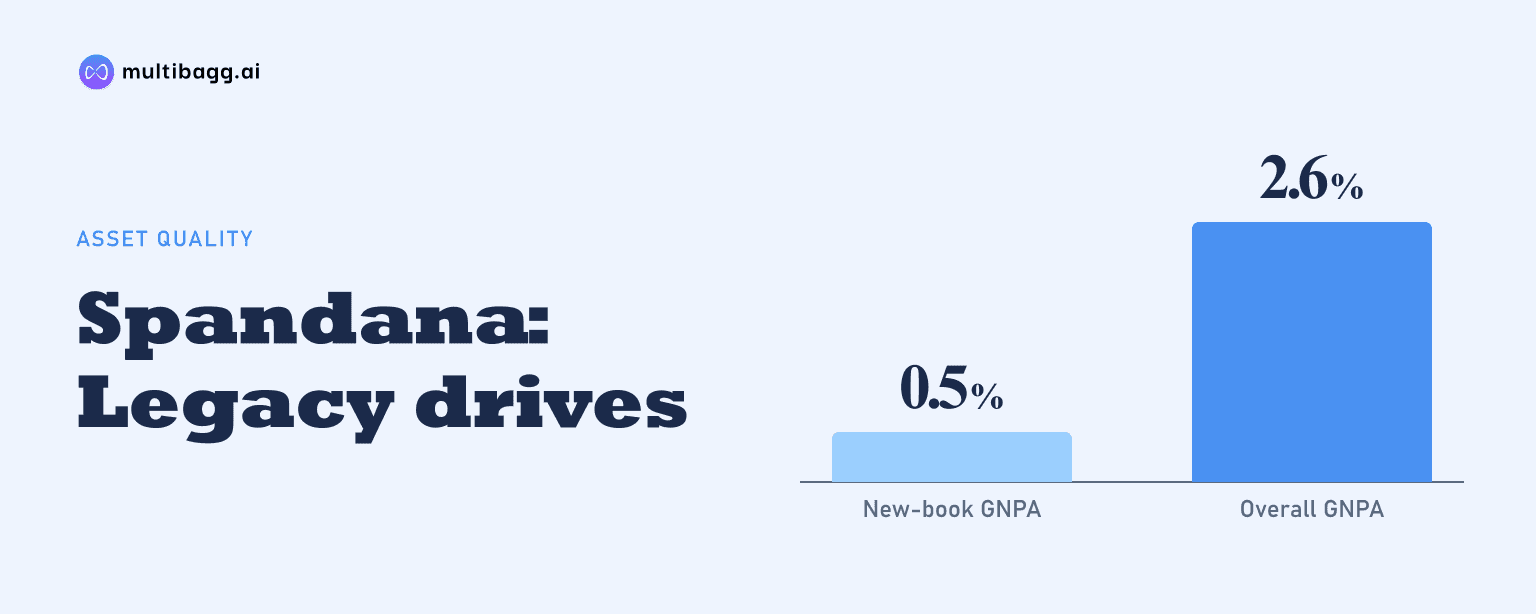
Spandana said loans disbursed from April 1, 2025 had gross non-performing assets, or GNPA, of 0.5%, compared with overall GNPA of 2.6% at the time of the call, indicating that older loans account for most stressed assets. Management defined the new book as disbursals made from that April 2025 date.
Know Spandana Sphoorty Financial inside out
Results, valuation, peers and who's buying, in one view.
What does Spandana’s 0.5% new-book GNPA mean?
Spandana’s 0.5% figure applies specifically to loans disbursed from April 1, 2025, which management defined as the new book. In response to an analyst’s question on separating GNPA between recent and earlier originations, Ashish Damani said the new book’s GNPA was 0.5%, and Venkatesh Krishnan confirmed the definition covered disbursals from that date.
The comparison matters because Spandana reported total GNPA of 2.6%, while the recent-originations measure was lower at 0.5%. Management confirmed the analyst’s understanding that the remaining stress was in the pre-April 2025 portfolio. The call did not disclose absolute GNPA amounts for either vintage or the new-book denominator, limiting the measure to a reported indicator of relative portfolio quality.
The 0.5% measure separates the disclosed performance of recent underwriting from the legacy portfolio carrying earlier stress. It does not mean all loans disbursed before April 1, 2025 are non-performing, and it does not establish a future loss rate. It does show that the newer book had a lower GNPA ratio than Spandana’s 2.6% overall portfolio measure.
Why did Spandana’s reported GNPA decline?
Spandana said its GNPA percentage declined partly because a subsidiary completed an asset reconstruction company, or ARC, transaction involving a GNPA book. Damani told an analyst that the ARC transaction reduced the visible GNPA number, while adding that GNPA would still have declined from the previous quarter without that sale.
The sale means the reported GNPA-ratio movement should not be viewed only as collections from delinquent borrowers. When asked whether GNPA would have been higher without the ARC transaction, Damani said the decline would have been less steep but would still have occurred quarter on quarter. He also said gross GNPA increased by Rs 15 crore in absolute terms, distinguishing the percentage ratio movement from the absolute balance movement.
Spandana did not disclose the size, price, timing or recovery outcome of the ARC transaction in the supplied discussion. It also did not provide GNPA ratios before and after excluding the sold book. The available disclosure therefore supports two points: the reported ratio benefited from the ARC sale, and management said the ratio would still have declined versus the previous quarter without it.
How is Spandana managing credit costs and write-offs?
Spandana said gross credit cost could hover between 2.5% and 3%, while management did not give a firm net credit-cost outlook because of uncertainty in certain markets. Krishnan said that even with collection efficiency of 99% to 99.5%, a 0.5% monthly flow could produce a 6% annual flow; recovery of 50% of that flow could result in gross credit cost of about 2.5% to 3%.
Management distinguished gross credit cost from the result after recoveries. Krishnan said better recoveries could result in nil or marginally positive net credit cost, but said guidance would be premature given developments in some states. This was management’s explanation of how recoveries affect the net outcome rather than a numerical target for net credit cost.
Spandana’s technical write-off policy is 455 days. Damani described the calculation as 90 days past due plus a further 365 days: if Spandana cannot collect anything from a borrower for one year after the account becomes 90-plus days past due, the loan moves to technical write-off. Management said any such write-off can arise only from the 2.6% GNPA pool.
Got a follow-up? Ask IRIS
What underwriting controls does Spandana cite for newer loans?
Spandana said its rule engines apply a maximum fixed-obligation-to-income ratio, or FOIR, of 50% across its loans. Krishnan said self-regulatory organisations, or SROs, mandate the threshold and that Spandana’s systems are designed not to exceed 50%, except for a possible isolated case caused by a system bug.
Management also said Spandana is the first, second or, at most, third lender to its customers. Krishnan said the company does not breach that limit under its normal systems and did not attribute delinquency to customers having more than three lenders. The call did not disclose the proportions of first, second and third lenders, the FOIR distribution, or the number of any exceptions.
At the product level, Spandana said its parent company has 100% qualifying assets, while subsidiary Criss Financial offers individual loans and micro-loans against property, or micro-LAP. In a post-merger scenario, management expects joint liability group, or JLG, loans to remain 60% to 70% of loans, cash loans to be about 20%, individual loans to be 1% to 2%, and micro-LAP to be 8% to 10%.
The planned mix means JLG lending would remain Spandana’s main exposure even as the company develops secured micro-LAP. Management said micro-LAP was present in six states and had a book of about Rs 305 crore, with an ambition to reach Rs 1,000 crore over the next two to three years. The company said it does not plan to enter new states for that product over the next year or so.
What could affect Spandana’s asset quality next?
Spandana said December and January should provide more clarity on the effect of weather-related disruption, with initial signals expected in November. Krishnan said collections at the end of October were not showing substantial stress across the portfolio, although Maharashtra required more collection effort than other areas discussed on the call.
Management said microfinance institution, or MFI, borrowers are not directly financed for farming and often have multiple income sources, including agricultural-allied activities. Krishnan said natural calamities have not historically been a major industry issue over the past 10 to 15 years, citing the 2018 Kerala floods, when he said customers took three to four months to recover.
The call did not provide a state-by-state overdue ratio, a share of customers dependent on agricultural income, or a forecast for weather-related credit costs. Management said it was too early to assess the impact and that a clearer picture should emerge over the next one to two months. That timing makes collection and delinquency data through December and January material to the asset-quality outlook.
Conclusion
Spandana’s main asset-quality disclosure is that loans disbursed since April 1, 2025 had GNPA of 0.5%, compared with 2.6% for the overall book, placing most reported stress in older loans. The reported GNPA ratio also benefited from an ARC transaction, though management said the ratio would have declined quarter on quarter even without the sale. Its stated gross credit-cost range remains 2.5% to 3%, with recoveries determining the net outcome.
The next point to watch is management’s expected clarity in December and January on weather-related collection trends, particularly after November signals. Spandana also plans to grow its micro-LAP book from about Rs 305 crore to Rs 1,000 crore over two to three years, while maintaining JLG loans at 60% to 70% of the expected post-merger mix. The 455-day technical write-off policy will remain relevant to the timing of any further write-offs from the 2.6% GNPA pool.