










SS Retail sees gross margin exceed 13% through direct buying
Key highlights
- SS Retail expects gross margin to exceed 13% in 18-24 months from 12.7%.
- Management attributed 30-40 basis points of H1 FY27 gross-margin improvement to OEM terms and 20-30 basis points to lower discounting.
- SS Retail reported EBITDA margin of about 5.6%, versus about 5.3% last year, and PAT margin of 3%, versus 2.5%.
- More than 250 stores opened in the past two years are expected to lift EBITDA as they mature.
powered by IRIS
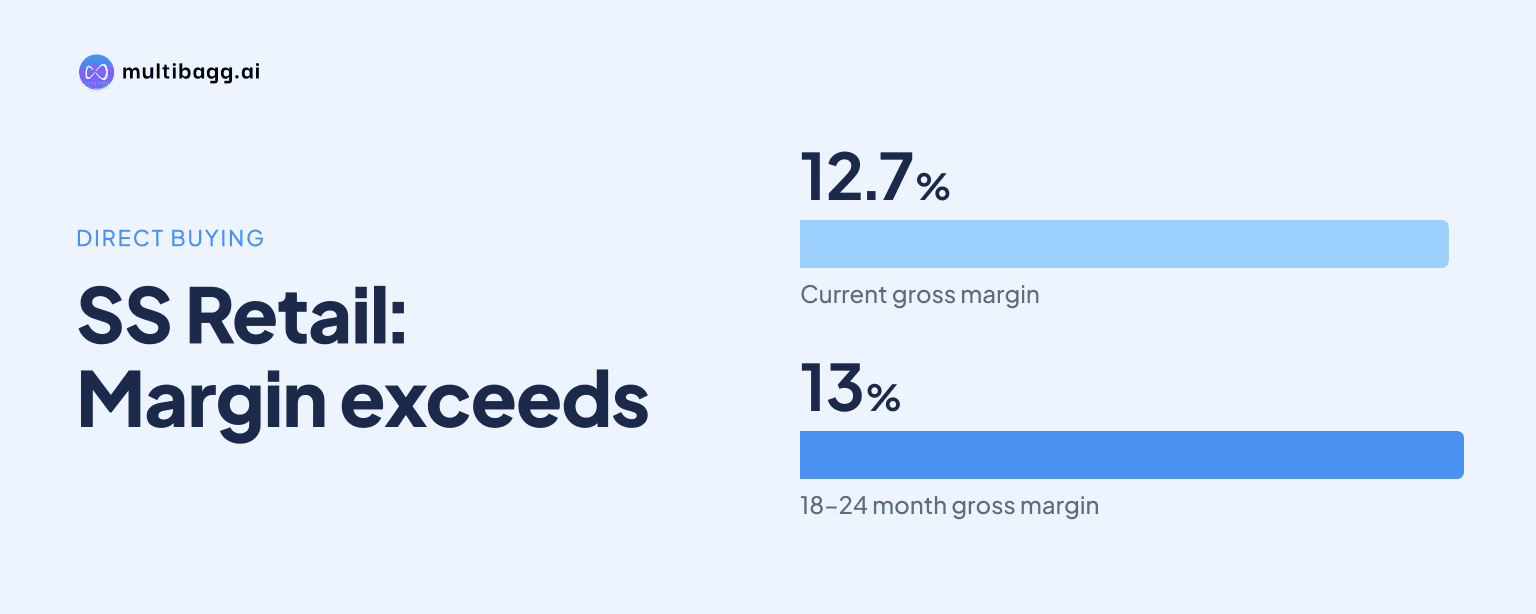
SS Retail expects gross margin to exceed 13% over the next 18-24 months from 12.7%, as management pursues direct original equipment manufacturer procurement and better brand terms. It also expects more than 250 stores opened in the past two years to mature and lift EBITDA margin from about 5.6%.
Know SS Retail inside out
Results, valuation, peers and who's buying, in one view.
What will lift SS Retail's gross margin above 13%?
SS Retail expects a phased move to direct purchasing relationships with original equipment manufacturers, or OEMs, to provide the main route to gross margin of 13% and above. Management said discussions are under way, with the transition potentially starting within 12-18 months and generating margin expansion over the following 18-24 months.
SS Retail said its scale could secure better commercial terms from brands, but management did not give a precise gross-margin target beyond 13% and above. It said the outcome can vary by product price bracket, making a fixed number difficult to provide even as direct procurement is introduced in phases.
The H1 FY27 increase to 12.7% was split between higher OEM margins and lower discounting, according to management. It estimated that about 30-40 basis points, where one basis point equals one-hundredth of a percentage point, came from OEM terms, while about 20-30 basis points came from lower customer discounts after mobile prices increased.
Samsung and Apple accounted for about 50% of SS Retail's mobile revenue in H1 FY27, while Chinese brands made up the remaining 50%. Management said this brand mix was broadly unchanged within 1%-2%, indicating that its margin plan is based on procurement and discounting rather than a disclosed major shift in brands sold.
How did SS Retail's margins change in H1 FY27?
SS Retail said gross margin reached 12.7% in H1 FY27, while EBITDA margin was about 5.6% and profit after tax, or PAT, margin was 3%. The comparison showed improvement from a 5.3% EBITDA margin and 2.5% PAT margin in the preceding year, though management did not disclose absolute profit figures in the call.
SS Retail said revenue rose about 73% in H1 FY27, with approximately 35% growth from average selling price, or ASP, and another 35%-36% from volume. Management expects ASP growth to ease in H2 FY27 after price increases, although it expects the full-year gap between volume and value growth to remain around 30%-35%.
The H1 FY27 gross-margin movement was not entirely structural because lower discounting contributed about 20-30 basis points. Management said future gains are expected to come from direct OEM relationships and better partnerships as scale rises, which remain planned arrangements rather than completed changes.
Got a follow-up? Ask IRIS
Why should mature stores lift SS Retail's EBITDA margin?
SS Retail expects store maturity to improve EBITDA margin because management said newer stores deliver about 4%-4.5% EBITDA margin, compared with more than 5% for mature stores. More than 250 locations opened during the past two years are expected to provide operating leverage as they move into the mature phase.
A new state network generally takes about four to six months to become EBITDA-positive, according to management. SS Retail opened 71 stores in H1 FY27, exceeding 60%-65% of its 120-store full-year opening guidance, creating a larger base of new locations that may initially operate below mature-store margins.
Management estimated that about 35 of the 71 H1 FY27 stores were added in Maharashtra and about 36 outside the state. It plans a 50:50 split between Maharashtra and non-Maharashtra additions over the next two years, while maintaining a cluster approach in states including Madhya Pradesh, Karnataka, Gujarat and Chhattisgarh.
SS Retail said two costs limited operating leverage in H1 FY27. Debt-based disbursement charges rose by roughly 20 basis points as finance penetration increased to 70% from 55%-57% last year, while partner commissions increased because Olineo's franchise-owned, franchise-operated model books costs as commissions and partners received growth-linked incentives.
How will IPO proceeds affect SS Retail's PAT margin?
SS Retail expects IPO proceeds used for working capital to reduce interest costs and add about 20-30 basis points to PAT margin in H2 FY27. Management said this effect was absent in H1 FY27 because the IPO proceeds had not then reached working capital.
Of the Rs 360 crore IPO proceeds, more than Rs 200 crore is earmarked in escrow for expansion over the next 18 months, according to management. The balance is intended for working capital, meaning management does not expect interest cost to become nil despite an anticipated reduction of about 50% from the 0.6x-0.7x range to 0.3x-0.4x.
SS Retail said its debt-to-equity ratio had declined to 0.4x from 0.9x and could remain at about 0.3x-0.4x as expansion continues. Management estimated store capital expenditure at about Rs 15 lakh per location, implying around Rs 20 crore for 120 new stores in FY27 and a similar amount in FY28.
Inventory rose to about Rs 583 crore in H1 FY27 from about Rs 341 crore last year, while revenue increased 73%. Inventory days increased to 54 from 46-47 days because of October and November festival stocking, but management expects days to fall below 50 by the end of Q3 and then remain within a 46-50-day range.
How do newer businesses affect SS Retail's consolidated margin?
SS Retail said Olineo and Nexora contributed about Rs 40 crore of Q2 FY27 revenue out of total revenue of Rs 940 crore, or roughly 6%. SS Retail itself contributed about Rs 900 crore, while management described the newer businesses' EBITDA contribution as neutral or very small.
Management said Olineo and Nexora had been operating for only about six months and had lower margins than SS Retail. Their contribution was below 5% in Q1 FY27, at roughly Rs 28 crore, before increasing to about Rs 40 crore in Q2 FY27, showing their revenue share expanded while their profitability remained in an early stage.
Conclusion
SS Retail's outlook combines direct OEM procurement, maturing stores and lower interest costs. The company expects direct brand relationships to take gross margin beyond 13% from 12.7%, while the difference between new-store EBITDA margins of about 4%-4.5% and mature-store margins above 5% explains management's expectation of operating leverage.
The next milestones are the expected H2 FY27 PAT-margin benefit from IPO-funded working capital and inventory days falling below 50 by the end of Q3. Management also plans to begin phased direct OEM purchasing within 12-18 months, open 120 stores in FY27 and work toward 750 stores and doubled revenue by FY28.