










SS Retail targets 750 stores and double FY26 revenue by FY28
Key highlights
- SS Retail reported H1 FY27 revenue of Rs 1,730 crore, up 73% year on year.
- SS Retail is targeting 750 stores by FY28 and plans 250 openings across FY27 and FY28.
- Same-store sales growth was 46% in Q2 FY27 and 38% in H1 FY27.
- Pre-owned devices contributed 7.3% of Q2 FY27 revenue, up from 6.5% in Q2 FY26.
powered by IRIS
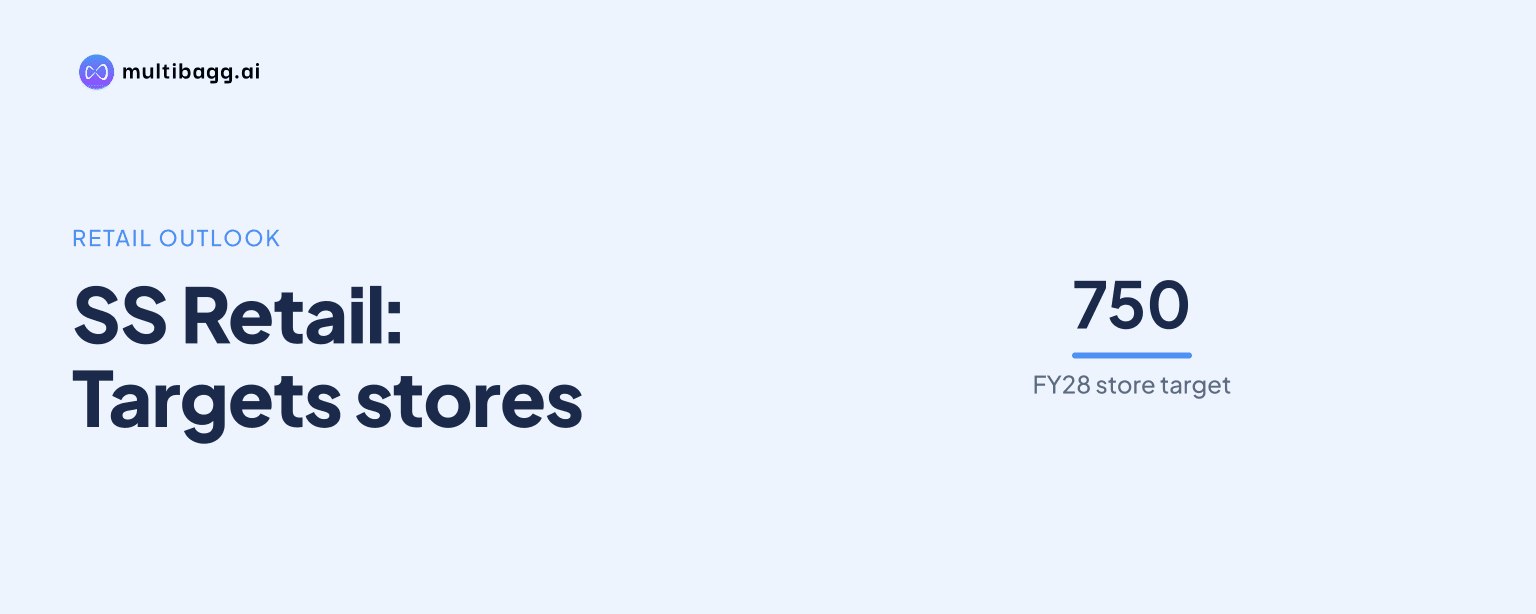
SS Retail Limited is targeting 750 stores by FY28 and plans to double revenue from its FY26 base, after H1 FY27 revenue rose 73% year on year to Rs 1,730 crore. Management said the plan depends on 35%-40% same-store sales growth in FY27, 250 planned openings, premiumisation and wider geographic reach.
Know SS Retail inside out
Results, valuation, peers and who's buying, in one view.
How will SS Retail double revenue by FY28?
SS Retail intends to double revenue through organic sales growth, store additions and a higher contribution from premium and adjacent categories, rather than through network expansion alone. Management expects same-store sales growth of 35%-40% in FY27, following 46% growth in Q2 FY27 and 38% in H1 FY27, the first half of financial year 2027.
The company reported consolidated revenue growth of 87% year on year to Rs 940 crore in Q2 FY27 and 73% to Rs 1,730 crore in H1 FY27. Earnings before interest, tax, depreciation and amortisation, or EBITDA, rose 99% to Rs 52.4 crore in Q2 and 73% to Rs 97.3 crore in H1. Profit after tax, or PAT, increased 160% to Rs 28 crore in Q2 and 102% to Rs 51.7 crore in H1.
Management said H1 normally represents 45%-47% of annual sales in mobile retail, while H2 represents 53%-55%, and it expects a similar pattern in FY27. That seasonality means H2 sales would be higher than H1 if the stated pattern holds, but the company did not issue a revenue target for FY27.
What is driving SS Retail’s same-store sales growth?
SS Retail’s recent same-store growth has primarily come from higher handset prices and premiumisation rather than unit growth. Management said approximately 35 percentage points of H1 FY27 same-store growth came from a higher average selling price, with around 3 percentage points from volume growth.
The average selling price, including goods and services tax, increased about 33% to Rs 34,050 in H1 FY27 from Rs 25,513 in H1 FY26. Management said handset prices had risen roughly 20% and that premiumisation added to the increase, while industry volumes had fallen about 15%, concentrated in phones priced below Rs 15,000.
Consumer finance is a further mechanism in the strategy, with nearly 70% of sales supported by financing, according to management. More than 60% of customers are repeat buyers, although SS Retail measures this ratio only for stores older than three years because it considers the mobile replacement cycle to be about 36 months.
Growth differed by market type in H1 FY27. Metro-market revenue rose 118% year on year, compared with 58% in urban markets and 69% in rural markets. Around 70% of the network is in Tier 2, Tier 3 and smaller towns, which management said remain central to its cluster-based expansion model.
Got a follow-up? Ask IRIS
How will SS Retail reach 750 stores by FY28?
SS Retail plans 250 store openings across FY27 and FY28, with about half in Maharashtra and the balance outside the state. It reported 574 stores across 228 cities and five states after adding 38 stores in Q2 FY27, while management described the 250-store programme as an expansion from a 503-store base to 750 stores.
Maharashtra remains the largest market, but the planned openings are intended to reduce its revenue concentration. Revenue from outside Maharashtra was 8% in Q2 FY27, up from 6% in Q2 FY26. Management said Maharashtra’s revenue contribution had declined from 94% last year to 92% currently and could fall below 90% in the following year.
The company is pursuing a cluster-led model in Karnataka, Madhya Pradesh, Gujarat and Goa, and management said operations began in Chhattisgarh during Q3 FY27. It plans one new-state entry each year after the current year, with Rajasthan, Uttar Pradesh and Haryana identified as possible future markets.
New-state expansion is designed to be phased. Management said it typically opens about 10 stores in a new state in the first year and expects a store to become EBITDA-positive in roughly four to six months. It also said separate state leadership teams for Karnataka, Madhya Pradesh, Chhattisgarh and Gujarat had been in place for about a year.
How will product mix and margins support SS Retail’s plan?
SS Retail expects pre-owned devices, accessories, protection products and consumer electronics to improve product mix and store productivity. Mobile phones made up 86% of Q2 FY27 revenue, followed by pre-owned devices at 7.3%, accessories and protection at 5%, and televisions and laptops at 1.7%.
Pre-owned devices increased their revenue contribution from 6.5% in Q2 FY26 to 7.3% in Q2 FY27. Mobile Exchange Wala operated in more than 108 stores, compared with 71 stores in FY26, and management targets about 30% network penetration by FY29 from roughly 20% at present.
Management said the shop-in-shop pre-owned format uses existing store infrastructure and does not require additional rental cost. Pre-owned inventory is about 40 days, which it said is roughly eight to 10 days lower than the new-mobile business because purchases are made at the store level without a hub.
Gross margin was 12.7% in Q2 FY27, up 71 basis points year on year, and 12.7% in H1 FY27, up 61 basis points. Management said direct purchases from original equipment manufacturers could provide further margin scope, with a phased shift potentially beginning within 12-18 months. It expects gross margin of 13% or above over the next two years but did not provide a precise target.
Conclusion
SS Retail’s growth plan combines premium handset sales, finance-supported purchases, repeat customers, pre-owned devices and a broader store footprint. H1 FY27 results showed faster metro growth than urban and rural markets, while the increase in non-Maharashtra revenue share to 8% indicates the geographic diversification remains at an early stage.
The next developments to watch are progress toward 750 stores by FY28, same-store growth against management’s 35%-40% FY27 expectation, and the expansion of Mobile Exchange Wala toward 30% network penetration by FY29. Management also expects direct original equipment manufacturer sourcing to begin in phases within 12-18 months and expects inventory days to fall below 50 by the end of Q3 FY27.