










SS Retail's Tier II/III Model Underpins 513 Maharashtra Stores
Key highlights
- SS Retail reported 513 Maharashtra stores as of 30 September 2026, with 75% outside Mumbai and Pune.
- About 70% of SS Retail stores are in Tier II/III-plus towns, using 500–700 square-foot formats.
- SS Retail had 574 stores as of 30 September 2026 and added 304 franchise stores from FY24 to FY26.
- Mobile Exchange Wala revenue increased from Rs 5 crore in FY23 to Rs 169 crore in FY26.
powered by IRIS
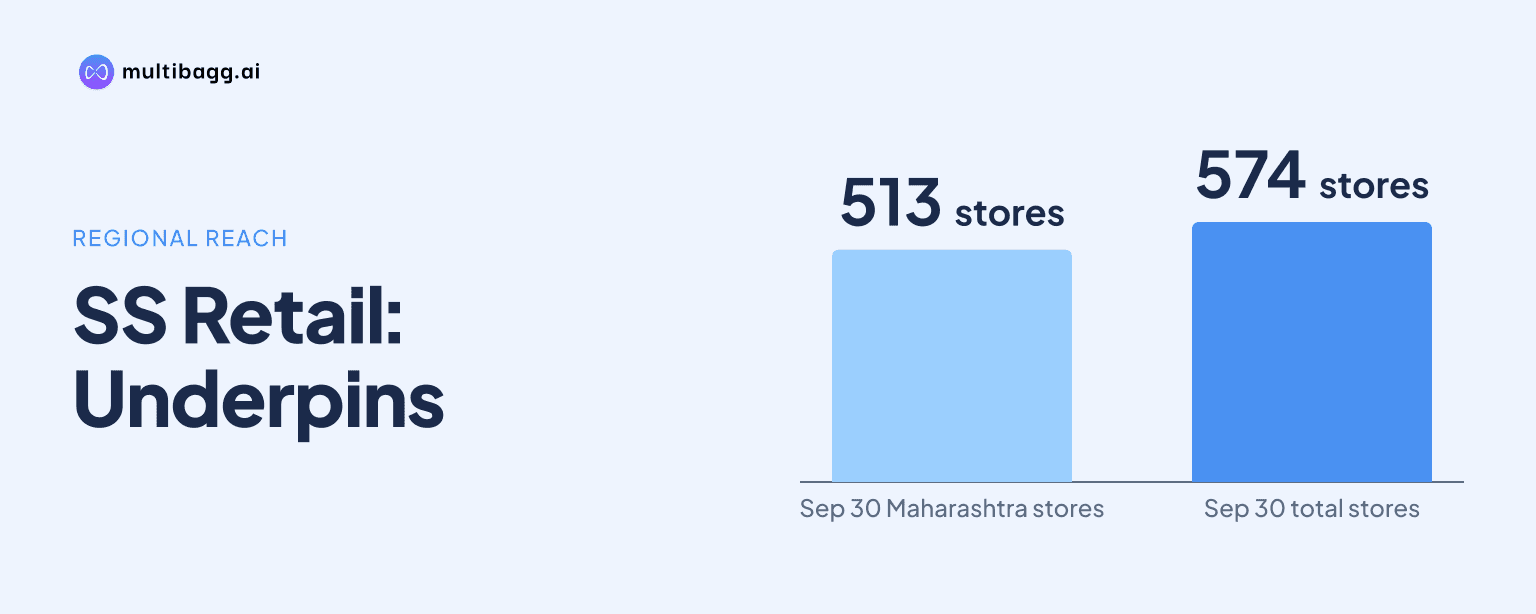
SS Retail Limited says its Tier II/III-plus strategy underpins a Maharashtra network of 513 stores as of 30 September 2026, with 75% of those outlets outside Mumbai and Pune. The company says about 70% of its overall stores are in Tier II/III-plus towns, using dense local clusters, smaller formats and lower-rent markets.
Know SS Retail inside out
Results, valuation, peers and who's buying, in one view.
How concentrated is SS Retail's Maharashtra network?
SS Retail's Maharashtra network comprised 513 stores as of 30 September 2026, and 75% were outside Mumbai and Pune. The company presents this split as evidence of a network built beyond the state's two largest urban markets rather than one concentrated principally in metropolitan locations.
Its district-level map, dated 31 March 2026, shows several substantial clusters across the state. Pune had 65 stores, Mumbai had 49, Nashik had 43, Kolhapur had 39, Solapur had 38 and Satara had 33. The same map listed 20 stores in Sangli, 15 each in Jalgaon, Ahmednagar and Latur, and 12 in Aurangabad.
The two disclosures use different dates. The district map is labelled 31 March 2026, while the 513-store Maharashtra total is dated 30 September 2026. SS Retail therefore reports the state network at a later point than the individual district counts shown in the presentation.
Why does SS Retail focus on Tier II/III-plus towns?
SS Retail says it focuses on Tier II/III-plus towns because the model aims to establish density at roughly one store per 2.5 lakh people. It identifies lower rental costs in Tier II and beyond markets and 500–700 square-foot stores as features that can make the approach replicable across states.
The presentation's projected regional mix provides the market context. Tier II markets are forecast to represent 20.8% of mobile-phone sales in fiscal year 2030 projection (FY30P), compared with 20.3% in fiscal year 2026 (FY26), while Tier III and beyond are forecast to move from 15.1% to 15.3%. Together, the two segments would account for 36.1% of projected sales in FY30P, up from 35.4% in FY26.
India's mobile-phone market is projected to increase from Rs 3.657 lakh crore in FY26 to Rs 5.198 lakh crore in FY30P. The presentation forecasts a 13.3% compound annual growth rate (CAGR) for the Rs 51,000–68,000 price band between FY25 and FY30, compared with 3.1% for phones priced below Rs 8,500.
How does SS Retail use partners to add stores?
SS Retail uses a franchise-led model to expand with partner participation in selected store costs. It reported 574 stores as of 30 September 2026, including 507 stores in two partner-led formats and 67 in another company-labelled format, and said it added 304 franchise stores from FY24 to FY26.
The FOFO format is defined by SS Retail as one in which the partner funds the lease and operating expenses, while SS Retail earns a fixed margin on stock. SS Retail funds inventory and shares capital expenditure with the partner in this format; by contrast, its presentation shows the company funding lease, stock, operating expenses and capital expenditure for its fully funded stores.
The revenue mix shifted between FY24 and FY26. The largest stated format's share declined from 77% to 71%, while FOFO increased from 3% to 8% and the other company-labelled format rose from 19% to 21%. SS Retail reported a 110% FY24–FY26 revenue CAGR for FOFO, versus 32% for the largest format.
Got a follow-up? Ask IRIS
Where does SS Retail plan to expand after building density?
SS Retail's stated sequence is to build deep regional footprints before entering the next state, with Gujarat identified as an FY27 entry after Maharashtra, Goa, Madhya Pradesh and Karnataka. Its medium-term adjacent-state expansion plan names Chhattisgarh, Rajasthan, Haryana and Uttar Pradesh.
The state timeline identifies Maharashtra as the founding state, initially shown with 35 stores, and Goa as entered in FY19 with 51 stores. Madhya Pradesh and Karnataka were entered in FY25 and are shown with 359 stores, while Gujarat is marked as entered in FY27; the company reported 574 stores as of the first half (H1) of FY27.
SS Retail says the population of its previous and new states would increase from 37.4 crore in FY27 to 69.3 crore in the medium term. It also states a 750-store ambition for 2028, which is 176 stores above the disclosed 574-store H1 FY27 network.
What additional products can support SS Retail's store network?
SS Retail is adding pre-owned phones, accessories, televisions, laptops and tablets alongside core mobile sales. Mobiles represented 86% of FY26 revenue, down from 88% in FY24, while pre-owned phones increased from 4% to 7% and televisions, laptops and tablets rose from 1% to 2%.
The Mobile Exchange Wala shop-in-shop format operated in 108 of SS Retail's 574 stores as of 30 September 2026, representing less than 20% store penetration. The company targets about 30% penetration by FY29 and says roughly 50% of sourcing comes from its own exchange and buyback activity, with the remaining roughly 50% sourced directly from consumers.
Mobile Exchange Wala revenue rose from Rs 5 crore in FY23 to Rs 169 crore in FY26, while its store count increased from seven to 71. SS Retail says the format uses proprietary battery and hardware quality-check software, sells A- and B-grade phones, and provides warranties of six to 12 months.
Conclusion
SS Retail's strategy combines a 513-store Maharashtra base, about 70% exposure to Tier II/III-plus towns and a cluster-first operating model. The company links lower-rent markets, 500–700 square-foot stores and partner participation in lease and operating costs to its plan for deeper regional penetration before wider geographic expansion.
The next disclosed milestones are the 750-store ambition for 2028, the FY27 Gujarat entry and possible medium-term expansion into Chhattisgarh, Rajasthan, Haryana and Uttar Pradesh. SS Retail also targets Mobile Exchange Wala penetration of about 30% by FY29, compared with less than 20% of stores as of 30 September 2026.