










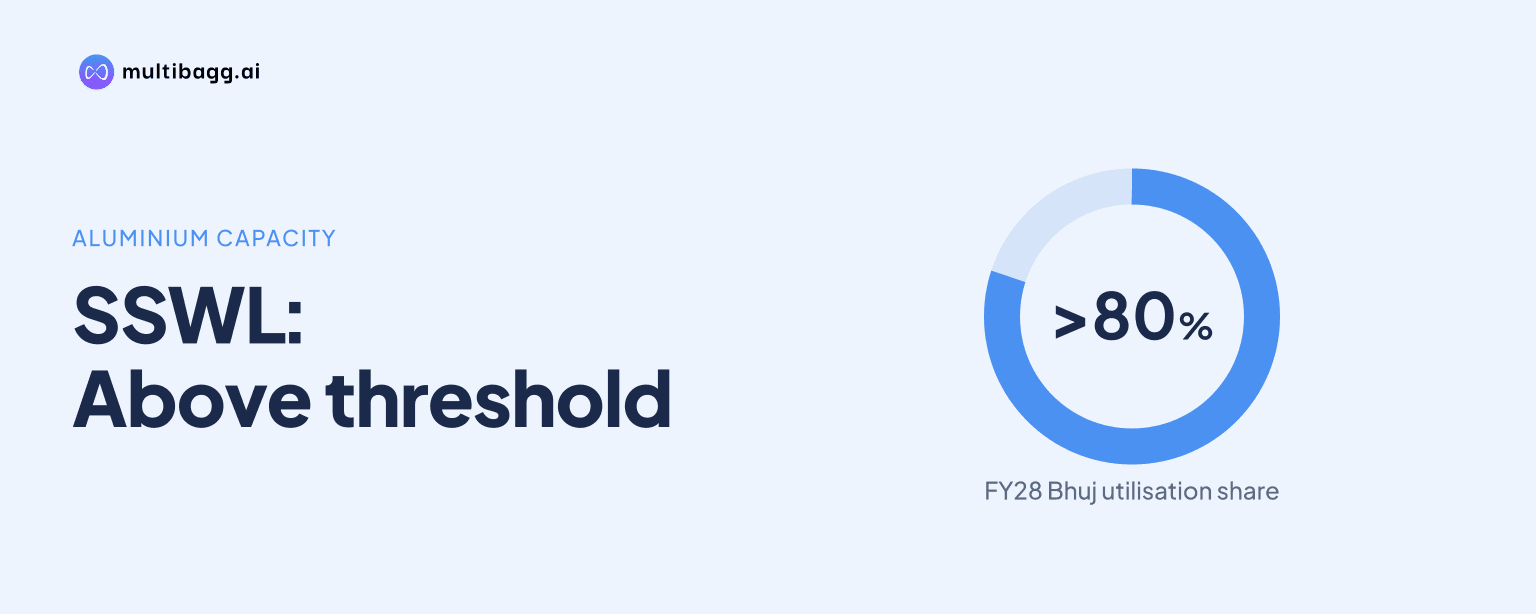
SSWL expects Bhuj utilisation above 80% throughout FY28
Key highlights
- SSWL expects Bhuj’s 1.2 million-wheel aluminium capacity to exceed 80% utilisation throughout FY28.
- SSWL’s aluminium-wheel capacity is planned to rise from 6.6 million wheels to 9.1 million after the 2.5 million-wheel Sambhajinagar addition.
- Sambhajinagar will add 2.5 million aluminium wheels and 1.6 million steel wheels, including 1 million passenger-car and 0.6 million OTR wheels.
- SSWL expects the Sambhajinagar facility to be at least 25% more productive operationally than current production.
powered by IRIS
Steel Strips Wheels expects its new 1.2 million-wheel Bhuj aluminium-wheel capacity to exceed 80% utilisation throughout FY28, with management expecting new facilities to reach full utilisation within three to four months of commercial production. SSWL also outlined an aluminium-wheel capacity roadmap of 9.1 million wheels after its planned Sambhajinagar expansion.
Know Steel Strips Wheels inside out
Results, valuation, peers and who's buying, in one view.
What utilisation does SSWL expect at Bhuj in FY28?
SSWL expects the Bhuj capacity enhancement to exceed 80% utilisation for the whole of FY28. Management said the new facilities should reach 100% utilisation within a maximum of three to four months after commercial production starts, supporting its confidence in the full-year target.
The utilisation expectation also sits alongside brownfield additions in tractor and truck wheels. SSWL said those added capacities were already sold out, while its factories were producing more parts in the same 24-hour period than they did three months earlier because of higher productivity.
Bhuj adds 1.2 million aluminium wheels a year to a 5.4 million-wheel Mehsana base following debottlenecking. That produces 6.6 million wheels before the planned Sambhajinagar addition, making Bhuj a material part of the capacity available for FY28.
How will SSWL reach 9.1 million aluminium wheels?
SSWL's stated route to 9.1 million aluminium wheels consists of 5.4 million at Mehsana, 1.2 million at Bhuj and 2.5 million at Sambhajinagar. This is above the 6.2 million-wheel figure put to management for the start of FY28 because management said Mehsana had been debottlenecked and additional wheels had been added there.
The 2.5 million-wheel Sambhajinagar project would take SSWL from 6.6 million to 9.1 million wheels. Management said the new Sambhajinagar facilities would be more efficient and more profitable than Mehsana or Bhuj, but did not disclose projected revenue, earnings or utilisation for that addition.
Management linked the larger capacity plan to domestic and export demand. It said brownfield increments in tractor and truck wheels had already been committed, while original equipment manufacturer, or OEM, exports were continuing and added capacity would be taken up as new businesses come on stream.
What capacity is SSWL adding at Sambhajinagar?
SSWL is adding 2.5 million aluminium wheels and 1.6 million steel wheels at Sambhajinagar. The steel-wheel build comprises 1 million passenger-car wheels and 0.6 million off-the-road, or OTR, wheels, which management said would target export demand and customers in southern India.
Management intends to have the first phase commissioned and ready for trials and approvals in the first quarter of the next calendar year. This is an initial-readiness timeline rather than a disclosed date for full commercial utilisation, and SSWL also expects hot stamping to be operational around that time.
The hot-stamping line has stated capacity of 1.3 million strokes a year and management associated it with Rs 400 crore of turnover. SSWL said the line could be expanded after the next order at marginal cost because most first-phase expenditure would already have been incurred, and it also identified a possible future knuckle-capacity addition at the site.
Got a follow-up? Ask IRIS
Why does SSWL expect EBITDA per wheel to improve?
Management expects earnings before interest, tax, depreciation and amortisation, or EBITDA, per wheel to improve in FY28 through a richer product mix, automation and closer proximity to customers. When asked whether EBITDA per wheel could reach Rs 450 to Rs 500, management said product mix itself should eventually support that range, without issuing formal numerical guidance.
The operational case rests partly on Sambhajinagar. Management said the new facility should be at least 25% more productive operationally than current production, with automation intended to reduce costs and rejection rates. It also cited shorter distances to customers including John Deere, TAFE and other southern customers as a way to reduce freight costs.
SSWL distinguished aluminium and steel-wheel economics in its product-mix discussion. Management said aluminium-wheel EBITDA per wheel is about 40% higher when the comparison includes commercial vehicles, tractors, electric vehicles and other categories, while a passenger-car aluminium wheel generates roughly twice the EBITDA per wheel of a passenger-car steel wheel.
Management also attributed its higher confidence in steel-wheel EBITDA to price increases, operational efficiencies and volumes. It said customers accepted cost increases of roughly 2% to 5% after SSWL told OEMs that existing-business prices needed to cover costs if it was to invest in additional capacity.
What could alter SSWL's expansion and export outlook?
Freight costs and export-market conditions remain variables for SSWL despite its current demand picture. Management said the company was being affected by the freight market, although freight also affects competing suppliers, and said it expected to provide more data when it next speaks with investors in January.
Management also said a prospective US-India trade deal could affect exports. It had targeted Rs 600 crore of exports for the year and said this could rise to Rs 700 crore or Rs 750 crore depending on how soon such a deal is reached; these are management targets and conditional expectations rather than reported export outcomes.
Commercial-vehicle and tractor demand is another sensitivity. Management said commercial-vehicle sales for the current month would be the highest in its history by a wide margin, while tractor volumes had grown about 15% in the first half, but it acknowledged that lower segment volumes would affect EBITDA per wheel.
Conclusion
SSWL's capacity plan combines an FY28 utilisation target at Bhuj with a longer aluminium-wheel expansion from 6.6 million wheels after the Mehsana debottlenecking to 9.1 million after Sambhajinagar. Management's rationale for higher wheel economics depends on product mix, automation, lower rejection rates and reduced distance from customers.
The next points to watch are commissioning, trials and approvals at Sambhajinagar in the first quarter of the next calendar year, and the pace at which Bhuj approaches full utilisation within three to four months of commercial production. Management also identified a potential hot-stamping expansion after a new order, possible knuckle capacity, freight trends and the US-India trade deal as factors that could affect exports.