










Steel Strips Wheels Targets Rs 400 Crore in Hot Stamping
Key highlights
- SSWL is investing Rs 170 crore, including land, building and equipment, in a Maharashtra hot-stamping factory.
- SSWL is targeting close to Rs 400 crore in annual hot-stamping turnover from the project.
- The planned hot-stamping line will have capacity of 13 lakh strokes a year and supply lighter automotive structural components.
- SSWL is discussing hot-stamping business with 2 additional customers and may add another line during execution.
powered by IRIS
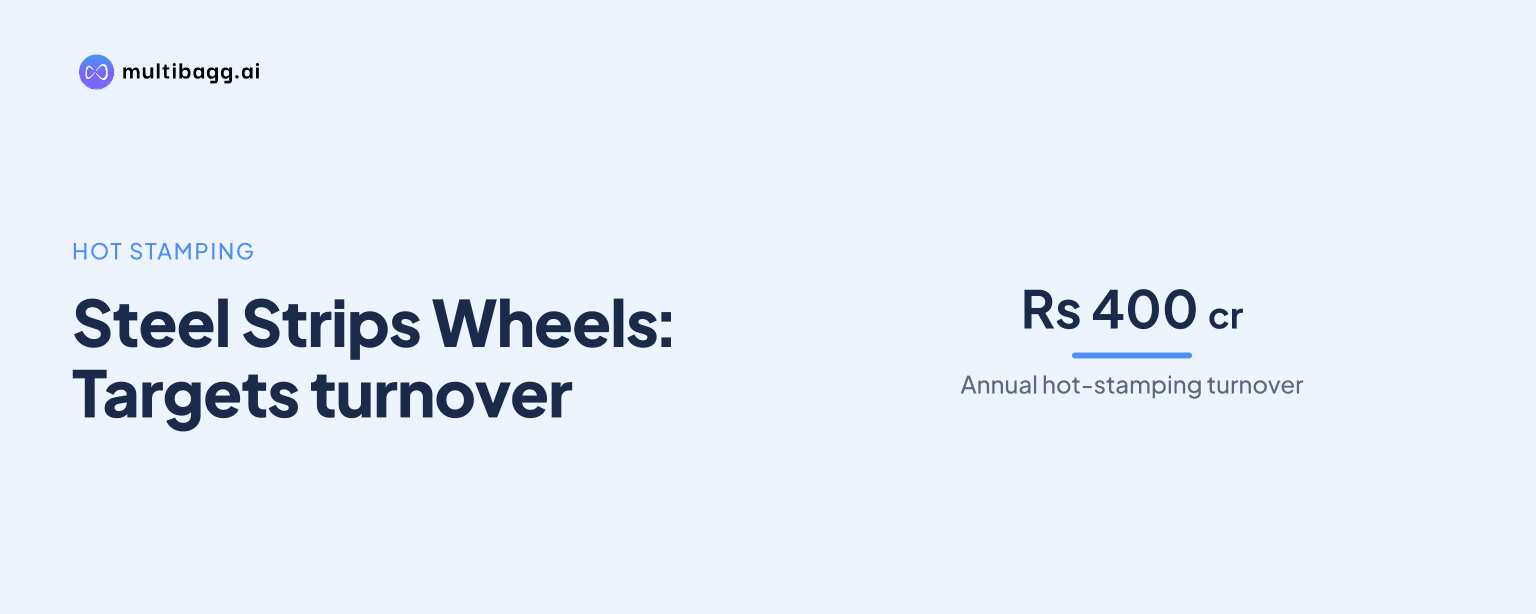
Steel Strips Wheels is targeting turnover of close to Rs 400 crore from a Rs 170 crore hot-stamping factory that management said an anchor customer in Maharashtra requested. The project is intended to supply lighter automotive structural parts, with stated capacity of 13 lakh strokes a year and commercial production targeted for next calendar year.
Know Steel Strips Wheels inside out
Results, valuation, peers and who's buying, in one view.
Why is SSWL investing Rs 170 crore in hot stamping?
SSWL is investing Rs 170 crore because management said it is setting up the factory for a specific customer located in Maharashtra, close to the planned facility, rather than creating capacity without identified demand. The budget includes land, building and equipment, according to management's response to an analyst asking about fixed-asset turnover. Management did not identify the anchor customer by name.
The new line will make automotive structural components using hot stamping, a process management said reduces part weight. SSWL linked the technology to lighter vehicles, electric vehicles and Corporate Average Fuel Economy, or CAFE, norms. Management also said expected customers would be in Nagpur or Nashik, making proximity to customers a stated rationale for the investment.
How large is SSWL's revenue goal for hot stamping?
SSWL's stated goal is turnover of close to Rs 400 crore from the Rs 170 crore investment, meaning the targeted annual revenue is more than twice the disclosed all-in project cost. Management gave the turnover objective after being asked about the type of asset turnover expected from the hot-stamping capital expenditure.
The operation is designed for 13 lakh strokes a year, which management identified as the capacity measure for hot stamping. It did not disclose the number of parts produced per stroke, expected utilisation, pricing, margin, depreciation or a project-specific return on capital employed. The close to Rs 400 crore figure is therefore a management target rather than a forecast supported by disclosed operating assumptions.
Management described the commercial model as customer-integrated: capacity is expected to be taken up according to customer volume requirements. It said the plant could start with sold-out capacity if orders are secured by the time production begins. SSWL was also talking with two additional hot-stamping customers and said it could add another line during execution depending on business converted.
Who will SSWL compete with in hot stamping?
SSWL said its identified competitors include Spain-based multinational Gestamp, JBM and Korea's Autogen, alongside two other players that management did not name. Management said the market has room for several competitors with technology, process controls and execution capability for new investments.
The company did not quantify its expected market share or disclose a customer award beyond the anchor relationship. Instead, management positioned the Rs 170 crore facility around proximity to customers and the weight-reduction benefit of hot-stamped structural parts. SSWL said the technology is expected to grow globally as vehicle makers seek lower-weight structural components.
Hot stamping sits alongside, rather than replaces, SSWL's wheel businesses. Management said its buyers and customers are the same or similar to those in its existing automotive operations. During the call, SSWL said aluminium wheels and aluminium knuckles generated earnings before interest, tax, depreciation and amortisation, or EBITDA, per wheel about 40% above the broader steel-segment comparison; it added that a passenger-car aluminium-versus-steel comparison was about twice.
Got a follow-up? Ask IRIS
When will SSWL begin hot-stamping production?
SSWL gave a next-calendar-year timetable, but management's descriptions of the milestone were not fully consistent. It first said it was targeting production around the same time next year or somewhat later, referring to the fourth quarter of the next calendar year. Later, management said the Sambhajinagar facility was intended to be commissioned and ready for trials and approvals in the first quarter of the next calendar year.
The distinction matters because trials and approvals can precede commercial production. Management did not reconcile the first-quarter commissioning comment with the later fourth-quarter production reference, and it did not provide an exact launch date. It did say this business works through integration with customers before volumes are taken up, making order conversion and approval timing central to the ramp.
The call separately covered a Rs 1,400 crore newer or greenfield capital-expenditure programme, but management did not provide a breakdown tying that entire figure to the Rs 170 crore hot-stamping project. On the broader business, management reported return on capital employed of 24% in the first six months of the financial year and said new facilities would improve returns, but it did not disclose a separate return target for hot stamping.
How does hot stamping fit SSWL's wider capacity plans?
SSWL is adding capacity across wheels and related products while entering hot stamping as a new structural-parts category. Management said its aluminium-wheel capacity had reached an annualised 54 lakh wheels after a 10% debottlenecking at Mehsana. It also outlined 12 lakh wheels at Bhuj and a further 25 lakh wheels at Sambhajinagar, taking the indicated aluminium-wheel total to 91 lakh wheels.
The company said Sambhajinagar would also add 16 lakh steel wheels, comprising 10 lakh passenger-car wheels and 6 lakh off-the-road, or OTR, wheels. Those wheel additions are distinct from the hot-stamping capacity of 13 lakh strokes a year. Management's case for the location included lower freight costs, closeness to customers and greater automation, rather than a disclosed financial linkage between the wheel projects and the close to Rs 400 crore hot-stamping turnover target.
Management also said Sambhajinagar's new facilities would be more automated and operationally effective than existing operations. It estimated that the new facilities would be at least 25% more productive operationally than current production, citing lower costs and rejections. That statement related to the wider Sambhajinagar expansion and was not presented as a specific productivity target for the hot-stamping line.
Conclusion
SSWL is entering hot stamping with a disclosed Rs 170 crore all-in investment, an anchor customer near its Maharashtra location and a target of close to Rs 400 crore in turnover. The project extends SSWL from wheels and knuckles into lightweight structural components, while its stated capacity of 13 lakh strokes a year provides an operating measure for the planned line.
The next disclosures to watch are commissioning, trials and commercial-production timing next calendar year, because management gave first-quarter and fourth-quarter references. Management's talks with two additional customers, the possible addition of another line during execution and whether the plant begins with sold-out capacity will also determine how the project develops.