










Stallion expects fixed HFC quotas to lift margins after 2028
Key highlights
- Stallion said Gulf-related material prices were affected by 10% to 20%, while freight and related costs rose by more than 20%.
- Management said imports in 2024, 2025 and 2026 will determine HFC quota allocations for the following 20 years.
- Stallion expects regular-business PAT margin to rise from 10% to 15% after fixed quotas begin in 2028.
- Management expects a 22% PAT margin at Bhilwara and 15% at helium and Mambattu operations.
powered by IRIS
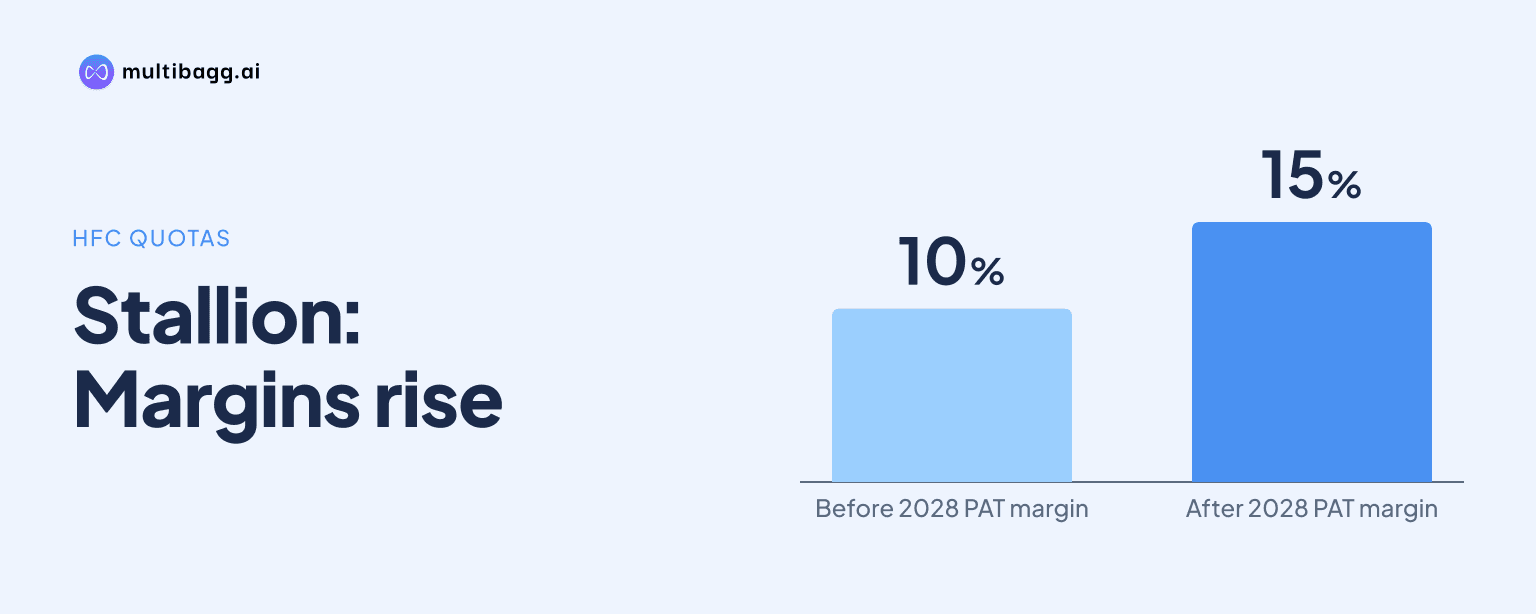
Stallion expects fixed hydrofluorocarbon (HFC) import quotas from 2028 to lift its regular-business profit after tax (PAT) margin to 15%, after Gulf disruption increased some material prices by 10% to 20% and raised freight and related costs by more than 20%.
Know Stallion India Fluorochemicals inside out
Results, valuation, peers and who's buying, in one view.
Why are Stallion's margins under pressure now?
Stallion says current margins are under pressure from Gulf-related input costs and intense selling during India’s HFC quota-calculation period. Management said prices of material coming from the Gulf were affected by 10% to 20%, while the disruption’s broader effect increased freight and related costs by more than 20%.
Management identified the quota-setting mechanism as an even larger issue than the Gulf disruption. It said imports during 2024, 2025 and 2026 will be added and divided by three to establish the quota applicable for the next 20 years. Stallion said this has encouraged market participants to maximise imports and sales before the calculation period closes, creating heavy selling pressure.
The company contrasted the current period with the preceding quarter, which management described as abnormal and driven by better planning. Management had characterised that quarter’s earnings as a one-off windfall that would not recur, whereas it called the subsequent quarter the regular operating condition. The comparison indicates that Stallion does not attribute the margin change solely to higher Gulf-related costs.
How could fixed HFC quotas change Stallion's business after 2028?
Stallion expects fixed HFC quotas from 2028 to limit imports to quota holders and lift its regular-business PAT margin to 15%. Management said country-level and individual-company quota allocations are expected to be announced in 2027, after the 2024-2026 import calculation period.
The proposed system would replace the current incentive to maximise imports with fixed allocations for permitted importers. Management said it expected Stallion to be a dominant player and to receive more than 50% of the country quota. That is management’s expectation, as the transcript contains no confirmed company allocation or final quota decision.
Management said the regular business is currently modelled at a 10% PAT margin in its revenue-mix illustration, before the expected post-2028 change. Its 15% expectation therefore concerns the existing business after import restrictions take effect, rather than an immediate group-wide profitability forecast.
The 2028 timing also underpins Stallion’s hydrofluoroolefin (HFO) strategy. Management said developed nations would face an initial 15% reduction in global HFC quota in 2028, which it expects to increase HFC costs and speed a move toward HFOs between 2028 and 2032. Those effects are management expectations rather than reported market outcomes.
Got a follow-up? Ask IRIS
What margin mix does Stallion expect from its facilities?
Stallion expects the Bhilwara facility to generate a 22% PAT margin, while helium and Mambattu operations are expected to operate at 15%. Management said the new facilities and ventures are intended to raise profitability above current levels, subject to commissioning and production ramp-up.
Management illustrated the prospective revenue mix with total turnover of Rs 1,200 crore. It expects Rs 600 crore of that turnover to come from Bhilwara, about Rs 200 crore from HFO blends and helium, and the remaining Rs 400 crore from the regular business.
This mix means Bhilwara’s 22% estimate is not a consolidated margin projection. Management said the weighted average across Bhilwara, HFO blends and helium, and the regular business would determine PAT, while it expects the regular-business margin to improve after 2028.
Stallion also stated an ambition of Rs 3,000 crore in revenue by financial year 2030. Management said it was aiming at Rs 3,000 crore while considering Rs 2,500 crore an outcome it could achieve safely, but it did not provide a detailed annual execution schedule supporting either figure.
When could Stallion's plants and HFO strategy contribute?
Stallion expects trials at its current plant to conclude by March, phased production to begin in April and operations to stabilise at 100% by May. Management said a chemical process plant’s reactors are started sequentially rather than all at once, causing production to increase through April.
The Mambattu facility is complementary to the current production plant because it requires 32% to 60% of its production needs from that output, management said. Mambattu was redesigned to include HFO blending, helium, hydrocarbons and other activities, and management said revenue expected from it would move into the first quarter of 2027 rather than the current financial year.
Bhilwara has no HFO capability at present, according to management. Stallion said it would initiate work on the planned HFO plant only after the current plant has operated smoothly for about three to five months; environmental studies have begun, land has been acquired and boundary work is complete, but construction requires environmental clearance.
Management estimates India’s current HFO requirement at about 500 to 600 tonnes and expects it to rise above 2,500 tonnes as the 2028 quota changes take effect. Stallion expects the HFO market to expand rapidly from 2028 to 2032, with HFOs eventually replacing HFCs in relevant applications.
Conclusion
Stallion’s margin outlook combines immediate pressure with a potential regulatory change in 2028. Management cited 10% to 20% Gulf-related material-price effects, freight and related cost inflation above 20%, and import-led selling pressure during the 2024-2026 quota-setting period. Its longer-term case rests on fixed HFC quotas lifting regular-business PAT margins to 15%, supplemented by the expected 22% Bhilwara margin and 15% margins from helium and Mambattu operations.
The next milestones are the targeted March trial completion, phased April production and expected May stabilisation of the current plant. Investors will also watch for the 2027 quota announcement, environmental clearance and subsequent construction decision for the HFO plant, as well as management’s funding choice for an anticipated Rs 150 crore working-capital need and Rs 200 crore of next-plant capital expenditure.