










Stanley H1 FY27 profit falls 68% as revenue, margins decline
Key highlights
- Stanley reported H1 FY27 adjusted PAT of Rs 4.44 crore, down 67.9% year on year.
- H1 FY27 revenue from operations declined 3.6% to Rs 206.41 crore.
- H1 FY27 EBITDA margin fell to 18.0% from 22.1% in H1 FY26.
- Stanley opened 3 stores and closed 3 stores during Q2 FY27.
powered by IRIS
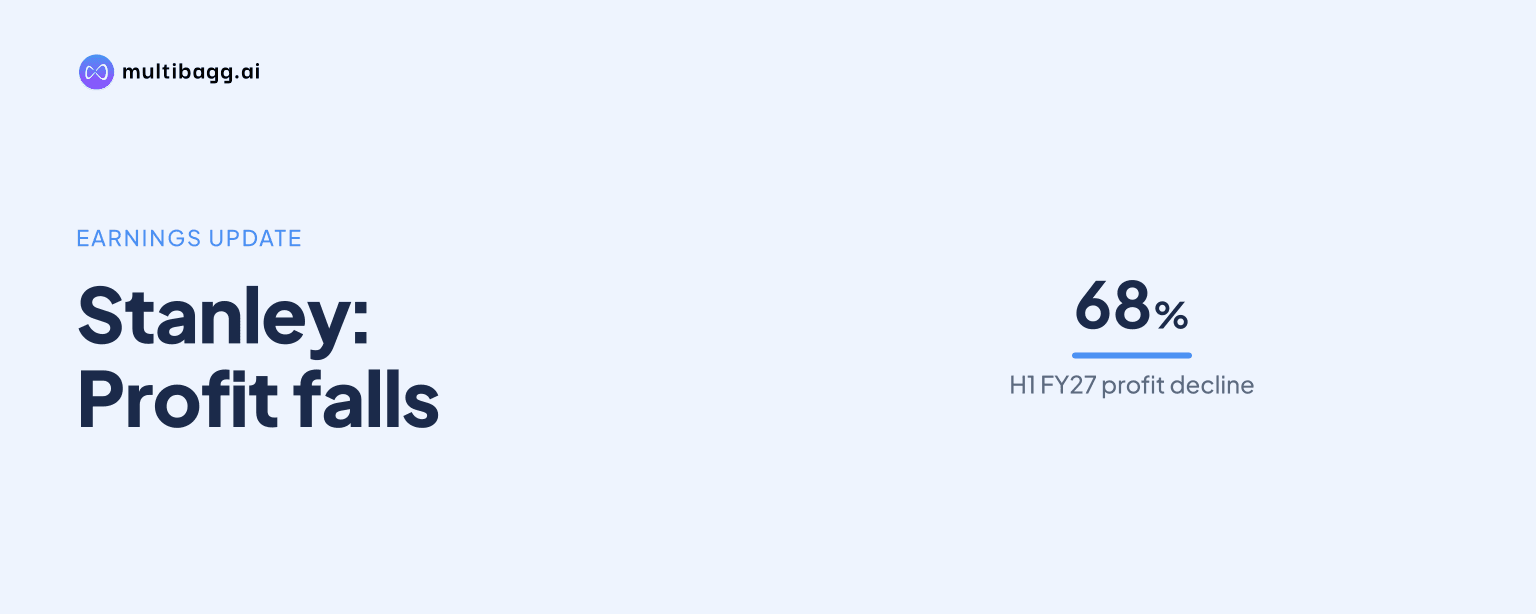
Stanley Lifestyles Limited reported adjusted profit after tax of Rs 4.44 crore for H1 FY27, down 67.9% year on year, as revenue declined 3.6% and EBITDA margin narrowed to 18.0%. The first-half result followed a Q2 recovery in revenue, but adjusted profit remained below the prior-year level.
Know Stanley Lifestyles inside out
Results, valuation, peers and who's buying, in one view.
Why did Stanley's H1 FY27 profit decline?
Stanley's adjusted profit after tax declined because lower first-half revenue was accompanied by a larger contraction in operating profitability. Revenue from operations for H1 FY27 was Rs 206.41 crore, compared with Rs 214.09 crore in H1 FY26, while earnings before interest, tax, depreciation and amortisation, or EBITDA, fell 21.5% to Rs 37.11 crore. The EBITDA margin declined by 4.1 percentage points to 18.0% from 22.1%.
The decline became more pronounced below the EBITDA line. Adjusted PBT fell to Rs 6.45 crore from Rs 18.49 crore, reducing its margin to 3.2% from 8.6%. Adjusted PAT margin was 2.2%, compared with 6.5% a year earlier. Stanley said adjusted PBT and adjusted PAT exclude exceptional items of Rs 1.15 crore in H1 FY27, consisting of Rs 48 lakh in Q2 FY27 and Rs 67 lakh in Q1 FY27.
How did Stanley perform in Q2 FY27?
Stanley recorded sequential revenue and profit improvement in Q2 FY27, although its year-on-year operating and earnings measures remained lower. Revenue from operations rose 7.8% quarter on quarter to Rs 107.06 crore from Rs 99.35 crore in Q1 FY27, and increased 1.6% from Rs 105.42 crore in Q2 FY26. EBITDA increased 15.5% from Q1 FY27 to Rs 19.89 crore, but was 19.9% below the Rs 24.82 crore reported in Q2 FY26.
The Q2 EBITDA margin improved by 1.3 percentage points from 17.3% in Q1 FY27, but remained 4.9 percentage points below the 23.5% margin in Q2 FY26. Adjusted PBT rose 63.7% sequentially to Rs 4.06 crore, while adjusted PAT increased 185.7% to Rs 3.29 crore from Rs 1.15 crore. Against Q2 FY26, adjusted PBT declined 49.9% and adjusted PAT declined 45.5%.
What changed in Stanley's retail network during Q2 FY27?
Stanley opened three stores in Q2 FY27 and closed three stores as part of a review of individual locations and their surrounding catchment areas. The openings included Stanley Boutique Homes in Colombo through a strategic partnership with Singer Sri Lanka PLC, marking Stanley's first international-market entry. Stanley said the Colombo partnership uses Singer's local market expertise and retail network.
In India, Stanley launched Sofas & More by Stanley in Jaipur, its entry into Rajasthan, and opened its first Stanley Superlative Living flagship store in Hyderabad. The Hyderabad location covers 72,000 square feet and combines furniture, kitchens, wardrobes, lighting, decor and personalised design services. Stanley said it closed three locations where markets had matured and offered limited scope for further customer acquisition, while reallocating resources toward locations with greater growth and customer-engagement potential.
The Q2 openings added formats at different price and product positions rather than a single-format expansion. Stanley's release describes one premium-to-ultra-luxury store serving purchases of Rs 8 lakh and above, 12 ultra-luxury stores, 18 luxury stores and 39 super-premium stores. It also states that Stanley operates 70 retail outlets across Indian cities through company-owned and franchise formats, alongside three manufacturing facilities in Bengaluru spanning more than 3,00,000 square feet.
Got a follow-up? Ask IRIS
What factors does management say affected demand and margins?
Management attributed the Q2 trading environment to delays in residential-project handovers and longer customer conversion cycles, despite the 7.8% sequential increase in revenue. Chairman Sunil Suresh said Stanley expects to improve customer conversions as handovers progress and seeks a greater contribution from newer stores. The release does not provide a timetable or quantified target for either measure.
Stanley also said industry inventory built ahead of the Furniture Quality Control Order, or QCO, in August 2026 led to heavier-than-expected festive price discounting. Management said possible inclusion of sofas and recliners under the QCO could create an opportunity if import-reliant furniture retailers seek domestic suppliers. This is a management view rather than a stated outcome, and the filing does not quantify sales that could arise from such demand.
What is Stanley doing to address its operating structure?
Stanley said it is pursuing a Best Cost Country, or BCC, sourcing model and greater localisation to improve cost competitiveness. Stanley is also refining its brand and retail architecture, strengthening internal processes and building its complete-home-solutions portfolio. Management linked these measures to sourcing efficiency, execution and customer experience, but disclosed no savings target or completion date.
Stanley is progressing with a proposed amalgamation of subsidiaries and step-down subsidiaries into Stanley. According to the release, the plan is intended to simplify the group structure and improve coordination across businesses. Stanley also said it will remain selective in retail expansion and continue reviewing location-level performance rather than committing to a specific number of future store openings.
Conclusion
Stanley's H1 FY27 figures show that the Q2 revenue recovery did not reverse first-half pressure on profitability. Revenue fell 3.6% to Rs 206.41 crore, while EBITDA declined 21.5% to Rs 37.11 crore and the EBITDA margin decreased to 18.0%. The resulting 67.9% fall in adjusted PAT to Rs 4.44 crore was steeper than the revenue decline.
The next disclosed event is Stanley's earnings conference call scheduled for November 16, 2026, at 2:30 PM IST. Investors will be able to assess management's discussion of residential handovers, customer conversions, newer-store contribution, the proposed group amalgamation and the BCC sourcing and localisation initiatives, none of which carries a quantified target in the release.