










Steelcast plans 11,750-TPA capacity addition costing Rs 151 crore
Key highlights
- Steelcast plans 11,750 TPA of additional capacity over the next two years.
- The programme carries total planned investment of about Rs 151 crore.
- Steelcast’s piece-weight capability is planned to increase from 2.5 tonnes to 3.5 tonnes.
- Steelcast sold 13,903 tonnes in FY26, up from 12,564 tonnes in FY25.
powered by IRIS
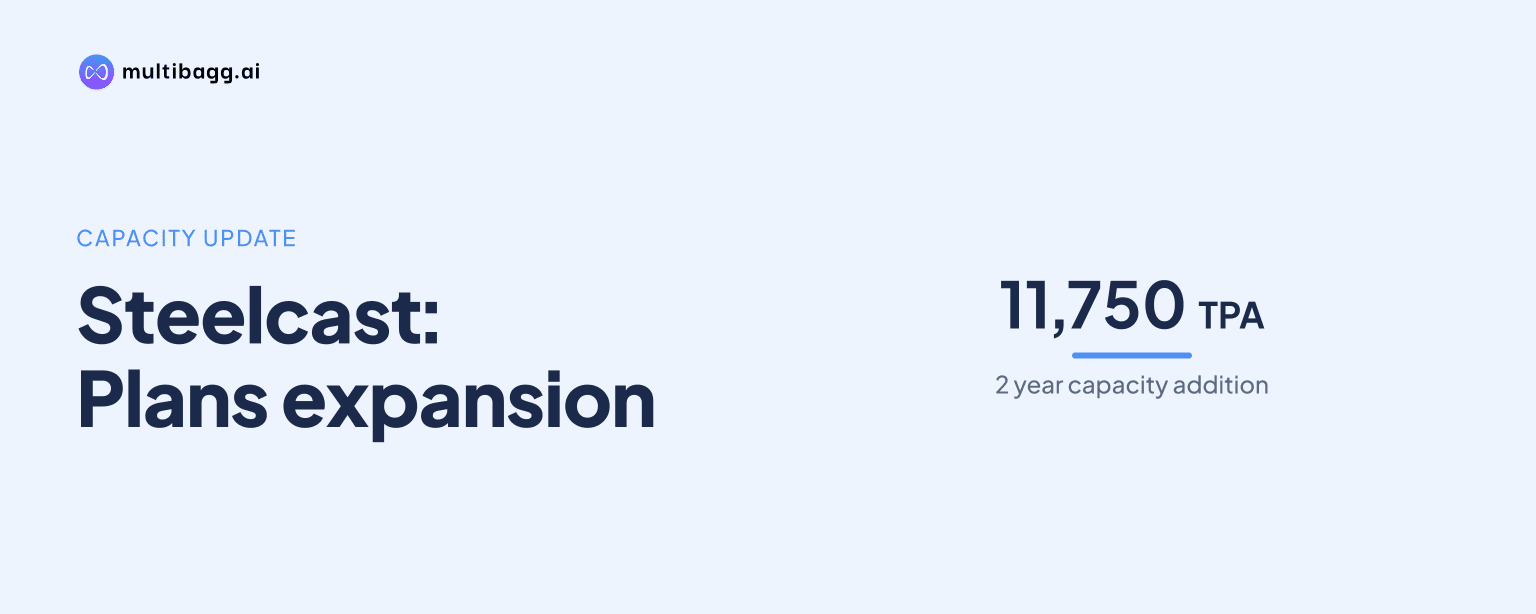
Steelcast has approved an 11,750-tonnes-per-annum capacity addition costing about Rs 151 crore over the next two years, combining an 8,500-TPA greenfield foundry and a 3,250-TPA expansion. The plan lifts piece-weight capability from 2.5 tonnes to 3.5 tonnes, which management says will increase its addressable markets.
Know Steelcast inside out
Results, valuation, peers and who's buying, in one view.
What capacity expansion has Steelcast approved?
Steelcast has approved 11,750 tonnes per annum, or TPA, of additional capacity over the next two years. The programme combines an 8,500-TPA greenfield foundry that had earlier received Board approval with a further 3,250 TPA expansion now approved by the Board. The presentation does not disclose Steelcast’s existing installed capacity, so 11,750 TPA is planned incremental capacity rather than stated total capacity after completion.
The earlier-approved greenfield foundry accounts for 8,500 TPA and about Rs 120 crore of investment. The later addition accounts for 3,250 TPA and about Rs 31 crore. Together, the two components total 11,750 TPA and about Rs 151 crore, with the greenfield foundry representing the larger part of both planned capacity and spending.
The change from Steelcast’s earlier disclosed plan is therefore an additional 3,250 TPA and about Rs 31 crore of investment. Steelcast describes the overall programme as taking place over the next two years, but does not provide separate commissioning dates for the 8,500-TPA and 3,250-TPA components. This means the full capacity-build schedule extends beyond the stated FY27 outlook period.
How will Steelcast’s casting capability change?
Steelcast says the new capacity will increase its maximum piece-weight capability by 1 tonne, from 2.5 tonnes to 3.5 tonnes. The 3.5-tonne capability is 40% above the current 2.5-tonne level. Management says the greater piece-weight capacity will expand Steelcast’s addressable markets, but the presentation does not quantify revenue, orders or margins expected from heavier castings.
The higher weight capability accompanies management’s FY27 focus on mining and earthmoving, while ground-engaging tools, or GET, and defence industries are expected to ramp up. Steelcast also says it has an adequate order book and good bookings across all its serviceable segments. However, the presentation gives no order-book value, sector split or indication of how much demand in mining, earthmoving, GET or defence needs castings above 2.5 tonnes.
Steelcast’s recent sales-volume data provide context for the capacity programme. Sales volume increased to 13,903 tonnes in FY26 from 12,564 tonnes in FY25, an increase of 1,339 tonnes. H1FY27 sales volume was 8,406 tonnes, while Q2FY27 volume of 4,370 tonnes exceeded both Q1FY27 volume of 4,036 tonnes and Q2FY26 volume of 3,411 tonnes.
Q2FY27 volume was 334 tonnes higher than Q1FY27 and 959 tonnes higher than Q2FY26. H1FY27 is a partial-year period, and Steelcast does not provide an H1FY26 volume figure in the presentation. The disclosed data therefore do not support a first-half year-on-year comparison or a calculation of current utilisation against the proposed 11,750-TPA addition.
Got a follow-up? Ask IRIS
How will Steelcast fund the Rs 151 crore expansion?
Steelcast says management intends to fund future projects through internal accruals. Its capital-allocation framework starts with operating cash generation, followed by debottlenecking and automation, renewable energy, greenfield capacity and dividends. Management says this internal-accrual approach is intended to preserve balance-sheet flexibility while supporting growth.
The presentation reports a debt-equity ratio of 0.00 times and says Steelcast has been debt-free for the third consecutive year. It also reports about Rs 120 crore of free reserves, invested in bank fixed deposits, mutual funds and secured bonds. These items are presented alongside the capacity plan, but Steelcast does not specify the portion of the Rs 151 crore that will be drawn from reserves.
Steelcast reported return on capital employed, or RoCE, of 28.8% in H1FY27, compared with 28.6% in FY26 and 29.0% in FY25. Its H1FY27 dividend payout was 20% of profit after tax. Management has not disclosed a project-specific return target, payback period, annual capital-expenditure schedule or incremental profit estimate for the 11,750-TPA programme.
What is Steelcast expecting in FY27 while the expansion proceeds?
Steelcast expects more than about 30% growth in FY27 and expects to maintain its margin profile at the same level, according to management. The presentation does not define whether the growth expectation refers to revenue, sales volume, profit or another measure. It also does not say what portion of the FY27 expectation depends on capacity additions planned over the next two years.
The company’s sales volume had already risen to 13,903 tonnes in FY26 from 12,564 tonnes in FY25, while H1FY27 volume was 8,406 tonnes. Management identifies mining and earthmoving as key sectors for FY27 and says GET and defence are expected to ramp up. The presentation does not disclose separate sales volumes, bookings or revenue for these four end markets.
Steelcast is also commissioning renewable-energy assets. Its new 2.4-megawatt hybrid power plant and 1.4-megawatt solar plant were under commissioning by 31 December 2026, and the company expects annual power-cost savings of about Rs 4.5 crore. Steelcast does not state whether those expected savings are included in its FY27 growth or margin expectations, or whether their output will support the planned greenfield foundry.
Conclusion
Steelcast’s two-part programme increases planned capacity by 11,750 TPA at an investment of about Rs 151 crore and raises the company’s stated piece-weight capability from 2.5 tonnes to 3.5 tonnes. The additional 3,250 TPA and Rs 31 crore build on the earlier 8,500-TPA greenfield foundry approval, while sales volume rose by 1,339 tonnes between FY25 and FY26.
The disclosed milestones to watch are the two-year capacity-build period and commissioning of the 2.4-megawatt hybrid and 1.4-megawatt solar plants by 31 December 2026. Management’s stated FY27 expectation of more than about 30% growth, its plan to use internal accruals, and the anticipated ramp-up in mining, earthmoving, GET and defence are the other disclosed factors relevant to execution.