










Steelcast Limited Approves ₹120 Crore Foundry Expansion
Key highlights
- Steelcast approved a ₹120 crore greenfield foundry with 8,500 tonnes of annual capacity.
- The expansion will lift Steelcast's installed capacity from 29,000 tonnes to 37,500 tonnes.
- Steelcast reported Q1 FY 2026-27 revenue of ₹124.82 crore, up 17.0% year on year.
- Steelcast approved a first interim dividend of ₹0.45 per share, with August 7, 2026 as the record date.
powered by IRIS
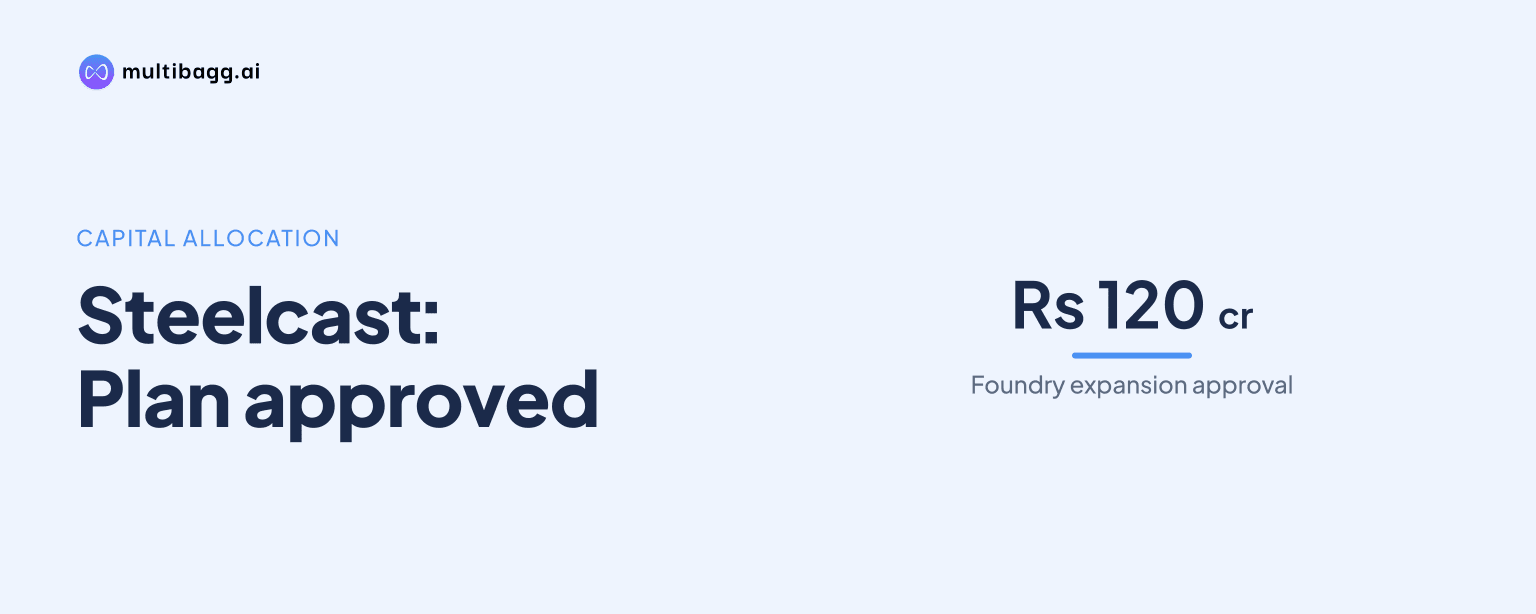
Steelcast Limited approved a ₹120 crore greenfield foundry project on July 29, 2026, adding 8,500 tonnes of annual casting capacity and taking its installed capacity to 37,500 tonnes from 29,000 tonnes. The project follows 17% year-on-year revenue growth in the June 2026 quarter and is planned for completion by March 31, 2028.
Know Steelcast inside out
Results, valuation, peers and who's buying, in one view.
Why is Steelcast Limited building a new foundry?
Steelcast is building the new foundry to cater to increasing customer demand and prepare for higher expected utilisation of its existing manufacturing base. The board approved the project at its July 29, 2026 meeting, alongside the company’s standalone financial results for the first quarter of FY 2026-27.
The proposed greenfield facility will add 8,500 tonnes per annum to Steelcast’s present installed capacity of 29,000 tonnes per annum. Once commissioned, the company’s overall capacity will rise to 37,500 tonnes per annum. The planned addition is equivalent to about 30% of the existing capacity.
Steelcast has estimated the project cost at ₹120 crore. The company said it will finance the entire expenditure through internal accruals, rather than through external borrowing. The disclosed implementation period is two years, with completion targeted by March 31, 2028.
The company reported projected capacity utilisation of 63% for FY 2026-27. It expects utilisation to reach 90% by March 31, 2029, which provides the stated basis for initiating the expansion before the existing facilities reach peak operating levels.
What financial performance supported the expansion decision?
Steelcast reported standalone revenue from operations of ₹124.82 crore for Q1 FY 2026-27, a 17.0% increase from ₹106.69 crore in Q1 FY 2025-26. Standalone net profit for the quarter stood at ₹23.71 crore, up 19.26% year on year.
The quarterly performance and the proposed capital expenditure were considered at the same board meeting. Revenue growth shows that the expansion decision followed a period of higher business activity, although the company’s disclosed rationale for the project remains the need to serve increasing customer demand.
The company also disclosed an order book of about ₹140 crore in information related to its first-quarter performance. This is a separate measure from quarterly revenue and indicates work expected to be executed, rather than sales already recognised in the June quarter.
Got a follow-up? Ask IRIS
What else did Steelcast announce on July 29, 2026?
Steelcast approved a first interim dividend of ₹0.45 per equity share of face value ₹1 for FY 2026-27. The payout represents 45% of the face value, and the company fixed August 7, 2026, as the record date for determining eligible shareholders.
The company stated that the dividend would be paid on or before August 28, 2026. Its board communication described the first interim dividend as approved, while another disclosure said the recommendation was subject to shareholder approval. Investors should rely on the company’s formal corporate-action notices for the final eligibility and payment process.
Steelcast also received IRIS certification from TUV India. The certification enables the company to enter the European rail-road industry market, according to the disclosed information. The announcement adds a potential new market avenue alongside the expansion of the domestic manufacturing footprint.
Steelcast is an India-based manufacturer of steel and alloy steel castings. Its capacity decision is therefore relevant to industrial customers that require cast components and to investors assessing the company’s ability to supply rising volumes over the longer project period.
How does the project affect Steelcast investors and operations?
The project commits ₹120 crore of internally generated funds to a capacity addition that will be completed over two years. Funding through internal accruals means Steelcast has not disclosed a plan to raise debt or equity specifically for this project.
For operations, the expansion raises the potential production base by 8,500 tonnes annually after commissioning. The benefit to reported revenue and profit will depend on project execution, commissioning and customer demand, none of which can be quantified from the disclosures available.
The company’s 63% projected utilisation for FY 2026-27 shows that the current capacity is not fully utilised. However, Steelcast has stated that it expects utilisation to reach 90% by March 2029, following the scheduled completion of the new facility. The company has not provided annual revenue guidance or profitability projections for the project.
For shareholders, the interim dividend creates a near-term corporate action, while the greenfield project represents a longer-duration allocation of capital. The IRIS certification may also broaden the company’s addressable market, but Steelcast has not disclosed prospective European rail-road revenue, customer contracts or order values linked to the certification.
Conclusion
Steelcast has combined a ₹120 crore manufacturing expansion with reported growth in its June 2026 quarter. The 8,500-tonne greenfield foundry will increase total installed capacity to 37,500 tonnes, while internal-accrual funding avoids a disclosed project-specific borrowing requirement. The first interim dividend of ₹0.45 per share and IRIS certification were additional outcomes of the July 29 board meeting.
The next disclosed milestones are the August 7, 2026 record date for the interim dividend, payment on or before August 28, 2026, and the March 31, 2028 target for project completion. Investors will also track whether utilisation progresses from the projected 63% in FY 2026-27 toward the company’s stated 90% expectation by March 2029.