










Steelcast reports ₹145 crore order book, 15 commercialised parts
Key highlights
- Steelcast disclosed a ₹145 crore executable order book, equivalent to approximately three months of sales.
- Steelcast said 15 of 32 parts developed in FY27 had transitioned towards revenue generation.
- Steelcast has 55 parts in sampling, tooling and customer qualification within a 111-part three-year rollout.
- Steelcast reported FY26 R&D spending of ₹4.13 crore and FY26 savings of ₹1.43 crore.
powered by IRIS
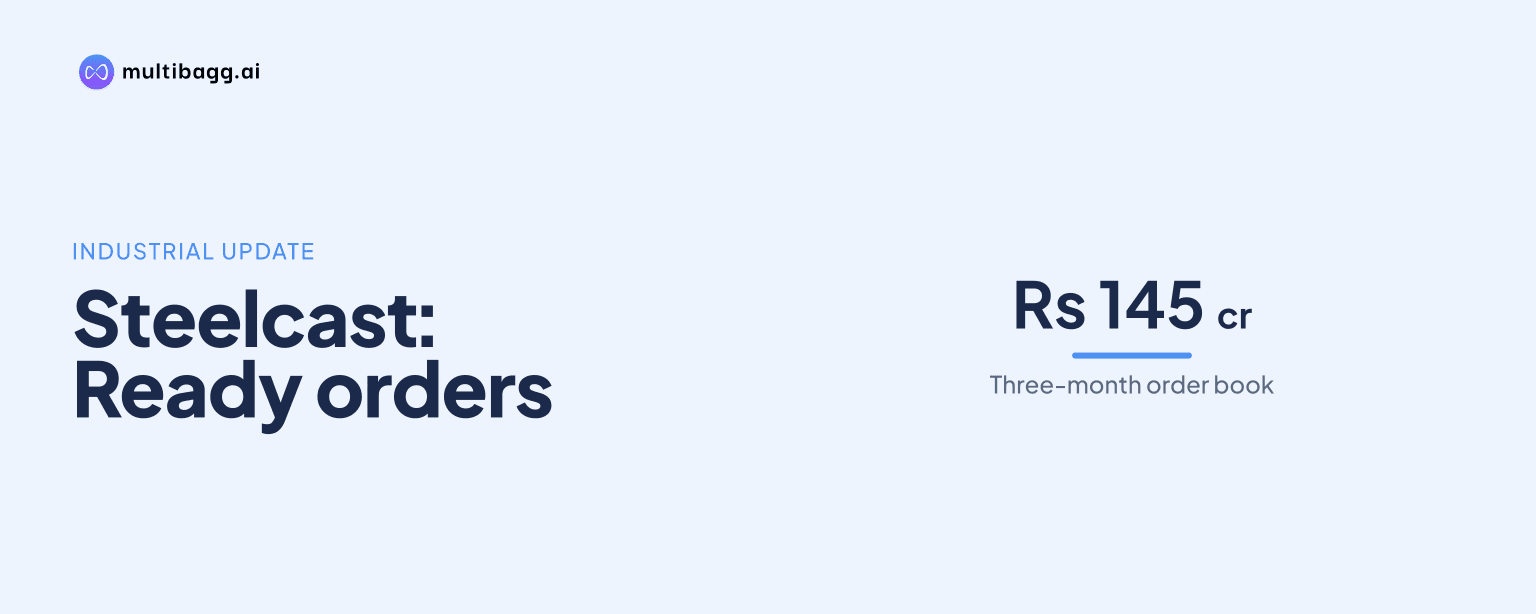
Steelcast Castechnik reported a ₹145 crore executable order book, equivalent to approximately three months of sales, while 15 of 32 parts developed in FY27 had transitioned towards revenue generation. Steelcast also disclosed 55 parts in sampling, tooling and customer qualification, within a three-year rollout programme covering 111 parts.
Know Steelcast inside out
Results, valuation, peers and who's buying, in one view.
What does Steelcast’s ₹145 crore order book cover?
Steelcast’s executable order book was ₹145 crore, representing approximately three months of sales at the time of the presentation. The disclosure identifies work available for execution, unlike the 55 parts still moving through sampling, tooling and customer qualification.
Steelcast does not disclose a customer, geography or segment breakdown for the ₹145 crore order book. However, it says mining and earthmoving will be the leading sectors in FY27, while its existing segments include electric locomotives, transportation, cement and construction alongside mining and earthmoving.
The two pipeline measures serve different purposes. The ₹145 crore figure measures executable sales value, whereas the 55-part figure measures components at pre-production development and qualification stages. Steelcast’s four-step process moves from co-engineering with original equipment manufacturers, or OEMs, to tooling and sampling, pilot orders, and then serial production.
How many FY27 parts has Steelcast commercialised?
Steelcast said 15 of 32 new parts developed in FY27 had transitioned towards revenue generation. The remaining 17 parts were not described as commercialised in the presentation, showing that a completed development programme and sales conversion do not necessarily occur at the same point.
Steelcast describes serial production as the stage that produces utilisation and revenue, after pilot orders validate the process. The 15 commercialised parts are therefore further advanced than the 55 parts in the sampling, tooling and customer-qualification pipeline, although the company does not provide a stage-by-stage split for those 55 parts.
Steelcast also disclosed a three-year rollout programme of 111 parts. The presentation does not say whether the 32 FY27-developed parts, the 15 commercialised parts and the 55 parts in development overlap with the 111-part total, so these figures cannot be added together.
The company does not disclose sales generated by the 15 parts, sales per component, or the expected value of the 55 parts under development. The disclosed evidence is therefore about product progression rather than the revenue contribution of an individual part or sector.
Which sectors is Steelcast developing in FY27?
Steelcast says Ground Engaging Tools, or GETs, will be a focus area in FY27, while construction and defence are also new sectors under development. The company is pursuing these segments alongside deeper wallet share with existing OEM customers.
Railways are another identified new segment, although Steelcast says the railroad industry is steady at its current level. In defence, management says it expects repeat orders from overseas defence customers; this is a management expectation rather than a reported order value or confirmed addition to the ₹145 crore executable order book.
Mining and earthmoving are expected to lead Steelcast’s FY27 activity, distinguishing them from the newer opportunities in GETs, construction and defence. The company’s existing segment mix also includes electric locomotives, transportation and cement, providing a broader base than the sectors it has specifically designated as FY27 leaders.
Steelcast reports a presence in 16 countries and expects to expand to more than 18 countries in the next one to two years. Management also says it is exploring new countries to de-risk the export business, but the presentation does not name the markets, give an export-sales target or disclose associated capital expenditure.
Got a follow-up? Ask IRIS
What supports Steelcast’s product-development cycle?
Steelcast reports that its development timeline has reduced to about six months from approximately nine months. The company attributes the process to simulation-led development, including virtual validation, radiography and defect prediction, together with co-engineering during the first stage of its product cycle.
In FY26, Steelcast spent ₹4.13 crore on research and development, or R&D, equal to 0.94% of total turnover. It also reported ₹1.43 crore of FY26 savings from R&D and continuous-improvement work, which is a separate measure from R&D spending.
The company lists five-axis machining, computer numerical control automation and precision metrology as advanced-machining capabilities. Its process-innovation activities include automated pouring, cooling, heat treatment and fettling, while its metallurgical work covers high-performance alloys and extreme-specification applications.
The reduction from around nine months to around six months is the disclosed comparison for Steelcast’s development cycle. The presentation does not provide a historical customer-approval rate, commercialisation rate or average time from qualification to serial production for the 55 parts now in development.
What could affect Steelcast’s pipeline conversion into sales?
Steelcast’s process requires customer qualification and pilot-order validation before serial production can generate utilisation and revenue. Of 32 parts developed in FY27, 15 had moved towards revenue generation, but the presentation gives no timetable for the other 17 parts or the wider 55-part pipeline.
Management says elevated commodity prices are resulting in an uptrend in business and expects export demand to be higher in the short term. For the medium term, management expects domestic demand to pick up, but it does not quantify the sales impact on the ₹145 crore order book or the new-part programme.
Steelcast has 13.3 megawatts of captive green-energy capacity, including 9.5 megawatts commissioned and 3.8 megawatts under commissioning. The presentation does not link the remaining 3.8 megawatts to output, costs, commissioning timing or execution of the ₹145 crore order book.
Steelcast also identifies operating features in Bhavnagar, Gujarat, including the Alang ship-recycling yard 50 kilometres away, Pipavav Port 130 kilometres away and a company-owned 66-kilovolt power transmission station. These facilities are presented as operating advantages, but the company does not quantify their effect on delivery times, margins or pipeline conversion.
Conclusion
Steelcast’s disclosure combines ₹145 crore of executable work, equal to around three months of sales, with a 55-part development pipeline and a 111-part three-year rollout. The transition of 15 out of 32 FY27-developed parts towards revenue generation is the reported link between its product-development activity and commercial output, while mining and earthmoving are expected to lead FY27.
The next disclosed milestones are progress in GETs, construction and defence, conversion of parts through pilot orders and serial production, and expansion from 16 to more than 18 countries over the next one to two years. Steelcast’s commissioning of the remaining 3.8 megawatts within its 13.3-megawatt captive green-energy programme is another stated item to monitor.