










Steelcast Ltd Schedules Q2 FY27 Results Call on November 13
Key highlights
- Steelcast will hold its Q2 FY27 and H1 FY27 results call on November 13, 2026, at 5:00 PM IST.
- Steelcast reported Q1 FY27 revenue from operations of ₹124.82 crore, versus ₹106.69 crore in Q1 FY26.
- Steelcast has outlined ₹35 crore of FY27 capex for additional space and balancing equipment.
- Steelcast has targeted capacity utilisation of about 58% in FY27 and about 90% by FY29.
powered by IRIS
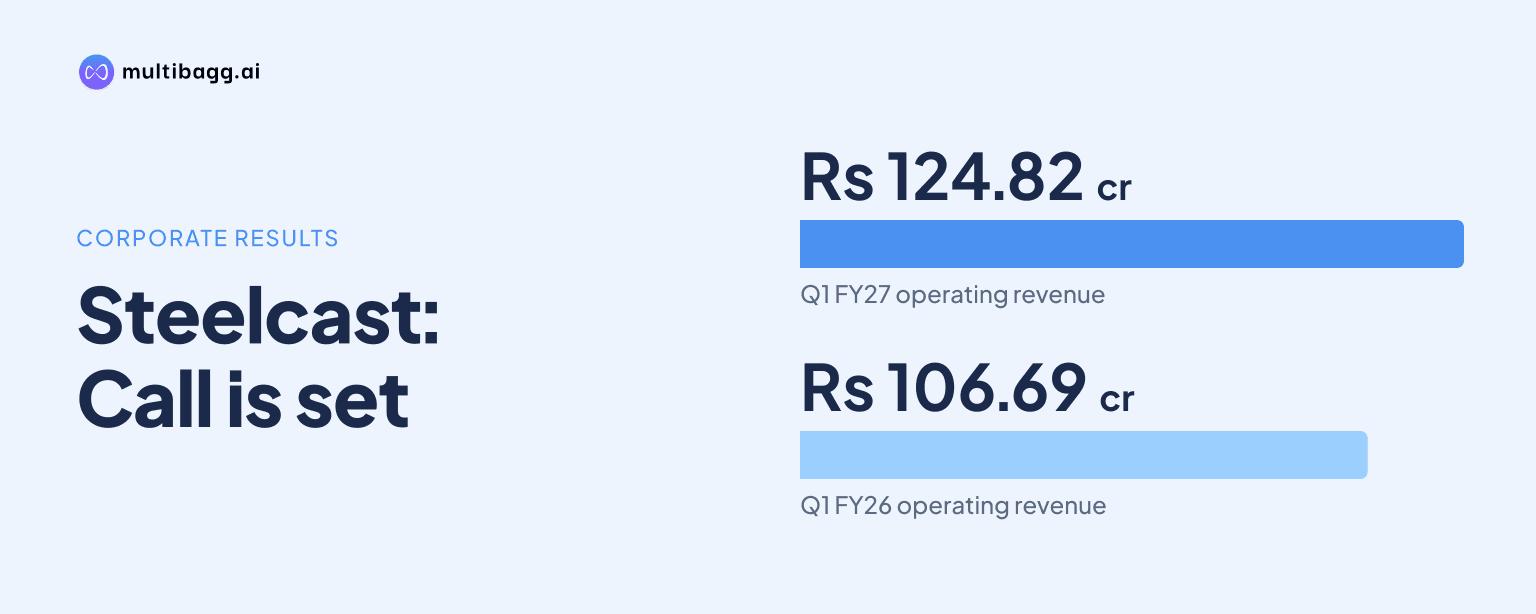
Steelcast Ltd has scheduled an analyst and institutional investor call for November 13, 2026, at 5:00 PM IST to discuss its unaudited Q2 FY27 and H1 FY27 results for the period ended September 30, 2026, after reporting Q1 FY27 revenue from operations of ₹124.82 crore.
Know Steelcast inside out
Results, valuation, peers and who's buying, in one view.
When will Steelcast discuss its Q2 FY27 results?
Steelcast will hold the analyst and institutional investor call on Friday, November 13, 2026, at 5:00 PM IST. The stated purpose is to discuss unaudited financial results for the quarter and half year ended September 30, 2026, which correspond to Q2 FY27 and H1 FY27.
The company said that the presentation for analysts and institutional investors will be submitted to the stock exchanges and made available on its website, steelcast.net. The announcement identifies the event as a results discussion and does not disclose the Q2 FY27 financial figures in advance.
For investors, the call is a scheduled opportunity to hear management commentary after the financial results are released. The company has not provided details in the supplied announcement on the format of the call, participating executives, or the duration of the session.
What financial information will the call cover?
The call will cover Steelcast's unaudited results for Q2 FY27 and H1 FY27. The reporting period includes the three months ended September 30, 2026, and the first six months of FY27.
The supplied material does not contain revenue, profit, margin, order-book, or volume figures for the September quarter. Therefore, the November 13 event should not be treated as a disclosure of the company’s Q2 performance before its unaudited results and accompanying presentation are made public.
The latest operating number cited in the supplied material relates to Q1 FY27. Revenue from operations for that quarter was ₹124.82 crore, converted from ₹12,481.97 lakh, compared with ₹106.69 crore, converted from ₹10,668.55 lakh, in Q1 FY26. That represents an increase of about 17% year on year based on the stated figures.
What expansion plans has Steelcast outlined for FY27?
Steelcast has outlined a ₹35 crore capital expenditure plan for FY27 for additional space to handle higher output and balancing equipment for new product mixes. The supplied material describes this as part of incremental expansion and debottlenecking activity.
Management has indicated a target of more than 20% volume and revenue growth in FY27 and over the following three years. These are management targets rather than reported outcomes, and the Q2 FY27 results and presentation may provide further information on progress against them.
The company has also indicated that capacity utilisation was around 46% during the referenced quarter. Its stated plan is to increase utilisation to about 58% in FY27 and to approximately 90%, or about 26,000 tonnes, by FY29. At peak utilisation and current realisations, the cited revenue potential is ₹850 crore to ₹1,000 crore.
Got a follow-up? Ask IRIS
Why are product development and capacity utilisation relevant?
Steelcast's utilisation plan is linked to the conversion of new components into serial production. The supplied material says the company developed 56 parts in FY25 and 46 parts in FY26, with 42 parts planned for FY27, taking the three-year total to 144 parts.
Management has said it already has tooling and sample purchase orders for the FY27 batch. However, the reported rise in capacity utilisation depends on samples and testing converting into regular production over the following 24 to 36 months. The disclosed plans therefore carry execution dependencies beyond the installation of equipment alone.
The company’s regional volume mix also indicates its reliance on both domestic and export markets. For FY26, the disclosed volume plan showed domestic shipments of 8,980 tonnes, or 48% of total volume, and export shipments of 9,729 tonnes, or 52%. The FY27 plan listed 11,225 tonnes for domestic markets and 12,161 tonnes for exports.
How does the scheduled call matter for investors?
The scheduled call matters because it will provide the next formal management discussion of Steelcast's financial performance, capacity ramp-up, and FY27 growth targets. The company’s Q1 FY27 revenue comparison provides a recent operating reference point, but it does not establish the September-quarter outcome.
The supplied material also refers to earlier performance in Q2 FY26, when revenue from operations was stated at ₹106.65 crore, EBITDA at ₹34.20 crore, and profit after tax at ₹23.20 crore. These prior-period figures provide historical context, although investors will need the Q2 FY27 filing to assess year-on-year changes on the same reporting basis.
No share-price movement, revised financial guidance, or Q2 FY27 earnings figure is included in the announcement. Investors will therefore need to distinguish between the confirmed event schedule, management’s capacity and growth objectives, and financial metrics that are yet to be reported.
Conclusion
Steelcast has set November 13, 2026, at 5:00 PM IST for its Q2 FY27 and H1 FY27 analyst call, with presentation material to be filed with stock exchanges and hosted on its website. The event follows Q1 FY27 revenue from operations of ₹124.82 crore and comes as the company pursues higher utilisation, new-product conversion, and a ₹35 crore FY27 expansion plan.
The next point to watch is the release of the unaudited results for the quarter ended September 30, 2026, along with management’s comments on progress toward more than 20% FY27 volume and revenue growth, the 58% utilisation target, and conversion of new parts into serial production.