










Stylam exits liner sales for higher-value domestic mix
Key highlights
- Stylam stopped selling about 300,000 commodity liner sheets per month in the domestic market.
- Stylam expects gradual domestic improvement in Q3 FY27 and a larger change within one to two quarters.
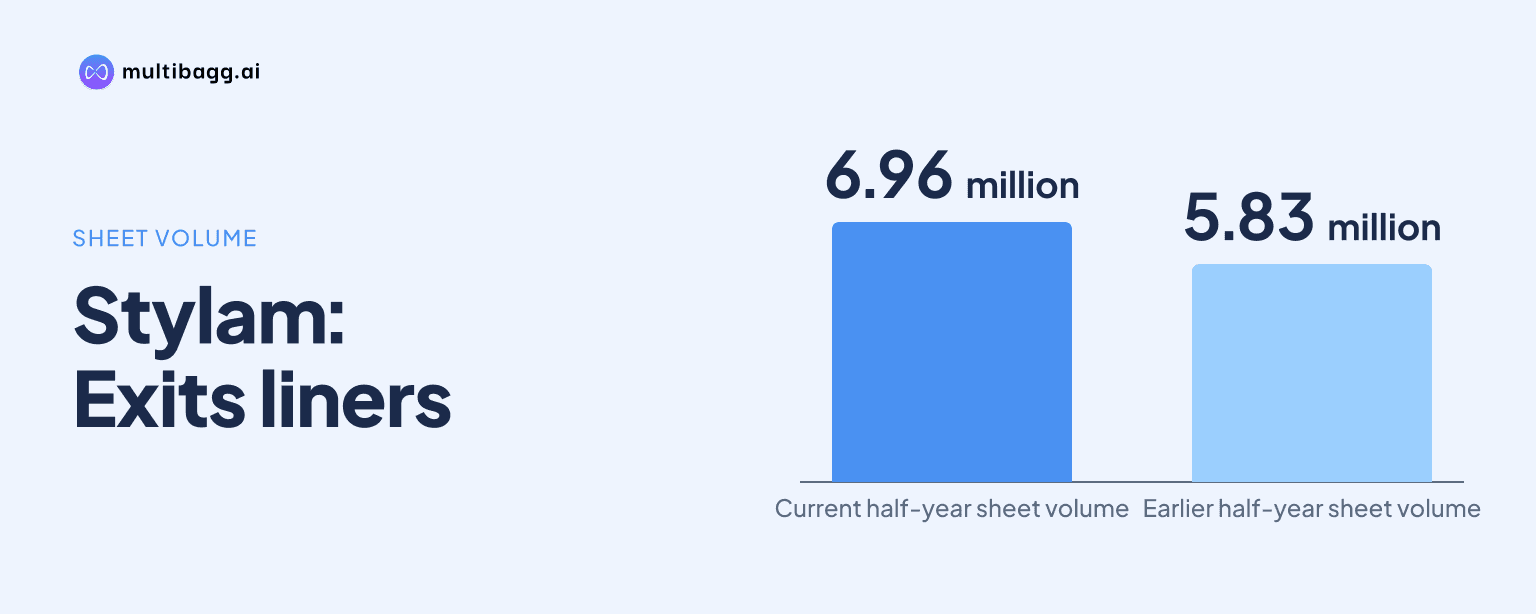
- Half-year sheet volume increased to 6.96 million from 5.83 million a year earlier.
- Ocean freight and PNG costs added Rs 11 crore of disproportionate expense in Q2 FY27.
powered by IRIS
Stylam Industries Limited stopped selling about 300,000 liner sheets a month in India to shift its domestic business toward value-added products, management said on November 4, 2026. Stylam expects gradual improvement in Q3 FY27 and a more substantial change in domestic value and volume within one to two quarters.
Know Stylam Industries inside out
Results, valuation, peers and who's buying, in one view.
Why did Stylam stop selling liner sheets in India?
Stylam stopped liner sales to move its domestic positioning away from commodity products and toward value-added laminates. Management said the company had been selling almost 300,000 liner sheets each month, but withdrew from that category because it did not want Stylam to be perceived as a “liner king.”
Management said Stylam could reopen the liner market and sell 300,000 sheets monthly immediately if it chose to do so. Instead, it is accepting lower sheet volume while seeking to maintain domestic value through a different product mix. The company did not disclose domestic revenue, realisation or margin attributable to liners.
Is Stylam’s domestic volume decline caused by weaker demand?
Stylam said the decline is primarily deliberate, reflecting its exit from liners rather than an inability to push domestic sales. An analyst asked whether lower sheet volume followed price increases, product mix changes or demand conditions, and management identified the discontinuation of commodity liners as the principal reason.
Stylam has taken some domestic price increases, although management said its domestic market share is “very less,” limiting their immediate impact. It also said the domestic business had not been progressing as intended for several years and that the revamp needed another quarter after an earlier estimate of two to three quarters.
Management did not quantify the proportion of domestic sales from premium laminates or disclose whether liners earned lower margins than the retained range. The stated mechanism is clear, however: fewer commodity sheets are being sold to change the mix, so domestic value and realisation will be more relevant measures than sheet volume alone.
When should Stylam’s domestic reset begin to show results?
Stylam expects a gradual improvement in Q3 FY27 and a larger change in domestic value and volume within one to two quarters. Management said the turnaround would not be “magic,” indicating that the sales and brand repositioning process is expected to develop progressively.
The plan also includes the acrylic solid-surface business, which management said had received little domestic or export sales focus during the past two to three years. Stylam expects the domestic laminate revamp to support acrylic surfaces within the same one-to-two-quarter timeframe, but it gave no sales, capacity-use or revenue target for that product.
Stylam’s domestic timetable is separate from the commissioning of its new plant on September 22, 2026. Two presses had started by the November 4 call, while a third was expected within two to three days and the fourth within a few days. Management expected the plant to become fully operational during November.
Got a follow-up? Ask IRIS
How does the domestic reset compare with Stylam’s export business?
Stylam’s domestic strategy contrasts with export growth, where management is seeking new markets and additional high-pressure laminate product segments. Half-year volume rose to 6.96 million sheets from 5.83 million sheets a year earlier, an increase of 1.13 million sheets, with little contribution from the new plant because it began operating only on September 22.
Export realisation increased when measured by weight, according to management. Stylam said export realisation was Rs 191 per kilogram in Q2 FY27, compared with an average Rs 161 per kilogram in the prior year and Rs 186 per kilogram in Q1 FY27. Management said kilograms are a more representative measure than sheets because the mix includes thin laminates and compact laminates.
Export shipments faced vessel availability and freight constraints in the Middle East and Europe. Management estimated that Q2 export sales could have been 2% to 3% higher without those disruptions, while adding that conditions had improved from worse to better by the November 4 call.
Can higher-value products replace Stylam’s lost liner volumes?
Stylam’s plan is for value-added products to preserve domestic value while replacing discontinued liner volumes, but management has not set a quantified replacement target. It said domestic value would remain the same despite the reduction in sheets, making future revenue mix and realisation disclosures central to assessing the strategy.
The new four-press plant may support the broader product strategy. Management expects Rs 250 crore to Rs 300 crore of turnover from the facility in FY27 despite freight and vessel constraints affecting some export markets. It said direct costs, rather than a large rise in fixed costs, would be the main additional cost associated with the new plant.
Management said the new plant’s maintenance cost should be almost nil for its first one to two years because it uses newer equipment. It did not provide a standalone margin target for the plant or the domestic premium portfolio, citing raw-material, energy and ocean-freight conditions.
What cost pressures are affecting Stylam during the transition?
Stylam said ocean freight and piped natural gas, or PNG, added Rs 11 crore of disproportionate expense in Q2 FY27. Ocean freight accounted for Rs 8.15 crore and PNG for Rs 2.5 crore, while the balance of the increase in other expenses was linked to higher production and sales volumes.
Management said energy and freight costs represented about 3% to 3.5% of margin pressure. It described Q2 operational margin as above 18%, but did not give a forward margin forecast because crude-linked raw-material prices, fuel costs and shipping conditions remained uncertain.
Conclusion
Stylam’s lower domestic sheet volume is a stated strategic trade-off rather than simply a demand indicator. By removing roughly 300,000 monthly liner sheets from its sales mix, Stylam is attempting to alter its domestic brand position and rely more on value-added products, while exports delivered a 1.13 million-sheet half-year increase.
The next evidence point is Q3 FY27, when management expects gradual domestic improvement and all four new presses to be operating after the September 22, 2026 commissioning. The key disclosures to watch are whether domestic value holds as management expects, whether premium volumes replace liners, and whether acrylic surfaces also improve within the stated one-to-two-quarter period.