










Stylam Freight and Fuel Cut Q2 FY27 Profitability 3-3.5%
Key highlights
- Stylam said ocean freight cost Rs 8.15 crore and PNG cost Rs 2.5 crore in Q2 FY27.
- Management estimated freight and fuel reduced Q2 FY27 profitability by about 3-3.5 percentage points.
- First-half sheet volume rose to 6.96 million sheets from 5.83 million sheets a year earlier.
- The new plant started operations on September 22, 2026, with FY27 turnover targeted at Rs 250 crore to Rs 300 crore.
powered by IRIS
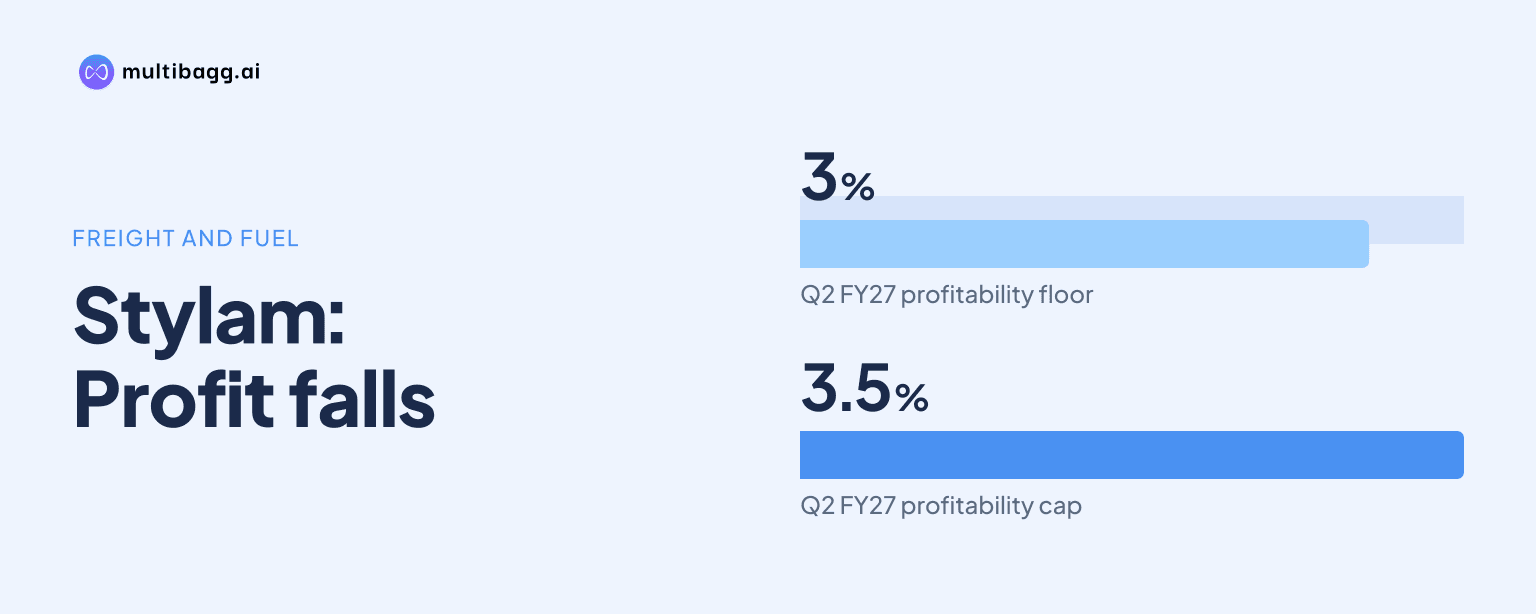
In Q2 FY27, Stylam Industries Limited said ocean freight and fuel inflation reduced profitability by about 3-3.5 percentage points, including Rs 8.15 crore of ocean-freight cost and Rs 2.5 crore of piped natural gas cost. Management described the quarter’s earnings before interest, tax, depreciation and amortisation margin as 18 point something percent.
Know Stylam Industries inside out
Results, valuation, peers and who's buying, in one view.
How much did freight and fuel cut Stylam’s Q2 FY27 profitability?
Stylam said higher ocean freight and energy costs reduced Q2 FY27 profitability by about 3-3.5 percentage points. Management identified ocean freight and fuels including pet coke, coal and gas as the main factors, and did not identify another exceptional cost item. It declined to provide an EBITDA margin outlook because crude-linked input prices and war-related shipping conditions were changing day by day.
The separately quantified Q2 FY27 costs were Rs 8.15 crore for ocean freight and Rs 2.5 crore for piped natural gas, or PNG. Together, those costs total Rs 10.65 crore, while management referred more broadly to about Rs 11 crore of disproportionate freight and fuel expense. The difference reflects rounding in management’s explanation rather than a separately disclosed cost category.
Stylam said its EBITDA margin was 18 point something percent after including export incentives recorded in other income as operational income. An analyst had calculated a 17% margin by excluding that income, while another analyst referred to about 21% in Q1 FY27 and roughly 19-20% in earlier periods. Management did not endorse a fixed near-term margin level amid fuel and freight volatility.
Why did Stylam’s other expenses rise in Q2 FY27?
Stylam said other expenses rose mainly because of ocean freight, fuel and costs linked to higher production and sales. An analyst cited other expenses of Rs 77 crore in Q2 FY27, compared with Rs 58 crore in Q1 FY27, a sequential increase of Rs 19 crore. Management said about Rs 11 crore was disproportionate freight and fuel expense, with the remaining increase moving with volumes.
Shipping disruption also constrained sales execution in Q2 FY27. Stylam said containers were unavailable and vessels were skipped on routes serving the Middle East and Europe, limiting dispatches despite export orders. Management estimated export sales could have been 2-3% higher without the disruption, although it did not quantify the associated revenue amount.
Stylam said container availability had moved from “worse to better” by the time of the call, but did not say conditions had normalised. Management said Middle East revenue had not yet been affected, while warning that a renewed disruption to seaports or shipping could affect Indian suppliers generally. That unresolved logistics risk was why Stylam did not attach a date to any possible freight-cost relief.
Did export growth offset Stylam’s cost inflation?
Stylam’s first-half sheet volume rose to 6.96 million sheets from 5.83 million sheets in the prior-year half, an increase of 1.13 million sheets. Management said the newly commissioned plant made little contribution to that increase because it started operations only on September 22, 2026. The volume comparison therefore largely reflects output before the new capacity ramp-up.
Export realisation was Rs 191 per kilogram in Q2 FY27, compared with Rs 186 per kilogram in Q1 FY27 and an average Rs 161 per kilogram in the prior year, according to management. Stylam said realisation per kilogram is more useful than per sheet because thin laminates and compact laminates differ in weight and value. It said kilogram-based data would be included in presentations from Q3 FY27.
Stylam said export price increases were difficult because it competed with organised manufacturers and local unorganised Indian suppliers. Its response was to pursue volumes, new markets and product segments within high-pressure laminates, or HPL, rather than rely on broad pricing action. Management said domestic price increases had been taken, but domestic market share remained comparatively small.
Got a follow-up? Ask IRIS
Can the new plant improve Stylam’s cost absorption?
Stylam’s new plant became operational on September 22, 2026, with two presses running by the earnings call. Management said a third press would start within two to three days and a fourth within a few days, making the plant fully operational within that month. It said the plant makes products Stylam already manufactures, so any initial production issues should last weeks rather than six months or a year.
Management expects Rs 250 crore to Rs 300 crore of turnover from the new plant in FY27, despite constraints on export shipping. It targets utilisation of about 25-30% in FY27 and more than 60-70% in FY28. These are management targets, and management linked their delivery to market conditions, export logistics and geopolitical developments.
Stylam said fixed-cost growth from the plant should not be substantial because it is at the same location, while direct costs will rise with output. Q2 FY27 depreciation from the plant was limited because operations began on September 22. Management also said the new equipment should require very low maintenance for one to two years, although it did not quantify a maintenance-cost saving.
What is Stylam changing in domestic and acrylic surfaces businesses?
Stylam said it is revamping domestic laminate operations and expects the process to take another one to two quarters, with changes expected in Q3 and Q4 FY27. It has stopped selling commodity liner products that previously accounted for almost 300,000 sheets a month. Management said the shift is intended to reposition Stylam toward value-added products rather than maximise commodity sheet volume.
Management said domestic volume may therefore decline even if sales value is maintained during the transition. Stylam said it could resume sales of about 300,000 liner sheets a month immediately, but has chosen not to do so while changing its domestic market positioning. It expects gradual, rather than immediate, improvement in domestic value and volume over the next one to two quarters.
For solid acrylic surfaces, a business started in 2019-20, Stylam said it is effectively restarting its commercial effort after limited focus on domestic and export sales in recent years. Management expects a change in domestic and export activity within one to two quarters but provided no revenue target. Discussions with Aica, which joined on June 15 or 16, remained ongoing after about four months, with no specific commercial opportunity disclosed.
Conclusion
Stylam’s Q2 FY27 margin pressure was primarily a measurable freight and fuel event, with Rs 8.15 crore of ocean-freight cost and Rs 2.5 crore of PNG cost contributing to a management-estimated 3-3.5 percentage-point profitability effect. At the same time, first-half volume increased to 6.96 million sheets from 5.83 million sheets, and export realisation reached Rs 191 per kilogram in Q2 FY27.
The next milestones are the new plant’s ramp-up after its September 22, 2026 start and management’s FY27 turnover target of Rs 250 crore to Rs 300 crore at 25-30% utilisation. Management also expects domestic revamp measures to begin showing in Q3 and Q4 FY27, while vessel availability, fuel costs and the estimated 2-3% of constrained export sales remain unresolved factors.