










Stylam Industries Limited targets Rs 250-300 crore from new plant
Key highlights
- Stylam targets Rs 250-300 crore of FY27 turnover from its new plant.
- The new plant became operational on September 22, 2026, with four presses expected to be running in November.
- Management targets 25%-30% new-plant utilisation in FY27 and 60%-70% plus in FY28.
- Ocean freight cost Stylam Rs 8.15 crore in the September quarter, while PNG added Rs 2.5 crore.
powered by IRIS
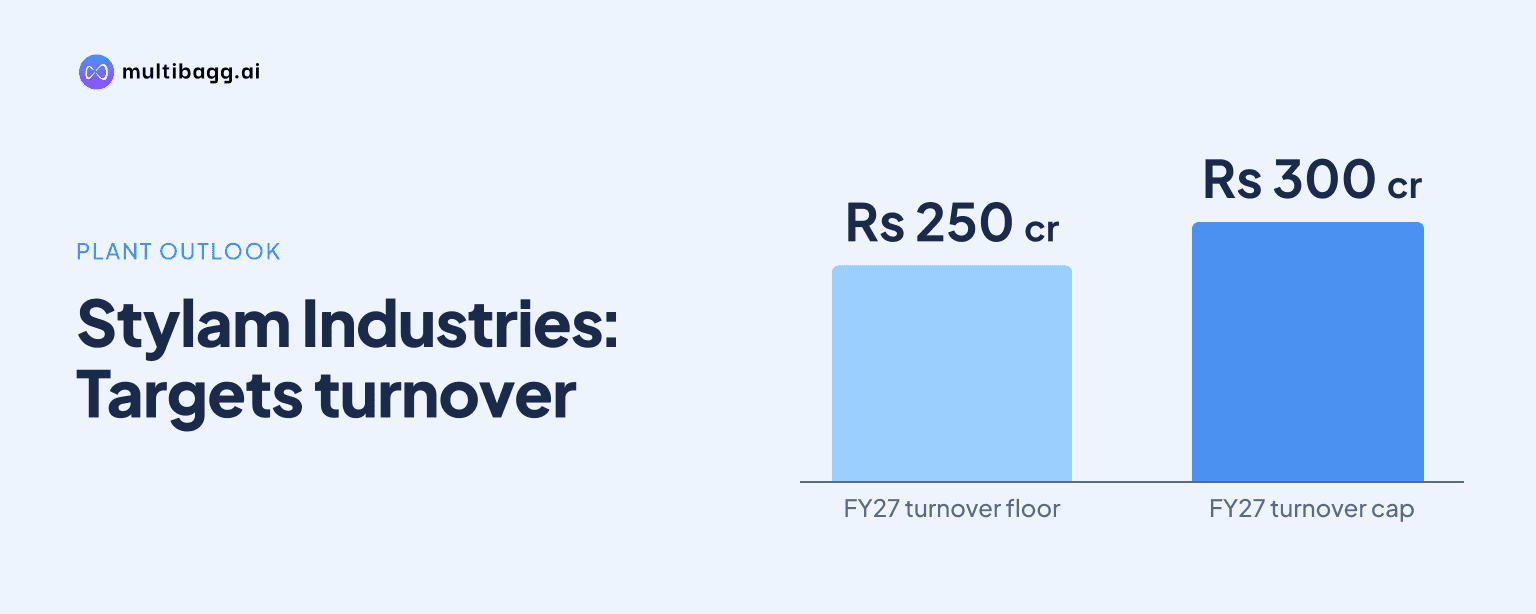
Stylam expects Rs 250-300 crore of FY27 turnover from its new plant, which became operational on September 22, 2026, despite vessel shortages and higher ocean freight affecting shipments to the Middle East. Management said two presses were already running and the remaining two were due to start within days of the November 4 earnings call.
Know Stylam Industries inside out
Results, valuation, peers and who's buying, in one view.
What is Stylam's new plant revenue target for FY27?
Stylam targets Rs 250-300 crore of FY27 turnover from the new plant, based on export orders already in hand. Management said the plant was being brought online press by press: two presses had started, the third was expected within two or three days, and the fourth within a few more days. It expected the facility to be fully operational during November 2026.
The revenue target is qualified by logistics constraints rather than a stated lack of demand. Management said it had export orders but was facing non-availability of vessels and higher ocean freight for Middle East destinations because of the war situation. Stylam did not disclose the value of its order book, the plant's total capacity, or a month-by-month sales forecast for the Rs 250-300 crore target.
Management also said the current-year target of 25%-30% utilisation would be followed by 60%-70% plus utilisation in FY28. This indicates that Stylam's FY27 revenue expectation reflects an initial ramp-up rather than full use of the facility. Stylam did not provide a corresponding FY28 revenue target, so the relation between the FY28 utilisation objective and turnover remains undisclosed.
When did Stylam's new plant start production?
Stylam's new plant became operational on September 22, 2026, which meant only limited depreciation from the facility appeared in the September-quarter accounts. The chief financial officer said production had started on two presses, while two more were still in the pipeline at the time of the November 4 call. Remaining capital work included items related to those presses, exterior walls, roads and other site improvements.
Management described the facility as the largest and most advanced plant, but did not quantify its installed capacity, capital expenditure or expected unit-cost reduction. It said there should not be prolonged teething issues because the plant makes the same products Stylam already produces. Management nevertheless allowed for a few weeks of stabilisation after all presses begin operating, rather than projecting an immediate full-scale ramp.
Stylam said fixed-cost additions from the plant should not be substantial because it is at the same location, while direct costs would rise with production. It also said maintenance costs at the new plant could be almost zero for its first one or two years because the machinery is new. These are management expectations, not reported savings in the September 2026 quarter.
How are Middle East shipping problems affecting Stylam?
Stylam said Middle East shipping disruption is delaying export execution through vessel shortages, skipped services and higher ocean freight, although it had not yet seen a direct revenue impact in the wider Middle East market. Management cautioned that a renewed escalation or closure affecting regional sea routes could affect all Indian suppliers, rather than Stylam alone.
The company estimated that container and shipping constraints reduced potential export sales in the September quarter by about 2%-3%. Management said the issue was not solely the cost of freight: containers from both the Middle East and Europe were harder to obtain, and multiple vessels had skipped India. It characterised the shipping situation as improved from worse to better, without saying that it had normalised.
Stylam quantified disproportionate September-quarter cost pressure at Rs 8.15 crore from ocean freight and Rs 2.5 crore from piped natural gas, or PNG. Together, that is Rs 10.65 crore, which management rounded to Rs 11 crore. It said the balance of higher other expenditure moved broadly with greater production and sales volumes, rather than representing a separate exceptional cost.
Got a follow-up? Ask IRIS
What changed in Stylam's export volumes and realisations?
Stylam reported first-half volume of 6.96 million sheets, up from 5.83 million sheets in the corresponding prior-year half, an increase of 1.13 million sheets. Management said the new plant made little contribution to that first-half volume because it started operations only on September 22. This means the reported volume increase was generated mainly by the pre-existing manufacturing base.
Management argued that export realisation per kilogram is a more suitable measure than realisation per sheet because the product mix includes thin laminates and compact laminates. It said export realisation was Rs 191 per kg in Q2 FY27, compared with Rs 186 per kg in Q1 FY27 and Rs 161 per kg in the prior-year average cited on the call. By that measure, Q2 realisation was about 19% higher than the prior-year average, even though an analyst calculated only a 1% year-on-year rise per sheet.
Export volume growth is being pursued across additional markets and product segments in high-pressure laminates, or HPL. Management linked the export opportunity partly to higher energy, labour and raw-material costs for European and other overseas manufacturers. However, it declined to set a future export growth rate, citing global uncertainty and competition from both organised companies and Indian unorganised producers.
Can Stylam protect margins while the plant ramps up?
Stylam said it would seek to maintain at least its current contribution-margin level while the new plant ramps up, but it gave no EBITDA margin guidance amid volatile crude-linked inputs and logistics costs. Management said the reported EBITDA margin was 18%-plus when export incentives recorded under other income were treated as operational income, rather than the 17% figure calculated by the analyst after subtracting other income.
The comparison across recent quarters shows the pressure management identified: an analyst cited about a 300-basis-point sequential decline in margin, while management attributed almost 3%-3.5% to energy and freight costs. A basis point is one-hundredth of a percentage point. Management did not provide a timetable for recovering that impact, saying crude prices, raw-material prices and the war situation were changing day by day.
Stylam said it has taken some domestic price increases, but described its domestic market share as limited and export-wide price increases as difficult. Its stated response is to focus on volume growth and the bottom line rather than assume complete cost pass-through. Management also expects operating efficiencies and economies of scale from the new plant as utilisation rises, but did not quantify either benefit.
Conclusion
Stylam's disclosed FY27 objective is a Rs 250-300 crore revenue contribution from a plant that began operating on September 22, 2026 and is targeted to reach 25%-30% utilisation this year. The ramp is supported by export orders and first-half volume growth to 6.96 million sheets, but its pace is constrained by container availability, skipped vessels and higher freight for Middle East shipments.
The next items to watch are completion of all four presses during November 2026, progress toward the 25%-30% FY27 utilisation target and management's 60%-70% plus FY28 objective. Middle East shipping conditions also remain material after Stylam estimated Rs 8.15 crore of ocean-freight pressure and a 2%-3% lost export-sales opportunity in the September quarter.