










Styrenix cuts GPPS risk as HIPS OEM demand supports sales
Key highlights
- Styrenix reported standalone Q2 FY27 sales volume of 43.4 KT and said lower GPPS volume was a deliberate management decision.
- More than 70% to 80% of Styrenix's 35,000-to-40,000-tonne HIPS capacity is fulfilled by OEM demand.
- Styrenix reported standalone Q2 FY27 EBITDA of Rs 84.5 crore, up 3.3% year on year, on total income of Rs 781 crore.
- Styrenix estimates annual Indian imports of refrigeration-liner ABS at roughly 30,000 to 40,000 tonnes.
powered by IRIS
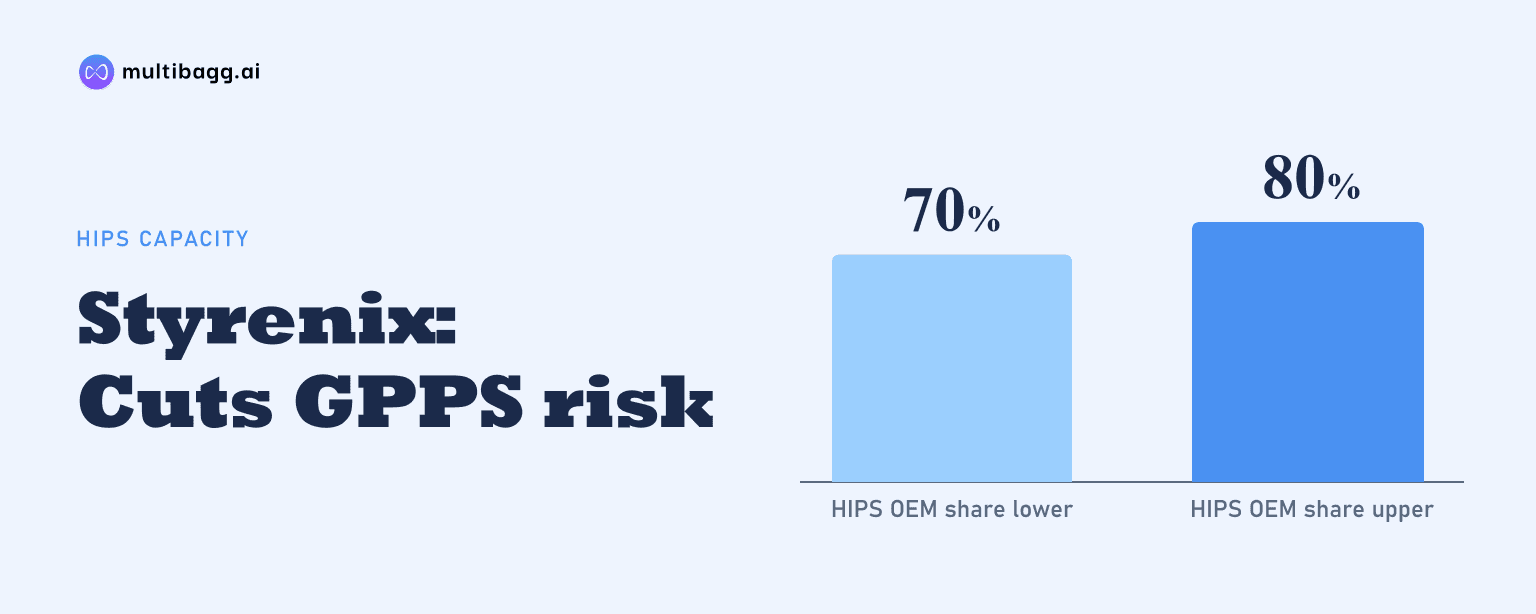
In Q2 FY27, Styrenix Performance Materials Limited intentionally reduced general-purpose polystyrene sales where styrene purchases were speculative, while more than 70% to 80% of its 35,000-to-40,000-tonne high-impact polystyrene capacity served original equipment manufacturers. Management said formula-driven HIPS business has a different exposure to input-cost volatility.
Know Styrenix Performance Materials inside out
Results, valuation, peers and who's buying, in one view.
Why did Styrenix reduce GPPS sales in Q2 FY27?
Styrenix reduced participation in selected general-purpose polystyrene, or GPPS, volumes in Q2 FY27 because it viewed styrene monomer purchases made in Q1 FY27 for those sales as highly speculative. Managing Director Rahul R. Agrawal said the foregone sales were mainly non-OEM demand, based on spot transactions and unorganised markets. ABS volumes rose significantly in Q2, but GPPS volumes fell as a result of this management decision.
The decision followed concerns about styrene supply from sources the company had historically used during H1 FY27. Management said GPPS has only a very small OEM-driven component in its portfolio, with limited scope to increase that share because the product is commoditised. That leaves a larger part of GPPS exposed to uncertain spot demand when raw-material prices or availability move before finished-goods sales are secured.
Styrenix did not disclose the tonnes of GPPS business it chose not to serve, or GPPS-specific revenue and profitability. Its standalone sales volume was 43.4 KT, or thousand tonnes, in Q2 FY27, and management identified the deliberate GPPS reduction as a contributor to the quarter's product mix. The company said its continuing approach is not to take aggressive raw-material positions when eventual GPPS demand is uncertain.
Why does Styrenix manage HIPS differently from GPPS?
Styrenix manages high-impact polystyrene, or HIPS, differently because a larger share is linked to OEM applications and formula-driven pricing arrangements. Management cited air conditioners, refrigerators and some packaging as HIPS end uses. It said this structure allows supply-chain cost changes to be passed through to customers, unlike much of the spot-led GPPS business.
More than 70% to 80% of Styrenix's 35,000-to-40,000-tonne HIPS capacity is now fulfilled by OEM demand, according to management. Before Styrenix took management control, OEM penetration in HIPS was extremely low because required grades had not been developed and supplies to those customers had not been consistent. Management said improving grade availability and supply consistency has changed the HIPS customer mix.
The distinction is therefore based on the route to market rather than solely on the two polystyrene grades. Styrenix said HIPS should remain “as usual” despite the uncertainty affecting GPPS, because OEM-led demand supports cost pass-through. It also said the greater OEM share could allow the company to realise additional earnings before interest, tax, depreciation and amortisation, or EBITDA, value from HIPS over time, without quantifying that potential.
How did supply disruption affect ABS and quarterly results?
Styrenix said a major supply-chain disruption made Q1 FY27 exceptional for acrylonitrile butadiene styrene, or ABS, volumes, but alternate raw-material supplies supported a recovery in Q2 FY27. These supplies carry higher costs, management said, but those costs can be passed on to ABS customers. It described Q2 ABS activity as back to a normalised basis, while the lower GPPS contribution affected the overall mix.
Standalone Q2 FY27 income rose faster than EBITDA and profit after tax on a year-on-year basis. Management did not provide a GPPS margin figure or quantify the financial effect of the sales it declined. The reported results cover the whole standalone business and should not be read as a separate measure of either the GPPS or HIPS strategy.
Q2 FY27 standalone total income increased 26.5% year on year, while EBITDA increased 3.3% and profit after tax increased 0.8%. For H1 FY27, total income grew 15.8%, EBITDA grew 70% and profit after tax grew 78.4%. The H1 EBITDA margin was 18.4%, compared with 10.8% in Q2 FY27, though the periods are not directly comparable because H1 includes two quarters.
Got a follow-up? Ask IRIS
What is Styrenix expecting for GPPS and ABS volumes?
Styrenix expects H2 FY27 ABS volumes to be in line with Q2 FY27, unless another unusual disruption occurs. Management said Q1 FY27 volumes were lower because of the supply-chain event, while alternate sourcing now gives it greater certainty that material can be procured. It added that non-OEM ABS demand had partly normalised despite elevated finished-goods and raw-material prices.
GPPS remains the less certain volume category because the same supply and spot-market risks continue. Management said it will continue to avoid speculative styrene buying where sales demand is not sufficiently secured. It gave no volume guidance for FY27 or FY28, but said that excluding the disrupted Q1 FY27, Indian operations were again running relatively full on the capacities then available.
Consolidated Q2 FY27 sales volume, including India and Thailand, was 55.1 KT, compared with standalone volume of 43.4 KT. Consolidated total income was Rs 997 crore, EBITDA was Rs 75.6 crore and profit after tax was Rs 23 crore. These consolidated figures include Thailand and do not isolate the India-focused GPPS and HIPS decision.
How could ABS expansion broaden Styrenix's product range?
Styrenix expects Phase 1 of its expansion plan to come on stream during the current financial year and says it will add capability for specific ABS grades. Management identified refrigeration-liner ABS as a grade historically unavailable from local Indian producers. It estimated India's total ABS market at 3.5 lakh to 4 lakh tonnes, including roughly 30,000 to 40,000 tonnes of refrigeration-liner ABS imports.
Management said Phase 1 capacity will be smaller than the relevant import opportunity, but should enable Styrenix to serve part of that market. Technology acquired through the Thailand business and the new Indian capacity could also help address customers of Korean or Japanese origin that have historically bought from overseas suppliers. Management described technology and supplier positioning as separate factors in winning that business.
Styrenix also said it is proceeding with Phase 2 of the ABS expansion under its original plan, without disclosing a completion date. Management expects the first new capacity to reach fairly high utilisation within a short period of commissioning, but this was an expectation rather than formal volume guidance. The company said Phase 2 work would have started by the time Phase 1 comes online.
Conclusion
Styrenix's Q2 FY27 approach separates a commodity-oriented GPPS channel from HIPS business with more OEM-linked demand. The company accepted lower GPPS volume rather than expose itself to speculative styrene purchases, while its HIPS capacity had more than 70% to 80% OEM participation and formula-driven mechanisms for handling cost changes.
The next matters to watch are Phase 1 commissioning during the current financial year, the planned progress of Phase 2, and whether alternate ABS raw-material sourcing remains dependable in H2 FY27. Management expects ABS volumes in the second half to align with Q2 FY27 levels, but has kept GPPS participation conditional on styrene availability and spot-market conditions.