










Styrenix Plans Local ABS for 30,000-Tonne Import Market
Key highlights
- Styrenix estimates Indian refrigeration-liner ABS imports at roughly 30,000 tonnes annually.
- Styrenix said local liner-grade ABS must be produced before customer validation and approval can begin.
- Management expects the Nandesari, Katol and Moxi expansions to align within about one quarter.
- Styrenix said historical ABS sales rose from 60,000 tonnes to about 110,000 tonnes within its first couple of years of management control.
powered by IRIS
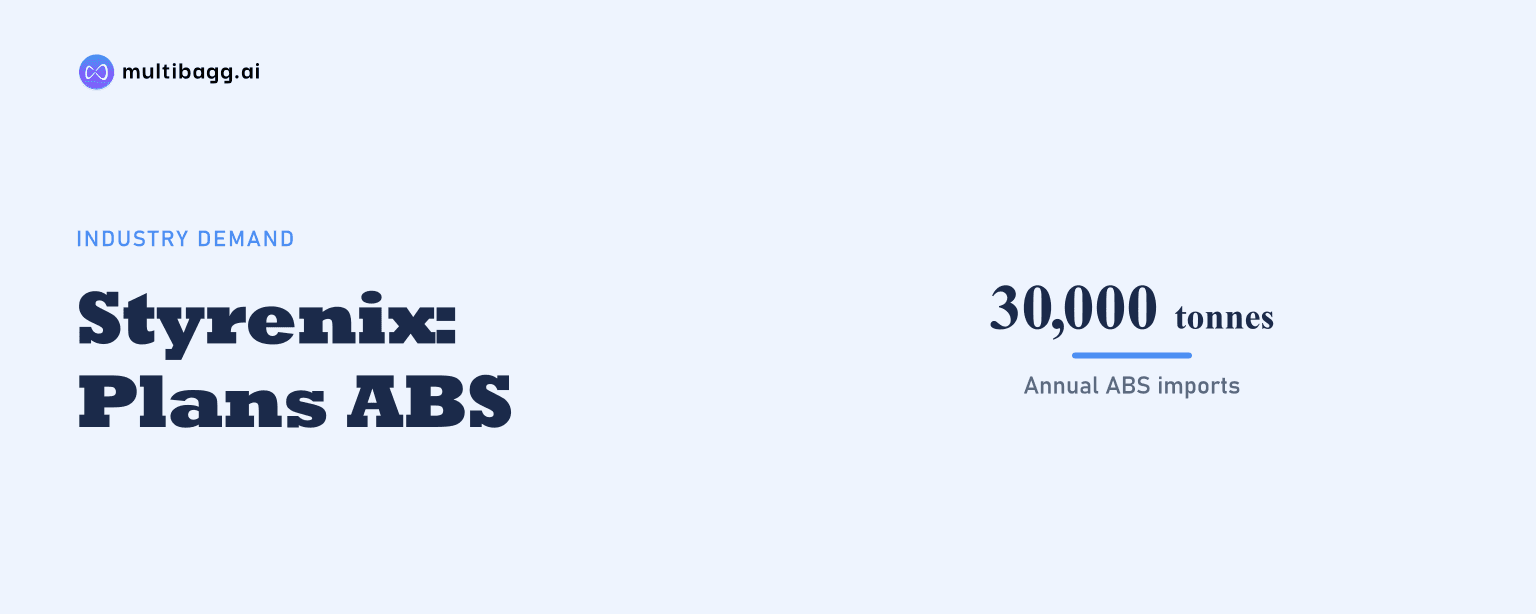
Styrenix Performance Materials Limited plans to make refrigeration-liner acrylonitrile butadiene styrene, or ABS, in India for a market importing roughly 30,000 tonnes annually, but sales to individual customers will begin only after the new plant produces the grade and customers validate it. The project uses elements of technology already available in Thailand.
Know Styrenix Performance Materials inside out
Results, valuation, peers and who's buying, in one view.
How large is Styrenix’s refrigeration-liner ABS opportunity?
Styrenix estimates that India imports about 30,000 tonnes of refrigeration-liner ABS a year. Management corrected an analyst’s estimate of 40,000 to 50,000 tonnes and said the opportunity is linked to the refrigeration industry, which management described as growing well.
The 30,000-tonne figure covers a specific ABS application rather than Styrenix’s entire ABS market. Management said companies are interested in local supply because they currently depend on imported refrigeration-liner ABS, while adding that the addressable market should grow alongside the refrigeration industry.
Styrenix separately described its available ABS sales potential in the existing market. Management said that when sales were about 9,000 to 9,500 tonnes, it believed another 2,000 to 3,000 tonnes could be sold if product were available, although it did not provide formal volume guidance for the expansion.
What technology will Styrenix use for local liner-grade ABS?
Styrenix will incorporate parts of its Thailand technology into additional Indian capacity to manufacture the refrigeration-liner ABS grade. Management clarified that the product being discussed is ABS, not high-impact polystyrene, or HIPS, although refrigeration-liner grades also exist in HIPS.
The company said it had worked on the product development side for several years and had identified a technology disconnect between its Indian production and the process available in Thailand. The planned technology incorporation is intended to allow local production of grades now imported by Indian customers.
Styrenix did not disclose a capacity allocation for refrigeration-liner ABS, a separate selling-price assumption or a margin target. Management instead said it was prudent to assume a product mix broadly similar to the historical mix, with operating leverage, competitive pressures and new products potentially offsetting one another in absolute spreads.
The liner-grade capability is part of a wider programme across three facilities. Styrenix is expanding the Nandesari rubber plant, the Katol styrene acrylonitrile, or SAN, plant, and the Moxi compounding facility, with management aiming to bring the capacities into operation at broadly similar times.
When can Styrenix sell locally made liner-grade ABS?
Styrenix can pursue customer approvals only after its added Indian capacity is operating and has produced the liner-grade ABS locally. Management said the validation sequence requires local production first, followed by customer testing and approval.
An analyst suggested that validation might require five to six months, but management did not endorse a fixed period. Management said timing varies among original equipment manufacturers, or OEMs, and other customers, and that it does not believe the process necessarily needs a full year.
The approval requirement is specific to the new liner grade. Management said Styrenix already has approved products in other imported-product segments and could sell those products immediately when additional capacity becomes available, meaning the broader expansion does not depend entirely on liner-grade approvals.
Management made two comments on domestic competition that leave the existing supply position unclear. It first said no competitor was supplying the ABS liner product, then said a local Indian producer has an approved grade in this space; the call did not reconcile the two statements or disclose market shares.
Got a follow-up? Ask IRIS
How quickly could Styrenix use the new capacity?
Styrenix expects its three expansion projects to come online broadly together, although management allowed for lags of a couple of months and an overall difference of about one quarter. It did not provide an exact commissioning month because final work can shift by 15 to 20 days and prime production determines when material becomes saleable.
Management said it was relatively confident that a large part of the new capacity would be used in the following financial year. It did not confirm an analyst’s suggested first-year utilisation range of 50% to 60%, saying it would not provide specific forward guidance.
The company’s current ABS operations provide part of the basis for that confidence. Management said Styrenix ran its ABS operations at full capacity in the second quarter after first-quarter disruptions normalised, and that it sold the product it produced.
Demand conditions were not described as uniformly expanding. Management said Indian demand in the first half was relatively flat over the year, with muted non-OEM demand in the first quarter improving somewhat in the second quarter.
What could affect Styrenix’s import-substitution plan?
Styrenix said its ability to sell and use its available ABS capacity had not changed despite import competition. Management could not quantify dumping because official import data had not been readily available after March, although it said market information indicated that some dumping had occurred.
Management said higher freight and structural costs in Korea may have reduced competitive intensity from Korean suppliers. It added that lower capacity utilisation in Taiwan, Thailand and potentially China could counterbalance that effect, leaving no major overall change in competitive intensity from Styrenix’s perspective.
Styrenix said the bulk of its ABS and HIPS business follows formula pricing, under which certain raw-material cost additions have been accepted by customers. Management contrasted this with uncontracted segments, where it has avoided speculative buying amid volatile raw-material markets.
The company also said it has actively managed general-purpose polystyrene, or GPPS, exposure by avoiding segments it considers speculative. By comparison, management said its HIPS assets were fully utilised, while ABS production in the second quarter was also running fully utilised.
Conclusion
Styrenix’s plan targets a defined 30,000-tonne annual import market through local production of refrigeration-liner ABS using elements of its Thailand technology. The opportunity is an import-substitution programme rather than an immediate replacement of imported supply because individual customers must first validate locally produced material.
The next developments to watch are commissioning across the Nandesari, Katol and Moxi projects, which management expects to align within about one quarter, and the start of customer validations after local production begins. Management expects a large part of the added capacity to be utilised in the following financial year, but has not disclosed a liner-grade capacity allocation, utilisation target or fixed validation timetable.