










Sumax capacity plan follows a 92% utilisation constraint
Key highlights
- Sumax said plants were operating at about 92% efficiency, limiting sales growth.
- Sumax plans to increase manufacturing space from 55,000 square feet to about 165,000 square feet.
- The Jhajjar facility is planned at 80,000 square feet and the Bhiwadi facility at 30,000 square feet.
- Sumax reported a Rs 9.48 crore capital advance for Jhajjar plant construction.
powered by IRIS
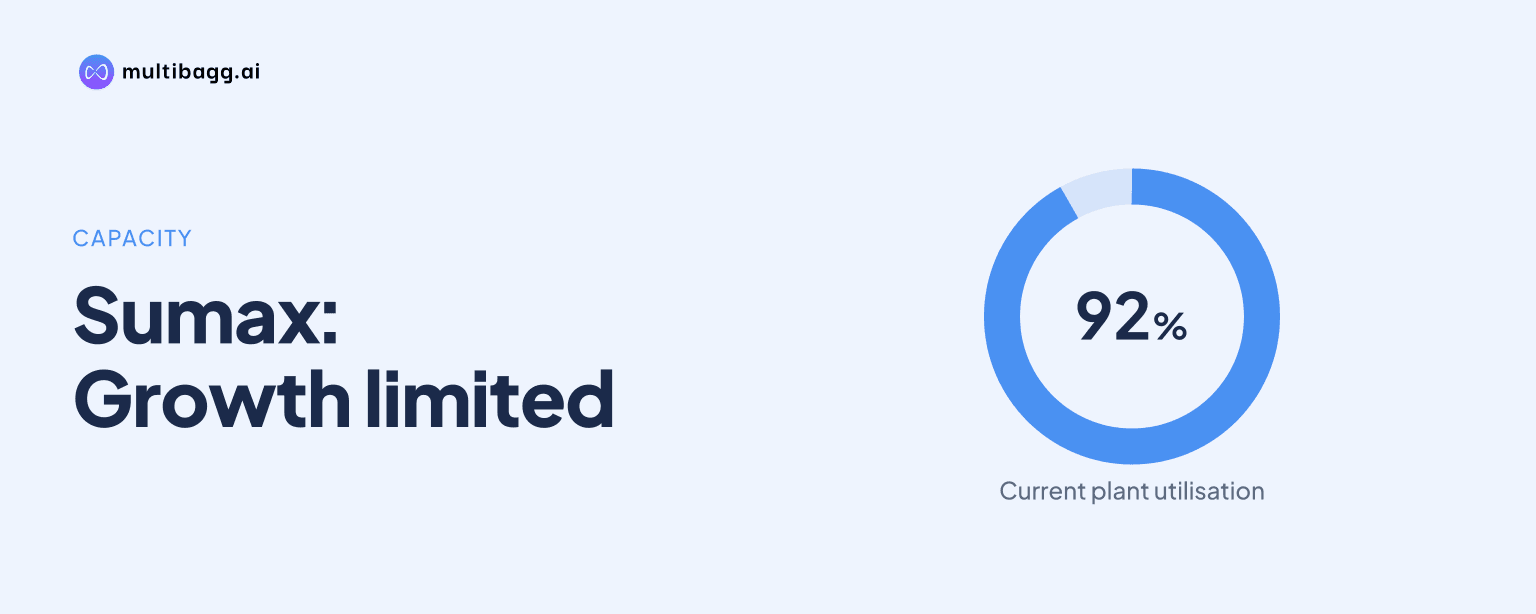
Sumax said in its H1 call that plants were operating at about 92% efficiency, constraining sales growth, and management plans to expand manufacturing space from 55,000 square feet to about 165,000 square feet. The Jhajjar facility is targeted for completion by the end of March, after which management expects capacity to support sales.
Know Sumax Engineering inside out
Results, valuation, peers and who's buying, in one view.
Why is Sumax expanding manufacturing capacity?
Sumax is expanding because management identified production capacity as the main limitation on sales, despite demand from automotive customers. In the H1 discussion, management said it had optimised available production capacity and selected products with higher returns, rather than pursuing all potential orders while plants operated at about 92% efficiency.
The immediate bottleneck includes die-cut production, where management said demand had risen and existing facilities could not meet requirements. Sumax said its products require consistent quality and that it intends to retain manufacturing in-house instead of outsourcing. The company reported that original equipment manufacturers, or OEMs, accounted for about 72% of revenue, compared with 28% from the aftermarket.
Management also said it was not accepting some orders because of current constraints. It said the expansion is intended to provide the production infrastructure needed to meet demand while preserving the quality controls required for OEM supplies. The call did not disclose the value of orders being declined or a production-volume capacity figure.
How much manufacturing space will Sumax add?
Sumax plans to increase its stated manufacturing-space base from 55,000 square feet to about 165,000 square feet. Management described an 80,000-square-foot facility at Reliance MET in Jhajjar and a 30,000-square-foot site at RIICO in Bhiwadi, together adding 110,000 square feet to the 55,000-square-foot base.
Management characterised the move as an almost 200% expansion of capacity from the 55,000-square-foot base. It said IPO proceeds were being used for the plants and working capital, with construction having begun after the IPO in September. The call did not disclose the total project cost for either site.
Sumax reported a Rs 9.48 crore capital advance to the contractor for the Jhajjar facility. Management said this amount would be capitalised into capital work-in-progress after Chartered Engineer certification and statutory obligations are completed.
When will Sumax's new capacity affect sales?
Sumax is targeting completion of the Jhajjar facility by the end of March, according to management. It said construction had progressed to casting the mezzanine-floor slab, while equipment and machinery were being ordered in stages to support commissioning.
Management said sales effects could start in April and May after the plant is completed, rather than waiting until October. It also said there could be slight sales growth through March, but linked a larger increase in revenue to the additional capacity becoming available. These comments were management expectations, not formal revenue guidance.
The Bhiwadi facility was also described as being under way, although management did not provide a separate commissioning date. Sumax said it expected approvals not to take very long after the sites were ready, citing its ISO TS certification, but it did not disclose a timetable for approvals, machinery installation or commercial production at Bhiwadi.
Got a follow-up? Ask IRIS
What will Sumax make in the expanded facilities?
Sumax said the new facilities will make its existing categories, including tapes, die-cuts and car-care products. Management plans to add stock-keeping units, or SKUs, and models within those categories rather than establish a separate product segment; it said car care alone can have 200 to 300 SKUs.
The expansion is intended principally to serve existing customers. Sumax said it works with more than 450 OEM, Tier 1 and Tier 2 customers and is not currently focused on adding many new accounts. Management said sales to a few existing companies had risen by almost 20% as their vehicle sales and model ranges increased.
Management named Maruti, Mahindra, Tata Motors, Royal Enfield, BYD, MG and JSW among customer or product-development relationships discussed during the call. It said the ability to add products for established OEM accounts is aided by the long duration of some contracts, which can continue for 10 or 15 years unless a vehicle model is phased out.
How does the capacity limit affect Sumax's performance?
Sumax said capacity constraints shaped its H1 product mix and profitability actions. When asked about a 365-basis-point increase in earnings before interest, tax, depreciation and amortisation, or EBITDA, margin, management said it had deprioritised some lower-margin orders and increased production optimisation, including hours worked, within existing capacity. A basis point is one-hundredth of a percentage point.
This strategy differs from the volume opportunity management described in India’s automotive market. Management referred to about 45 lakh cars and 2.5 crore bikes, while saying capacity was running at about 92% efficiency. Its position was that product mix could improve profitability before expansion, but materially higher sales need more manufacturing space.
Sumax said manufacturing represented about 60% of revenue and trading about 40%. For OEM supplies, management said some raw materials require 60 to 90 days of lead time and pricing is generally sought to be locked for 12 to 18 months. It cited a price increase effective from 1 April 2026 and said substantial currency movements can prompt discussions with OEM customers.
Conclusion
Sumax’s expansion plan addresses the operational limitation management identified in H1: plants operating at about 92% efficiency while some demand cannot be served. The intended rise from 55,000 to 165,000 square feet would add space for existing tapes, die-cuts and car-care products, with OEM customers representing about 72% of revenue.
The next event to watch is management’s end-of-March target for the Jhajjar facility, followed by its expectation of sales effects from April and May. Progress on machinery installation, statutory approvals and the Bhiwadi site will also matter, as management linked expected growth in 2027 and its outlook for 2028 to the new facilities becoming operational.