










Sumax lifts H1 EBITDA margin to 15.5% through OEM product mix
Key highlights
- Sumax reported H1 FY27 EBITDA of Rs 11.99 crore, up 39% from Rs 8.59 crore.
- H1 FY27 EBITDA margin increased to 15.5% from 11.9%, a reported 356-basis-point rise.
- Net profit rose 60% to Rs 8.44 crore in H1 FY27, while total income reached Rs 77.49 crore.
- Chennai and Manesar operated at about 92% utilisation, with die-cuts at 95%.
powered by IRIS
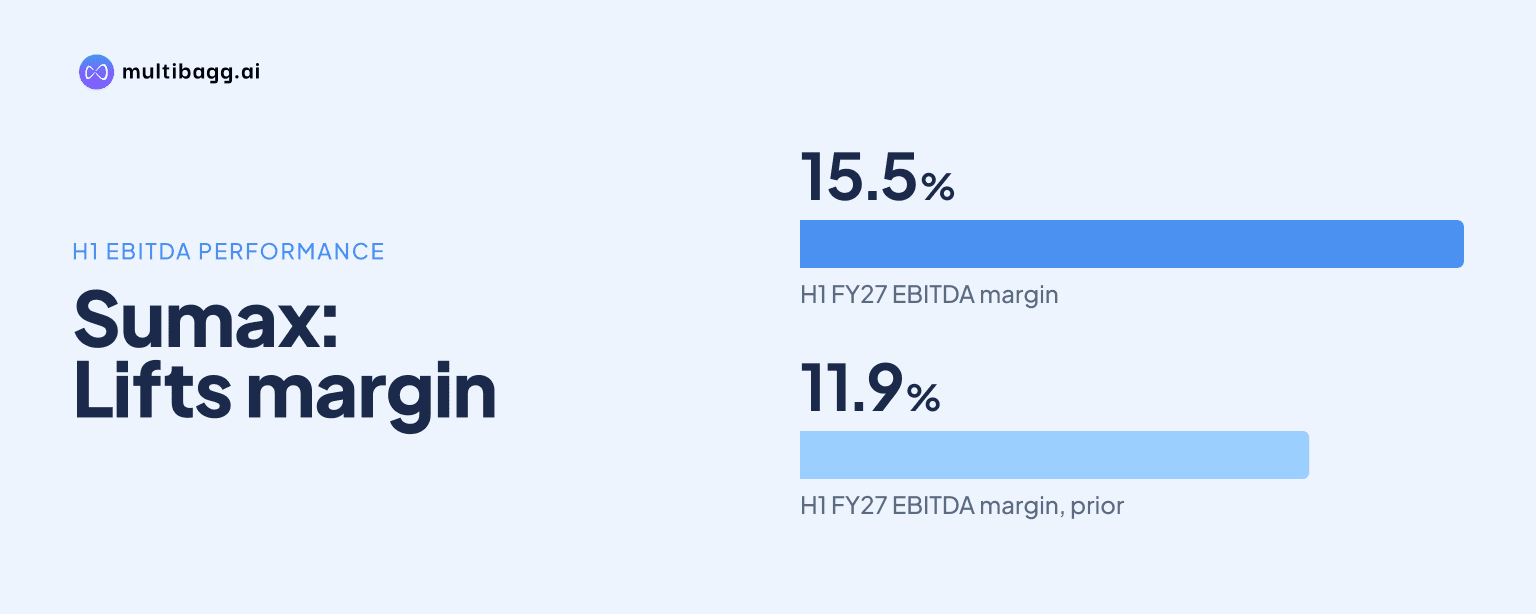
Sumax Engineering Limited lifted EBITDA margin to 15.5% in H1 FY27 ended September 30, 2026, from 11.9% a year earlier, as it used capacity running at about 92% for higher-return original equipment manufacturer products. EBITDA increased 39% to Rs 11.99 crore while total income grew about 7% to Rs 77.49 crore.
Know Sumax Engineering inside out
Results, valuation, peers and who's buying, in one view.
How did Sumax expand margins despite modest H1 revenue growth?
Sumax expanded margins by allocating limited production capacity to better-margin orders rather than pursuing all available business. Management said some lower-margin orders were not a priority because Chennai and Manesar were operating at about 92% utilisation, leaving product selection and production optimisation as the principal levers available during H1 FY27.
The result was a divergence between sales and profit growth in the half year ended September 30, 2026. EBITDA rose to Rs 11.99 crore from Rs 8.59 crore, while net profit increased to Rs 8.44 crore from Rs 5.26 crore. EBITDA margin rose 356 basis points to 15.5%, and net profit margin increased 360 basis points to 10.9%.
Management also cited maximising output from current facilities, including production hours, where possible. Earnings per share rose 24% to Rs 4.44 from Rs 3.57, reflecting the faster increase in profit than in total income. The company did not attribute the margin change to a single product or disclose a segment-level profit split.
Which parts of Sumax's business supported the higher-margin mix?
Sumax's return-focused allocation centred on OEM business, which management said represented about 72% of revenue, against 28% from the aftermarket. Manufacturing accounted for about 60% of revenue and trading for 40%, while the company said its strategic focus was on manufactured products supplied to OEM customers under auditable quality and specification requirements.
The manufactured range includes adhesive tapes, die-cuts, pre-taped masking films, rubbing and polishing compounds, buffing pads, reflective tapes, domes, graphics and car-care products. Management said Sumax has more than 3,000 stock-keeping units, or SKUs, and intends to expand sales of existing products with established demand rather than depend on an immediate move into unrelated categories.
Paint protection film, or PPF, was one product identified by management as consistent with its higher-return approach. Sumax received Tata Motors approval for PPF during H1 FY27 under a bill-to/ship-to model, and management said sales to dealerships had started. The product is offered with five-year and 10-year warranties, but Sumax did not disclose PPF revenue, profit or margin targets.
Management said the Tata Motors dealership channel could include products beyond PPF. It had sold air-conditioner disinfectant for the preceding few months and had approvals for other products to be introduced through the model. PPF testing was also under way with two additional OEMs as of the November 13, 2026 earnings call, with no approval timetable or sales forecast provided.
Got a follow-up? Ask IRIS
Why did Sumax's revenue growth remain limited in H1 FY27?
Sumax said production capacity was the main constraint on H1 FY27 sales growth, rather than a shortage of demand. Die-cuts were operating at 95% utilisation, polishing and adhesive tapes at about 92%, buffing pads at 91%, and pre-taped films at about 90%, compared with overall utilisation of about 92% at Chennai and Manesar.
Management said it had not taken some orders because of these limits and therefore prioritised revenue and profitability per unit of available capacity. That operational choice explains why total income was Rs 77.49 crore, up about 7%, while EBITDA increased 39%. Management described its 2026 focus as first addressing products that could produce better returns with limited additional output.
The company said existing customer relationships offer scope for expansion after capacity increases. Sumax serves more than 450 OEM, Tier 1 and Tier 2 customers, and management said contracts may continue for 10 years or 15 years unless a vehicle model is phased out. It cited sales rising by almost 20% to some existing customers as their model volumes increased.
When could Sumax's new plants increase sales capacity?
Sumax is targeting completion of its Reliance MET facility at Jhajjar by the end of March 2027, with management saying revenue could begin to appear after commissioning in April or May. The company is also developing a RIICO facility at Bhiwadi, Rajasthan, using initial public offering proceeds for added capacity and product development.
Management described the Jhajjar facility as about 80,000 square feet and the Bhiwadi facility as 30,000 square feet. It also described the current base as 55,000 square feet and the post-expansion footprint as about 1,65,000 square feet, characterising the project as nearly a 200% capacity expansion. The new sites are planned for existing categories including tapes, die-cuts and car-care products.
Capital deployment was under way by September 2026. The chief financial officer said Rs 9.48 crore classified as long-term loans and advances was paid to the Jhajjar construction contractor and would move to capital work in progress after chartered engineer certification and statutory requirements. Machinery and equipment ordering was also in progress.
Management said OEM customers need to audit a new facility before relying on it for production, so plant commissioning is not the only condition for the capacity ramp. It did not provide a FY28 revenue-growth target or peak-revenue estimate, calling the expansion a staged process. Sumax also said exports would be a main focus for 2027, after supplying two die-cut batches to Nissan's Egypt facility and exporting to nine countries.
Conclusion
Sumax's H1 FY27 margin expansion came from a deliberate capacity-allocation decision rather than broad-based volume growth. By prioritising higher-return OEM products and optimising plants operating at about 92% utilisation, the company lifted EBITDA 39% and net profit 60%, despite total income increasing by about 7%.
The next point to watch is management's target to complete the Jhajjar facility by the end of March 2027 and begin contributions after commissioning in April or May. Progress at Bhiwadi, OEM audits, PPF testing with two additional OEMs and the stated 2027 export push will determine how quickly constrained capacity converts into additional revenue.