










Sudarshan Pharma sets India-based API strategy for China risks
Key highlights
- India imports approximately 70% of API intermediates from China, according to Sudarshan Pharma’s presentation.
- The government identified 53 critical APIs and intermediates with high India reliance on China.
- Sudarshan Pharma says it is setting up a unit for a few critical APIs described as imported from China.
- Sudarshan Pharma lists 21 new export avenues and 10 major African markets.
powered by IRIS
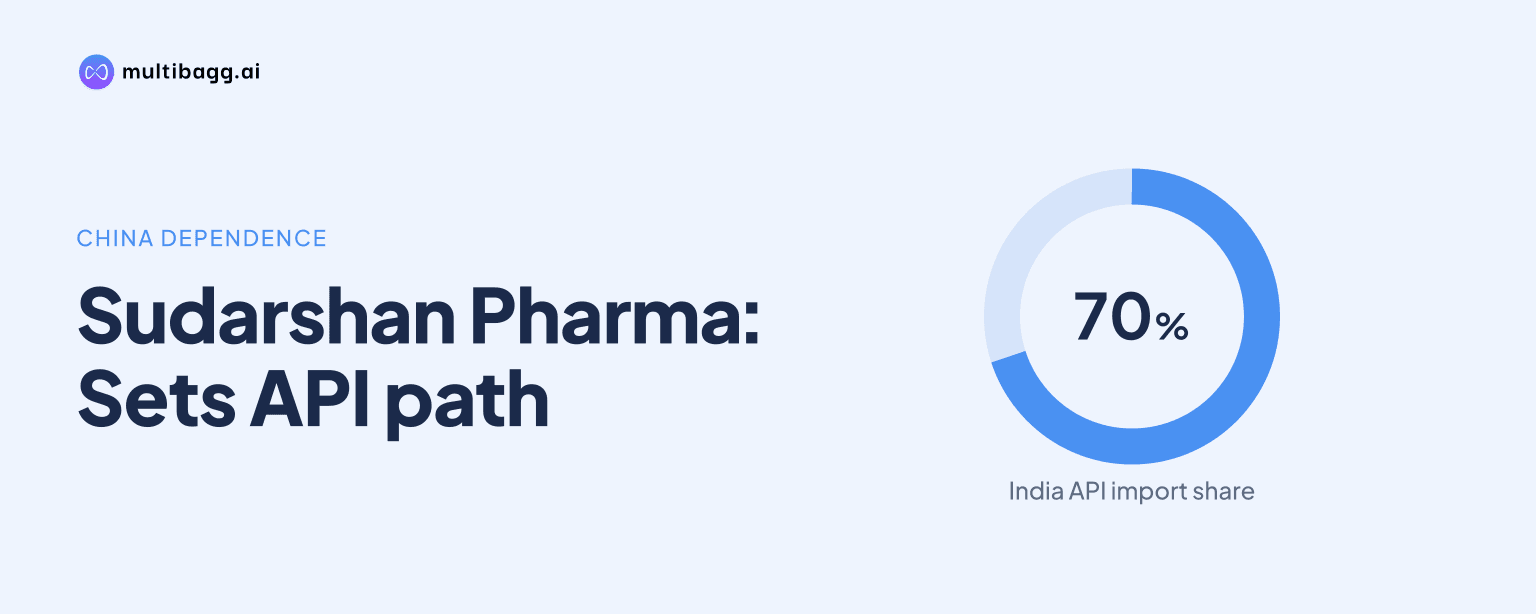
Sudarshan Pharma Industries Limited is positioning its API and intermediates business as an India-based alternative to China-linked supply chains, citing India’s approximately 70% reliance on China for API intermediates and a government list of 53 critical APIs and intermediates with high China dependence.
Know Sudarshan Pharma Industries inside out
Results, valuation, peers and who's buying, in one view.
Why is Sudarshan Pharma targeting China-linked API supply chains?
Sudarshan Pharma says China-linked sourcing creates an addressable market gap because India imports about 70% of the intermediates required for active pharmaceutical ingredients, or APIs, from China. The presentation identifies price volatility, inconsistent supply, logistics disruption, tariff uncertainty, geopolitical risk and regulatory disruption as issues for buyers of specialty-chemical raw materials, intermediates and excipients. Its positioning is therefore focused on supply diversification rather than solely on overall pharmaceutical-market growth.
The degree of China dependence differs by product category in the presentation. Imports from China are shown at 75% to 80% for antibiotics, 50% to 55% for hormones, prostaglandins, thromboxane and leukotrienes, 55% to 60% for pro-vitamins and vitamins, 80% to 85% for other heterocyclic compounds, and 70% to 75% for other organic compounds. The company also links the pandemic that began spreading in 2020 to API supply disruptions and price rises, while noting that Chinese chemical-company closures for environmental non-compliance could affect Indian API and formulation producers.
What manufacturing plan does Sudarshan Pharma disclose?
Sudarshan Pharma says it is setting up a manufacturing unit to make a few critical APIs that the presentation describes as imported from China. The disclosed plan is linked to the central government’s identification of 53 critical APIs and intermediates where India’s dependence on China is high, most of which are used for essential medicines. The presentation does not specify the unit’s location, capacity, investment, commissioning date or the individual APIs selected.
The policy context cited by Sudarshan Pharma totals approximately Rs 10,000 crore earmarked for the bulk-drug industry. That includes Rs 3,000 crore for promoting bulk-drug parks over the next five years and Rs 6,940 crore for a production-linked incentive scheme supporting domestic manufacturing of critical key starting materials, drug intermediates and APIs over the next eight years. The company presents this policy framework as an opportunity for domestic production, but it does not disclose whether its planned unit has received an incentive or park-related support.
How does Sudarshan Pharma propose to serve regulated markets?
Sudarshan Pharma says its offering combines specialty chemicals, advanced intermediates, APIs and excipients manufactured and sourced in compliance with Indian Pharmacopoeia, British Pharmacopoeia and United States Pharmacopeia standards. The presentation frames documentation, transparency, technical support, on-time delivery and regulatory readiness as operating mechanisms intended to support customers serving regulated markets. It does not provide product-specific approvals, audit outcomes or market-by-market regulatory registrations.
The company’s stated customer proposition includes predictable pricing, supply-chain resilience, tariff and geopolitical-risk mitigation, and long-term supply contracts. These are company-stated objectives rather than reported operating results. The presentation contrasts China-related risks, including long lead times and frequent rate fluctuations, with its proposed India-based compliant manufacturing and sourcing model. It also says compliance documentation could support faster regulatory approvals, although it supplies no approval timelines or comparison data.
Got a follow-up? Ask IRIS
Which export markets and customers are in Sudarshan Pharma’s focus?
Sudarshan Pharma lists 21 new export avenues across North America, Europe, the Middle East, Asia and Africa. The named markets are the United States, Canada, China, the United Kingdom, Poland, the Netherlands, the United Arab Emirates, Jordan, Lebanon, Oman, Qatar, Australia, Singapore, Nepal, Taiwan, Saudi Arabia, Bangladesh, Sri Lanka, Pakistan, Algeria and Mauritius. The list describes focused or new export avenues, not reported sales by country.
The presentation separately identifies 10 major African markets: Congo, Nigeria, Cameroon, Morocco, Uganda, Rwanda, Mali, Kenya, Ghana and Somalia. It also lists six new-clientele names: MAC-CHEM, Healing's Pharmaceuticals, Zyphar's Pharmaceuticals, Evans cure, RAVIBIOLIFE and Dr. Reddy's. No customer revenue, contract duration, product supplied, shipment date or geographic contribution is disclosed, so the material establishes commercial targets and relationships rather than their financial scale.
What broader Indian market backdrop does Sudarshan Pharma cite?
Sudarshan Pharma places its strategy within India’s export position: the presentation says Indian drugs and pharmaceutical exports reached US$27.9 billion in FY24 and that Indian drugs are exported to more than 200 countries. It also states that the pharmaceutical sector represented 6.6% of India’s total merchandise exports, with the United States identified as the key market. These are sector statistics cited by the company, not Sudarshan Pharma’s own export figures.
The company says India ranks third globally by pharmaceutical-production volume and 14th by value, while ranking 12th among exporters of medical goods. It further cites foreign direct investment inflows of US$236 million into Indian drugs and pharmaceuticals between April 2023 and June 2024. Compared with the company’s 21-country export-avenue list, these broader figures indicate the scale of the market backdrop, but the presentation does not quantify Sudarshan Pharma’s present share of Indian pharmaceutical exports or its exposure to any individual country.
Conclusion
Sudarshan Pharma’s stated strategy is to address high China dependence in pharmaceutical inputs through an India-based portfolio spanning specialty chemicals, advanced intermediates, APIs and excipients. Its central evidence is the presentation’s estimate that India imports about 70% of API intermediates from China, alongside category-level dependence that reaches 80% to 85% for other heterocyclic compounds and the government’s 53-product critical list.
The next development to watch is execution of the disclosed manufacturing unit for selected critical APIs, including which products are chosen, its capacity and timeline, and whether it receives support under the approximately Rs 10,000 crore bulk-drug policy framework. Commercial progress in the 21 named export avenues, 10 African markets and six listed new-clientele relationships would also clarify how the company’s supply-chain proposition translates into reported business activity.