










Sudeep says low-effluent iron phosphate can scale in India
Key highlights
- Sudeep says its battery-grade iron-phosphate process reduces effluent by 90% versus conventional chemistry.
- Management said conventional chemistry produces 15,000 litres of effluent per metric tonne of iron phosphate.
- Sudeep said it took four years to develop the process and customer validation normally takes two years.
- Phase 1 capacity of 25,000 tonnes is scheduled for commissioning in April 2027.
powered by IRIS
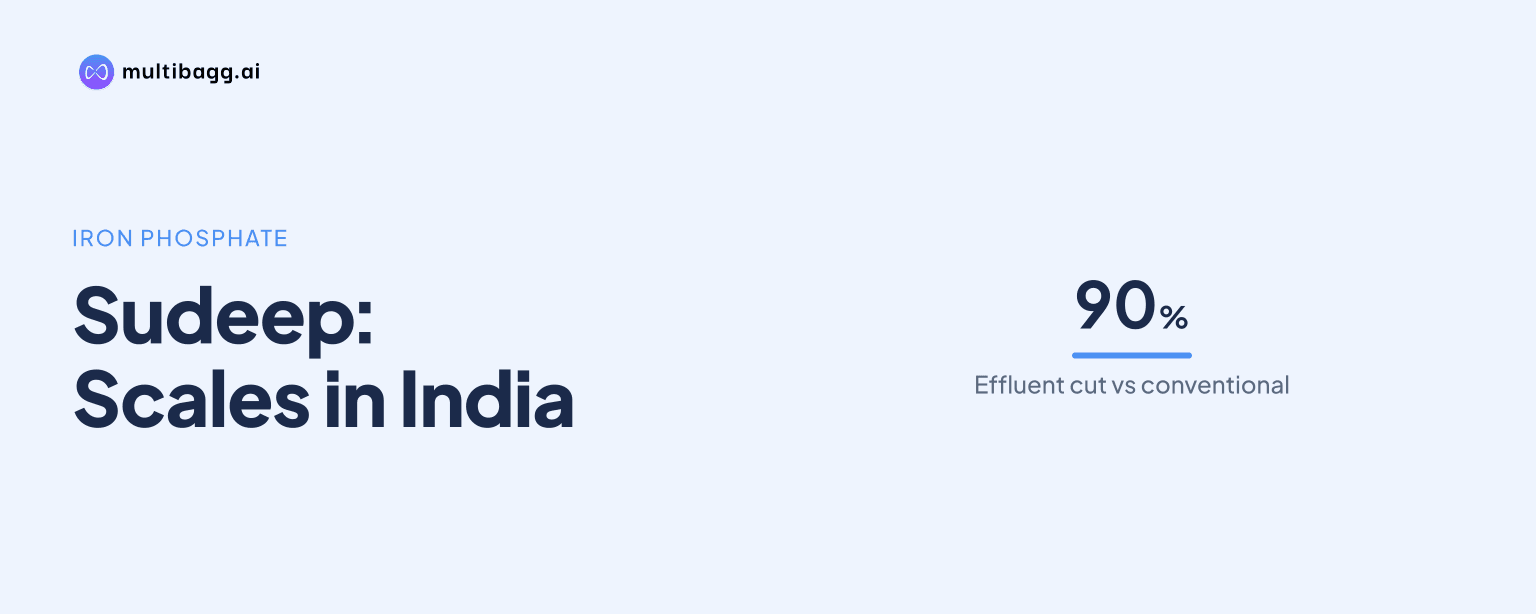
Sudeep says its battery-grade iron-phosphate process can scale in India because it reduces effluent by 90% versus conventional chemistry, which management said generates 15,000 litres per metric tonne. The company also cited nearly 95% lower solid waste, four years of process development and ex-China raw-material arrangements for capacity plans reaching 200,000 tonnes.
Know Sudeep Pharma inside out
Results, valuation, peers and who's buying, in one view.
Why does Sudeep say conventional iron-phosphate chemistry is difficult to scale in India?
Sudeep says conventional Chinese chemistry is difficult to scale in India because it produces 15,000 litres of effluent for every metric tonne of iron phosphate. At production scales of 100,000 or 200,000 tonnes, management said the resulting wastewater volume creates a substantial permitting and treatment challenge in India.
Management said a producer using the conventional route would need a multiple-effect evaporator, or MEE, plant to evaporate the effluent and then dry the resulting by-product. Sudeep said that by-product has a parallel market in China, including poultry and pork applications, but that such a market does not exist in India. In management's view, this removes operating-cost advantages available to Chinese producers.
Sudeep said the conventional process may allow a new entrant to move quickly at small volumes, but it believes scale beyond 10,000 to 15,000 tonnes would become difficult in India. That contrasts with Sudeep's stated plan to build capacity to 100,000 tonnes and subsequently to 200,000 tonnes, based on its expansion plans and customer demand.
How does Sudeep's battery-grade iron-phosphate process differ?
Sudeep says its proprietary process is a green-chemistry route that reduces effluent by 90% and solid waste by almost 95% compared with the conventional process. Management said it considers the process more competitive on operating expenditure and capital expenditure at scale, although it did not disclose a cost-per-tonne comparison or an earnings before interest, tax, depreciation and amortisation margin for the battery business.
Sudeep said it has an 11-year learning curve in producing iron phosphate across pharmaceutical applications and has worked on battery-grade iron phosphate from 2018 to the current period. Management described the process as indigenous and proprietary, and said its product performance is at par with required battery-grade performance. It did not provide independent product-performance data or customer test specifications during the call.
Sudeep told investors that developing the process took four years. It also said customer validation normally takes two years, creating an additional hurdle to replication. Management's distinction is that a competing plant may make small batches, but process development, customer qualification and scale-up would all need to be completed before it could compete for commercial volumes.
What upstream arrangements support Sudeep's ex-China strategy?
Sudeep says it already operates an ex-China supply chain for both battery-material raw materials and has secured supplies largely from India for capacity of up to 100,000 tonnes. Management identified purified phosphoric acid as the largest cost contributor in battery-grade iron phosphate, making raw-material security part of the commercial model.
The company said it has bought phosphoric acid for 30 years and has long-term contracts intended to support its ramp-up. Sudeep also identified Morocco, Israel, Vietnam and Mexico as large producer markets for purified phosphoric acid. Management said this geographic diversity is intended to meet requirements at both 100,000 tonnes and 200,000 tonnes, with supply remaining ex-China.
The non-Chinese sourcing strategy is linked to Sudeep's targeted United States market. Management said United States cell manufacturers can receive a 45X credit of $35 per kilowatt hour of cell capacity if they meet probable foreign entity, or PFE, compliant supply-chain requirements. Sudeep said India benefits from that framework and customers may pay a premium for a PFE-compliant supply chain, while adding that its aim is not to compete with China solely on price.
Got a follow-up? Ask IRIS
When could Sudeep's technology reach commercial battery-material volumes?
Sudeep said it plans to commission Phase 1 capacity of 25,000 tonnes in April 2027 and was targeting binding commitments in the fourth quarter, or Q4, before commissioning. Management did not disclose the volume covered by binding agreements during the call, but said it expected to provide customer and offtake details in its next call.
For customers that have approved the existing product and process, Sudeep said approval of the new Dahej facility should be a plant approval rather than a full product requalification. Management estimated that this could take about three months and no more than six months. It separately said it was assuming a three-to-six-month period for customers to validate the Dahej site before commercial supplies scale.
Sudeep said initial Phase 1 volumes, and potentially Phase 2 volumes, would be largely export-led. Korea is a priority because cathode and lithium-iron-phosphate capacity already exist there, and Korean cell companies have operations in the United States, management said. Europe was also cited as an area where Sudeep is making progress with specific customers.
How does Sudeep plan to protect returns while expanding capacity?
Sudeep says it is targeting asset turnover close to three times and a return on capital employed, or ROCE, profile similar to its historical core business when evaluating battery-material investment. Management said battery margins will differ from its core business because of larger scale, and it declined to disclose a specific earnings before interest, tax, depreciation and amortisation margin target.
Management said Phase 2 and Phase 3 timing will be based on delivery schedules in binding customer commitments rather than requiring Phase 1 to be commissioned first. It said back-end engineering design work is already under way to reduce time to market. At 200,000 tonnes, management said asset turnover could be above three times, but it did not provide a capital-expenditure estimate or a specific ROCE figure.
This approach contrasts with conventional-process competitors that management believes could face a 10,000-to-15,000-tonne scale ceiling in India. Sudeep's stated edge is therefore not simply being an ex-China source, but combining lower waste, four years of development, customer-validation time and raw-material arrangements intended for 100,000 tonnes and then 200,000 tonnes.
Conclusion
Sudeep's central claim is that waste management can determine whether battery-grade iron phosphate is commercially scalable in India. Its stated 90% reduction in effluent and nearly 95% reduction in solid waste address the 15,000-litre-per-tonne wastewater burden management associates with conventional chemistry, while the company is pairing that process with an ex-China raw-material chain.
The next milestones are Sudeep's targeted Q4 binding commitments, Phase 1 commissioning in April 2027 and the three-to-six-month customer-validation period for the Dahej facility. Management has also said it intends to provide a customer and offtake breakdown toward 100,000 tonnes, which would inform the timing of a potential expansion toward 200,000 tonnes.