








Suntech forecasts 21% FY27 EBITDA margin as rental expands
MAX Plan at ₹4,999/yr

Find your next multibaggerBe a Pro Investor
Research stocks and track your picks on the go. Download the app.
Key highlights
- Suntech forecasts a cumulative FY27 EBITDA margin of about 21%.
- Suntech said rental generated EBIT of about 33%.
- Rental represented about 9% to 10% of business, with a target of about 20% in two to three years.
- Suntech expects Rs 100 crore to Rs 150 crore of orders within 30 to 45 days from its Rs 800 crore pipeline.
powered by IRIS
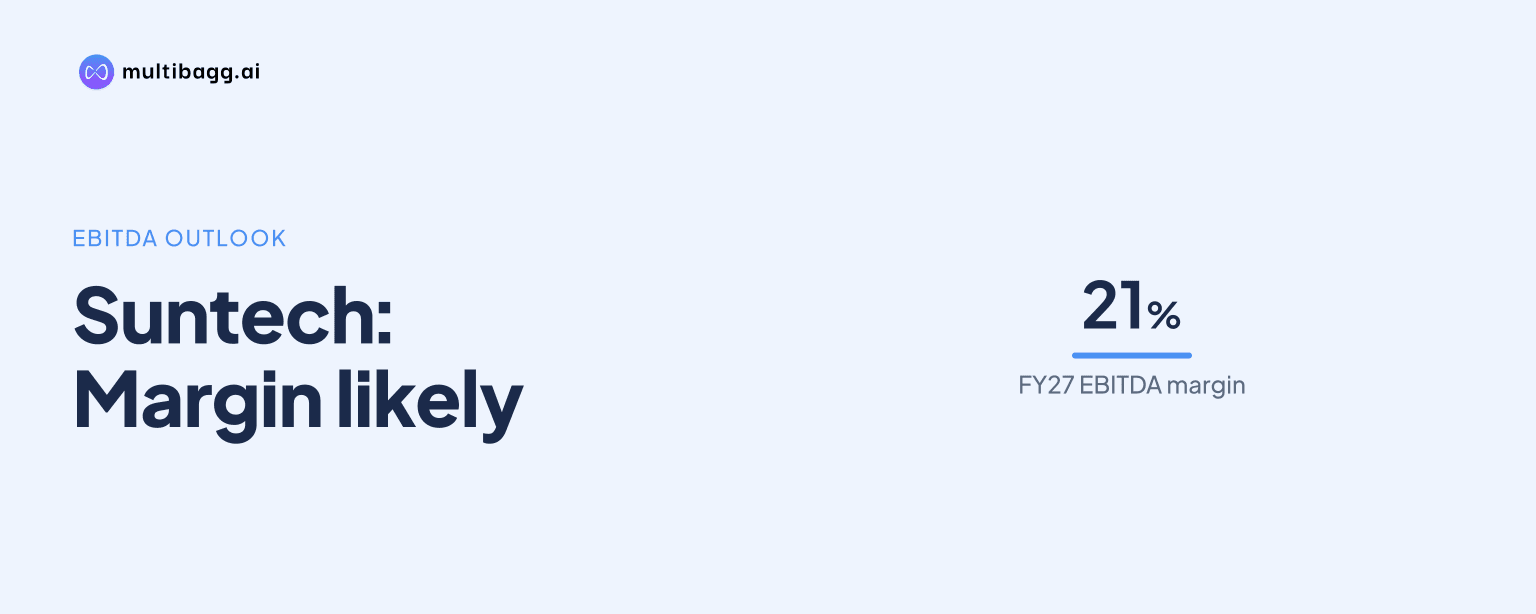
Suntech Infra Solutions Limited forecasts a cumulative FY27 EBITDA margin of about 21%, with management expecting a seasonally stronger H2 to offset a lower-margin H1. Suntech said its rental segment generated EBIT of about 33% and aims to increase rental from about 10% to 20% of total business over the next two to three years.
Know Suntech Infra Solutions inside out
Results, valuation, peers and who's buying, in one view.
What is Suntech's FY27 EBITDA margin outlook?
Suntech expects a cumulative EBITDA margin of about 21% for FY27. Management gave this estimate after an investor noted that the prior year had delivered roughly 20% to 21%; management said the FY27 outcome should be similar, while also saying the full-year result should be 3% up on the H1 level.
The forecast is a full-year cumulative measure rather than a target for each half. Management said H1 EBITDA margin would be slightly lower than H2 because of seasonal effects, meaning the planned 21% outcome depends on a better second-half contribution. EBITDA means earnings before interest, tax, depreciation and amortisation, while EBIT means earnings before interest and tax.
Management did not provide a revenue, EBITDA or EBIT amount for FY27. Therefore, the 21% outlook establishes the expected profitability ratio but does not quantify the rupee profit that could result. The call also did not disclose a separate EBITDA margin for piling foundations, the principal activity discussed alongside rental.
Why does Suntech expect H2 to support the full-year margin?
Management expects H2 to support the FY27 result because it described H1 as seasonally lower and said maximum order-book churn occurs in H2. Suntech was working with a pipeline of about Rs 800 crore and expected Rs 100 crore to Rs 150 crore of orders to be secured within 30 to 45 days from the call.
Suntech also said it was hopeful of securing 20% to 25% of that Rs 800 crore pipeline before the end of March 2027. That implies potential wins of about Rs 160 crore to Rs 200 crore from the stated pipeline, although management presented this as an expectation rather than confirmed orders. The expected order flow relates to workload in the seasonally more active half, not to a disclosed direct calculation of margin.
The company described piling foundations as a short-cycle business, with most projects lasting three to nine months, compared with 12 to 30 months for civil projects. Management said this means the order book must be replenished regularly during the year. For illustration, it said a business targeting Rs 300 crore of sales in the following year should seek an order book of 1.25 times to 1.5 times that target, or Rs 350 crore to Rs 450 crore.
How can a bigger rental mix affect Suntech's margins?
Suntech said a larger rental mix can support margins because the rental segment generated EBIT of about 33%, compared with the company’s stated FY27 EBITDA margin outlook of about 21%. The measures differ, but management cited rental profitability as the reason it did not see a margin challenge as the segment expands.
Rental accounted for about 9% to 10% of Suntech's business at the time of the call. Management’s stated target is to move that mix from about 10% to 20% over the next two to three years, rather than to reach 20% in FY28. The company also said it sees growth in both rental and piling foundations, so it did not provide a fixed annual segment split.
Management described its equipment approach as already hybrid. Suntech owns critical equipment such as rigs for its own use, while hiring smaller equipment including diesel generator sets, excavators and JCB machines from the market. It said these machines are common and easily available, and hiring avoids the operating and maintenance requirements associated with owning them.
Got a follow-up? Ask IRIS
Can Suntech return to its earlier EBITDA margin levels?
Management said a comparison with the earlier 24% to 25% EBITDA level is not directly appropriate because the business mix has changed. In the earlier period, pure job work represented about 40% to 50% of business, whereas management said Suntech now has hardly any pure job work.
Despite that mix change, management said Suntech should be around 21% after H2 and argued that growing rental could help it reach prior margin levels. This was management’s view, not a formal target for a specific year. Its stated priority was instead to grow top line and profitability while maintaining the FY27 margin outcome.
Capital deployment could also influence the operating model behind that plan. Suntech said it intended to invest about Rs 15 crore to Rs 20 crore in equipment during the 90 to 120 days following the call, though the specific equipment had not been finalised. Management said buying critical assets would remain a recurring effort as orders increase and larger projects are won.
What funding choices could affect Suntech's operating model?
Suntech said it can use operating leases, hired equipment or a hybrid structure as it expands, rather than relying only on owned and financed assets. Management said it had explored an operating-lease proposal that could keep items off the balance sheet, while reiterating that its existing model already uses market-hired smaller equipment.
Management said equipment debt had fallen from Rs 52 crore on April 1 to between Rs 42 crore and Rs 43 crore as of October 1, with repayments of about Rs 2.8 crore a month. It anticipated being debt-free by the end of FY28, but expressly qualified that expectation: additional capital raised for future equipment purchases could change the outcome.
The funding choices have no separately disclosed EBITDA impact in the call. Management acknowledged the question of whether a hybrid model might have lower margins, but responded that the 33% rental EBIT contribution and the current hybrid approach meant it did not see a challenge in achieving the stated FY27 margin.
Conclusion
Suntech’s central FY27 profitability message is a cumulative EBITDA margin of about 21%, despite a seasonally softer H1. Management’s case rests on H2 order conversion and a rental business that produced about 33% EBIT while representing only about 9% to 10% of current business.
The next items to watch are whether Suntech secures the expected Rs 100 crore to Rs 150 crore of orders within 30 to 45 days and whether it converts 20% to 25% of the Rs 800 crore pipeline by March 2027. Over the longer term, management’s stated test is whether rental reaches about 20% of business within two to three years while equipment funding remains consistent with its debt-free-by-FY28 objective.

