








Suntech targets 20% equipment-rental mix within three years
MAX Plan at ₹4,999/yr

Find your next multibaggerBe a Pro Investor
Research stocks and track your picks on the go. Download the app.
Key highlights
- Suntech targets equipment rental at 20% of business within two to three years, up from about 9% to 10%.
- Management said Suntech's rental segment generated roughly 33% EBIT.
- Suntech management expects a 21% full-year EBITDA margin, about 3 percentage points above the first-half result.
- Equipment loans were expected at Rs 42 crore to Rs 43 crore as of October 1, versus Rs 52 crore on April 1.
powered by IRIS
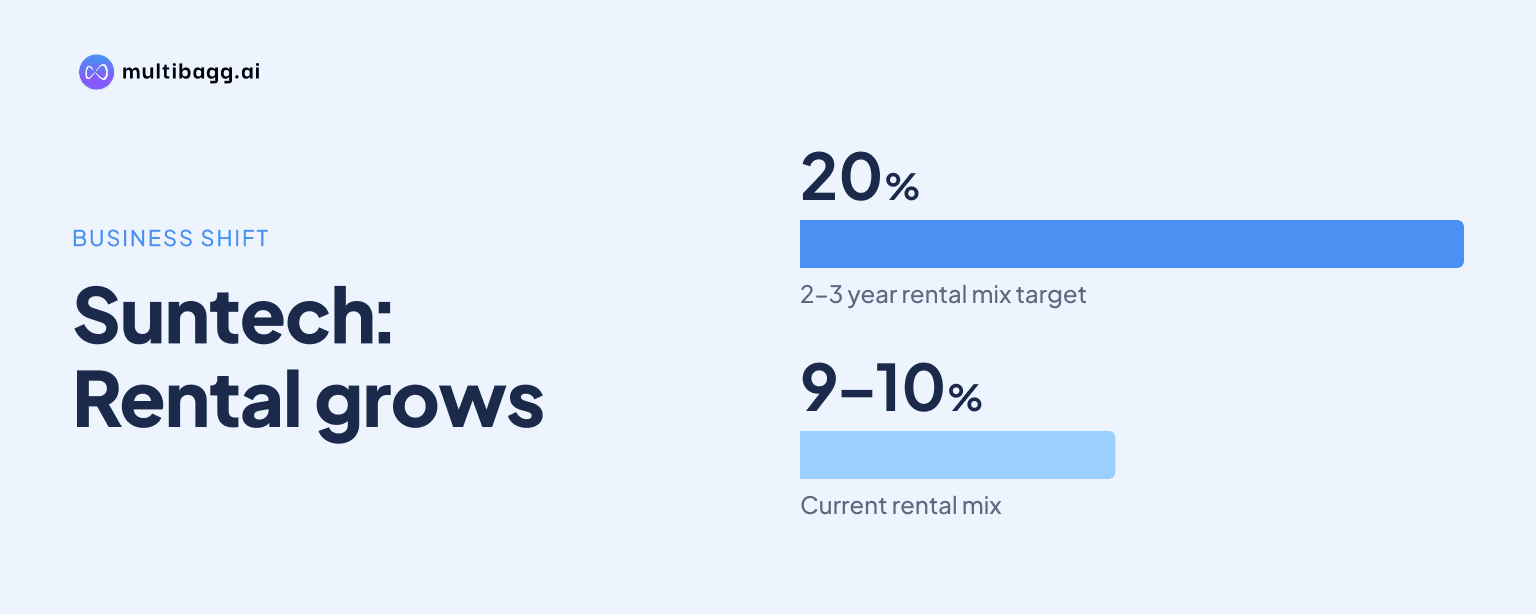
Suntech Infra Solutions Limited is targeting equipment rental at 20% of business within two to three years, up from about 9% to 10%, and management said the segment generated roughly 33% earnings before interest and tax (EBIT), supporting its expectation of a 21% full-year earnings before interest, tax, depreciation and amortisation (EBITDA) margin.
Know Suntech Infra Solutions inside out
Results, valuation, peers and who's buying, in one view.
What equipment-rental mix is Suntech targeting?
Suntech is targeting equipment rental at 20% of business within the next two to three years. Management put the existing rental contribution at about 9% to 10% when asked about the prospective split between rental and job work. It did not provide annual rental-mix milestones or a revenue target for the segment.
The plan would approximately double rental's share from the current 9% to 10% range. Management described the objective as moving the mix from 10% to 20%, rather than assigning the 20% target specifically to fiscal year 2028 (FY28). An analyst had asked whether the 10% figure was a FY28 target, but management instead set a two-to-three-year timetable.
Suntech's underlying activity is piling foundation work, where management said project tenures typically range from three to nine months. That differs from civil-work projects, which management said can run for 12 to 30 months. The shorter piling cycle means orders can recur during the year as Suntech expands its overall business and rental mix.
Why does Suntech expect rental to support profitability?
Suntech expects rental to support profitability because management said the rental segment generated EBIT of about 33%. This was the segment-level measure cited in response to a question on whether a hybrid equipment model could dilute margins. Management did not disclose rental revenue, capital employed or the period covered by the 33% EBIT figure.
The 33% rental EBIT figure is not directly comparable with Suntech's 21% full-year EBITDA margin expectation because EBIT and EBITDA exclude different costs. Management nevertheless cited rental profitability when expressing confidence in the 21% margin. It said the full-year outcome should be about 3 percentage points above the first-half result.
Management said first-half EBITDA margin would be slightly lower than the second half because of seasonal effects. Its 21% full-year expectation was described as similar to the prior year's margin of about 20% to 21%. The 21% goal is a near-term margin expectation, while the shift from a 10% rental mix to 20% is a two-to-three-year strategy.
Got a follow-up? Ask IRIS
Can Suntech grow rental while reducing equipment debt?
Suntech said it can add equipment capacity through operating leases, outside hiring or a hybrid model while reducing borrowings. Management said operating leases could keep equipment items off the balance sheet and that it had already explored this route. It also said commonly available machines could be hired externally.
Suntech already uses a hybrid model for smaller equipment. Management said it hires diesel-generator sets, excavators and JCB equipment rather than buying them because these items require operators and maintenance. The call did not quantify the portions of rental activity supported by owned, leased or hired machinery.
Management said equipment loans were expected to stand between Rs 42 crore and Rs 43 crore as of October 1, down from Rs 52 crore on April 1. It said Suntech was repaying about Rs 2.80 crore monthly and anticipated becoming debt-free by the end of FY28, subject to whether it raises further capital for equipment purchases. Leasing and hiring are therefore financing options, not a commitment to avoid future borrowing.
How could the rental plan affect Suntech's margins?
Suntech said a growing rental contribution could help it return to historical EBITDA-margin levels, but it did not issue a numerical target above 21%. An investor referred to a previous peak of roughly 24% to 25%, and management said attaining that earlier level would not be a major challenge as rental rises from 10% to 20% of the mix.
Management said historical comparisons are not like for like because pure job work represented about 40% to 50% of business in the earlier period, while Suntech now has hardly any job work. The transcript does not provide job-work segment margins or quantify the profit effect of its lower contribution.
Suntech's immediate objective is to grow revenue while maintaining profitability. Management illustrated that, for a next-year sales target of Rs 300 crore, an order book of Rs 350 crore to Rs 450 crore, or 1.25 to 1.5 times sales, would be appropriate. That example concerned piling foundation work, where the three-to-nine-month execution cycle allows backlog to be replenished during the year.
Conclusion
Suntech's strategy is to approximately double equipment rental's share of business to 20% within two to three years from about 9% to 10%. Management's rationale is the segment's roughly 33% EBIT and its expectation of a 21% full-year EBITDA margin, although the two measures are not directly equivalent and the call did not disclose rental revenue or a detailed route to the target mix.
The next disclosures to watch are any annual rental-mix milestones, the split between owned and hired equipment, and progress on the stated Rs 2.80 crore monthly debt repayment. Management also said it would work on designing a dividend policy in FY28, while its debt-free expectation by the end of FY28 remains conditional on whether additional capital is raised for equipment purchases.

