










Supreme Court of India excludes Videocon foreign assets from CIRP
Key highlights
- Supreme Court held that subsidiary-held Brazilian and Indonesian interests cannot form part of VIL’s CIRP estate.
- VOVL’s creditors approved BPRL’s Brazilian quota transaction with 99.96% of voting share on 2 June 2023.
- BPRL’s ROFR transaction was stated to have concluded on 2 July 2026.
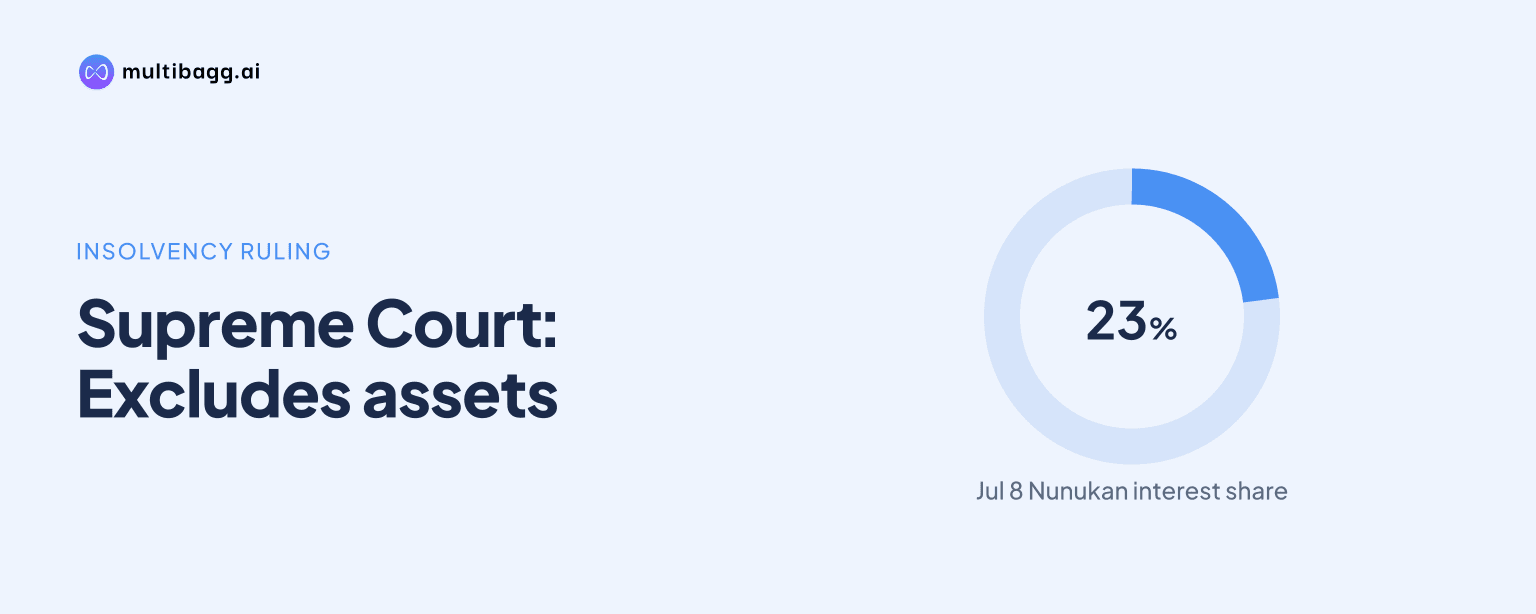
- VINI’s 23% Nunukan block interest was stated to have been formally transferred on 8 July 2026.
powered by IRIS
Supreme Court of India held that Videocon Industries Limited cannot include Brazilian and Indonesian oil-and-gas interests in its corporate insolvency resolution process, or CIRP, because the interests were held through subsidiaries. The Court also left undisturbed BPRL’s Brazilian quota transaction, approved by VOVL’s committee of creditors with 99.96% of voting share.
Know Videocon Industries inside out
Results, valuation, peers and who's buying, in one view.
Why did Supreme Court exclude the foreign assets from Videocon Industries Limited’s CIRP?
Supreme Court held that the foreign oil-and-gas interests were not assets of Videocon Industries Limited because they belonged to separate subsidiary companies. Section 18 of the Insolvency and Bankruptcy Code requires the interim resolution professional to take control of assets over which the corporate debtor has ownership rights, but its Explanation excludes assets of Indian and foreign subsidiaries.
The Court said the same statutory approach appears in Section 36(4)(d), which excludes subsidiary assets from a liquidation estate. Videocon Industries Limited’s estate could include its shareholding in Videocon Oil Ventures Limited, or VOVL, but could not include the Brazilian and Indonesian interests owned further down the group chain. VIL’s CIRP began on 6 June 2018, while VOVL was admitted to CIRP on 8 November 2019.
The Court also rejected reliance on three Beneficial Ownership Agreements dated 2008, 2010 and 2015. It held that those intra-group arrangements, under which overseas subsidiaries agreed to hold assets for Videocon Industries Limited’s benefit, did not transfer the assets to Videocon Industries Limited. Loan documents, lender correspondence and meeting minutes likewise could not confer title without a transfer document.
How were the Brazilian and Indonesian interests held within the group?
Videocon Industries Limited held the foreign interests indirectly through VOVL, Videocon Hydrocarbon Holdings Limited, Videocon Energy Brasil Limited and Videocon Indonesia Nunukan Inc. VIL held all shares of VOVL and 1% of Cayman Islands-incorporated Videocon Hydrocarbon Holdings Limited, while VOVL held the remaining 99%; that company wholly owned Videocon Energy Brasil Limited and Videocon Indonesia Nunukan Inc.
In Brazil, Videocon Energy Brasil Limited held quotas in IBV Brasil Petróleo Limitada, a Brazilian joint venture, while BPRL Ventures B.V. held the other 50%. A Quotaholders’ Agreement dated 12 September 2008 gave the non-transferring quota holder a right of first refusal, or ROFR, when the other holder proposed a transfer.
In Indonesia, Videocon Indonesia Nunukan Inc. held a 23% participating interest in the Nunukan block under a Joint Operating Agreement dated 4 July 2007. Pertamina submitted that the interest was deemed transferred to Pertamina and BPRL Ventures Indonesia B.V. on 11 July 2019 after default, and that the Republic of Indonesia formally effected the transfer on 8 July 2026.
What happened to the effort to include these interests in VIL’s estate?
The effort failed because Supreme Court upheld the conclusion that the assets of subsidiaries could not be brought into Videocon Industries Limited’s CIRP. The National Company Law Tribunal, or NCLT, had ordered on 12 February 2020 that VIL and its subsidiaries be treated as a single economic unit, but the National Company Law Appellate Tribunal, or NCLAT, stayed that order on 19 February 2020.
VIL’s CIRP had been consolidated with those of 12 domestic group companies on 8 August 2019, but VOVL was not included. The promoter’s application of 3 July 2019 sought to treat the assets and interests of VOVL and three overseas entities as VIL assets. A separate request to consolidate VOVL’s CIRP with VIL’s was dismissed for non-prosecution on 9 February 2022.
Supreme Court further found that the promoter was barred by conduct from reopening the question. It cited letters dated 21 November 2016 and 17 January 2017 seeking to release VIL as co-obligor and shift facilities to VOVL, along with the promoter’s participation in monetisation. A Section 12A withdrawal proposal that excluded the offshore assets was rejected by 98.14% of voting share and was not challenged.
Got a follow-up? Ask IRIS
Why did the Court leave BPRL’s Brazilian transaction undisturbed?
Supreme Court left the BPRL transaction undisturbed because it arose in VOVL’s separate CIRP through BPRL’s contractual ROFR over Videocon Energy Brasil Limited’s IBV quotas. After offers from PRIO S.A. and Eneva S.A. for the Brazilian assets, BPRL received its ROFR notice on 13 April 2023 and matched the offers on 26 May 2023.
VOVL’s committee of creditors approved BPRL’s offer by 99.96% of voting share at its 40th meeting on 2 June 2023. The NCLT approved the transaction on 26 June 2024, while dismissing the promoter’s objection. NCLAT dismissed the related appeals in its 14 May 2026 judgment, and the Court recorded that the transaction concluded on 2 July 2026.
BPRL stated that it had invested about USD 109.2 crore in the Brazilian assets after Cabinet Committee on Economic Affairs approval dated 27 July 2022. It also stated that it paid about USD 15.1 crore between December 2018 and December 2025 to cure Videocon Energy Brasil Limited’s defaults and prevent forfeiture. The Court noted that BPRL, as a third party, had acted upon the completed transaction.
What does the ruling mean for VIL creditors and vendors?
Supreme Court held that VIL creditors and vendors may recover only from Videocon Industries Limited’s estate under the Code, rather than from assets legally owned by subsidiaries. The VIL Vendors Association, representing about 97 unpaid suppliers, had said its members were to receive 0.72% of admitted claims, but the Court held that exclusion of non-VIL assets caused no legal injury.
The promoter had argued that admitted claims of Rs 23,120.90 crore, about 40.2% of total claims, related to the foreign assets. Supreme Court did not treat that claim figure as proof that Videocon Industries Limited owned the assets. It also said liquidation value, calculated as the average of two registered valuers’ estimates, was placed before the committee of creditors on 2 September 2020 without a challenge by the promoter.
The Court said that an allegation that Videocon Industries Limited transferred rights or provided guarantees without consideration would need to be pursued before the adjudicating authority under Sections 43 to 51 or Section 66 of the Code. It recorded that no such application had been filed. The Court permitted the VIL Vendors Association to pursue remedies available under law.
Conclusion
Supreme Court’s ruling keeps a clear boundary between Videocon Industries Limited’s shareholdings and the assets owned by its subsidiaries. The statutory exclusion in Section 18, reinforced by Section 36(4)(d), prevailed over arguments based on beneficial ownership arrangements, group-level financing and the request to treat the companies as a single economic unit. It also preserves the completed BPRL ROFR transaction in VOVL’s distinct CIRP.
The next matter to watch is whether the VIL Vendors Association files an application under Sections 43 to 51 or Section 66 concerning the alleged historic transfers or guarantees, as Supreme Court identified those provisions as the available route. The source also records that the Indonesian participating interest was formally transferred on 8 July 2026, following VINI’s 2019 default.