










Videocon Industries Limited plan remand upheld by Court
Key highlights
- VIL’s Rs 2,962.02 crore resolution plan was remitted because dissenting creditors were not specifically assured cash payment.
- The plan proposed Rs 2,700 crore of 6.65% NCDs, with redemption beginning 25 months after closing and extending through the sixth year.
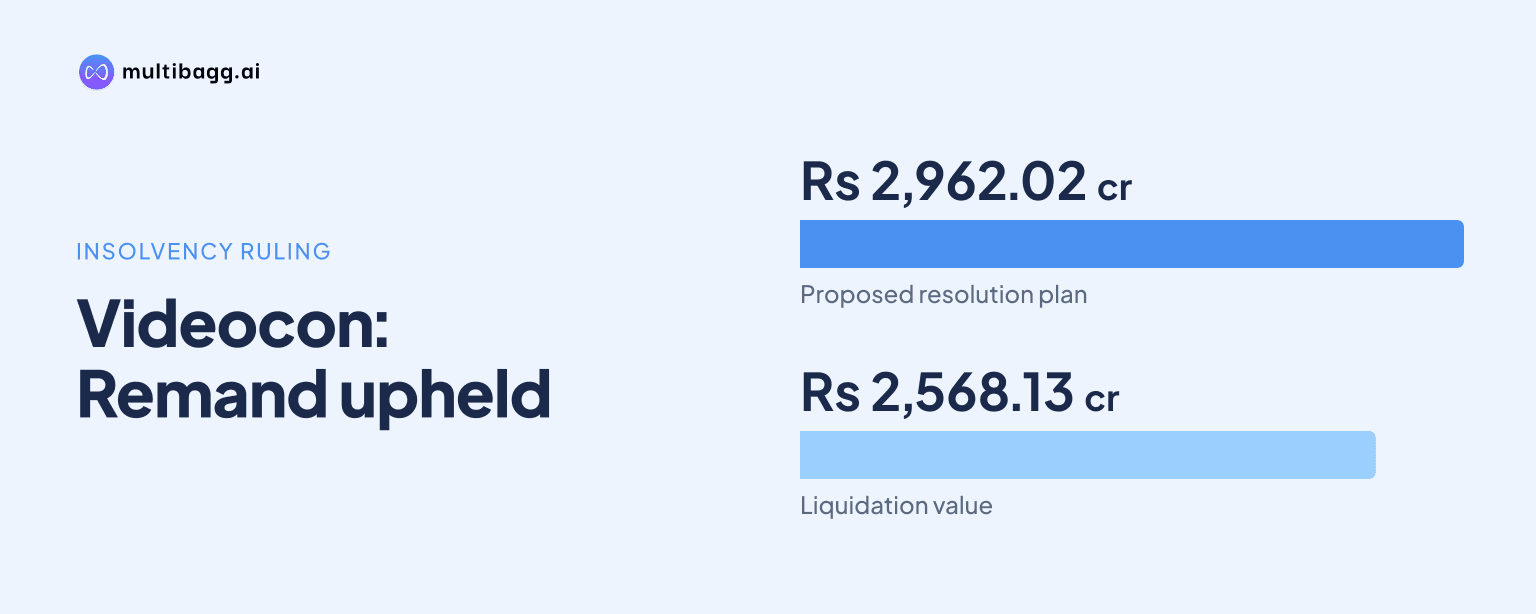
- VIL’s proposed outlay exceeded the Rs 2,568.13 crore liquidation value, but the NCLT recorded a 95.85% haircut on Rs 64,838.63 crore of admitted claims.
- The CoC approved the plan with 95.09% voting share in December 2020 and later voted 97% to invite fresh expressions of interest.
powered by IRIS
Videocon Industries Limited (VIL) must return its Rs 2,962.02 crore resolution plan to creditors after the Supreme Court, in its November 16, 2026 judgment, held that deferred non-convertible debentures did not specifically assure dissenting financial creditors payment in money or the required priority. The Court upheld the remand ordered on January 5, 2022.
Know Videocon Industries inside out
Results, valuation, peers and who's buying, in one view.
Why did the Supreme Court uphold the remand of VIL’s plan?
The Supreme Court upheld the remand because VIL’s plan contravened Section 30(2)(b) of the Insolvency and Bankruptcy Code, 2016, and Regulation 38(1)(b) of the Insolvency Resolution Process for Corporate Persons Regulations, 2016. The defect concerned the terms for financial creditors that did not vote for the plan, rather than the plan’s overall Rs 2,962.02 crore outlay or the size of the haircut.
The dispute arose in the consolidated corporate insolvency resolution process, or CIRP, of VIL and 12 other group companies. The National Company Law Tribunal, Mumbai, admitted creditor applications between June 6, 2018 and September 25, 2018, then ordered consolidation on August 8, 2019. Twinstar Technologies Limited’s plan was approved by 95.09% of voting share on December 11, 2020.
The Court said the National Company Law Tribunal, or NCLT, and the National Company Law Appellate Tribunal, or NCLAT, cannot rewrite a resolution plan or substitute their commercial judgment for that of the Committee of Creditors, or CoC. But they may assess statutory compliance, and the NCLAT could remit a non-compliant plan to the CoC rather than alter its payment terms or force liquidation.
Why were VIL’s deferred debentures not valid payment for dissenting creditors?
VIL’s deferred non-convertible debentures, or NCDs, were not valid payment because the plan did not expressly provide dissenting financial creditors cash in the manner required by law. The plan provided Rs 200 crore upfront to financial creditors as a class and Rs 2,700 crore of NCDs carrying a 6.65% annual coupon, with redemptions extending to the sixth year.
The first Rs 200 crore NCD redemption was due 25 months after the closing date, while four subsequent instalments of Rs 625 crore each were due in the third through sixth years. The Court held that a dissenting creditor cannot be required to remain tied to the debtor through securities when Section 30(2)(b) requires payment in money for that creditor’s liquidation entitlement.
VIL’s plan included clauses saying dissenting creditors would receive at least their Section 53 liquidation entitlement and be paid in priority. The Court held that such general assurances could not replace specific plan provisions stating how, when and in what form they would be paid. It also found that the plan did not secure the priority over assenting creditors required under Regulation 38(1)(b).
Got a follow-up? Ask IRIS
How did VIL’s proposal compare with its claims and asset values?
VIL’s Rs 2,962.02 crore proposed outlay exceeded the Rs 2,568.13 crore liquidation value, but it was below the Rs 4,069.95 crore fair value reported to the CoC on September 2, 2020. The Supreme Court held that being Rs 393.89 crore above liquidation value did not cure the separate statutory failure in treatment of dissenting financial creditors.
The NCLT recorded on June 8, 2021 that admitted claims totalled Rs 64,838.63 crore and that the proposal implied a 95.85% haircut. It also recorded that operational creditors would receive 0.72% of admitted claims. Those comparisons were part of the record, but the Court did not base its remand on a view that the CoC’s commercial assessment of value could be replaced by judicial assessment.
The amended plan submitted on November 7, 2020 included Rs 52 crore upfront for admitted workmen and employee dues and Rs 10 crore upfront for operational creditors. It also offered 8% equity in VIL to financial creditors and directed the corporate debtors’ cash balances to those creditors. The NCLT asked the CoC and applicant to increase operational-creditor payouts, particularly for micro, small and medium enterprises, but that request was not the basis for the remand.
Can VIL’s creditors reconsider or replace the resolution plan?
The CoC can reconsider VIL’s plan because it did not become functus officio, meaning its role was not exhausted, when it approved the proposal in December 2020. The Court held that the CoC remains in existence during the CIRP until a plan is implemented or liquidation is ordered, and the approval had not attained finality while statutory appeals remained pending.
The NCLAT stayed the NCLT approval on July 19, 2021 and directed maintenance of status quo ante. On September 18, 2021, the CoC, through State Bank of India on behalf of assenting creditors holding about 94.98% voting share, asked for the matter to be returned for reconsideration. The Court said the stay kept the process open while the plan’s legality was tested.
After the NCLAT’s January 5, 2022 remand, the CoC voted by 97% at its 25th meeting on January 12, 2022 to invite fresh expressions of interest, and Form G was published on January 18, 2022. When the Supreme Court issued notice on February 14, 2022, it directed the CoC not to proceed further. The Court rejected a request to confine reconsideration to Twinstar’s existing plan because that choice rests with the CoC.
Did competition approval provide another reason to remit VIL’s plan?
Competition approval did not provide another reason to remit VIL’s plan because the Competition Commission of India had cleared the transaction before voting concluded. The Court recorded a December 8, 2020 communication from the regulator, while the CoC voting ended on December 11, 2020.
The finding reversed the NCLAT’s view that prior approval had not been shown under the proviso to Section 31(4). The Court therefore distinguished the cleared competition requirement from the unresolved creditor-payment issue. VIL’s remand rests on the plan’s cash-payment and priority terms, not on an absence of competition clearance.
Conclusion
The combined effect of the ruling is that VIL’s December 2020 plan cannot be implemented in its approved form, despite its Rs 2,962.02 crore outlay exceeding the reported Rs 2,568.13 crore liquidation value. The decisive point was the statutory protection for dissenting financial creditors: a deferred NCD structure and general compliance language did not amount to an assured cash payment with the required priority.
The next point to watch is the CoC’s commercial decision after reconsideration. The record shows that creditors had supported fresh expressions of interest by 97% on January 12, 2022, while the Supreme Court declined to limit the process to a revision of the earlier proposal. Any plan considered next will need explicit terms addressing the identified payment-in-money and priority requirements.