










Supriya retains Rs 1,000 crore FY27 goal after H1 sales
Key highlights
- Supriya reported H1 FY27 revenue of Rs 396 crore, up 14.8% from Rs 345 crore in H1 FY26.
- Management retained its Rs 1,000 crore FY27 revenue target, implying about Rs 604 crore of H2 revenue.
- H1 FY27 EBITDA fell 25.3% to Rs 93 crore and EBITDA margin was 23.4%.
- Management expects nearly Rs 60 crore of Ambernath expense in FY27 while site revenue may be close to zero.
powered by IRIS
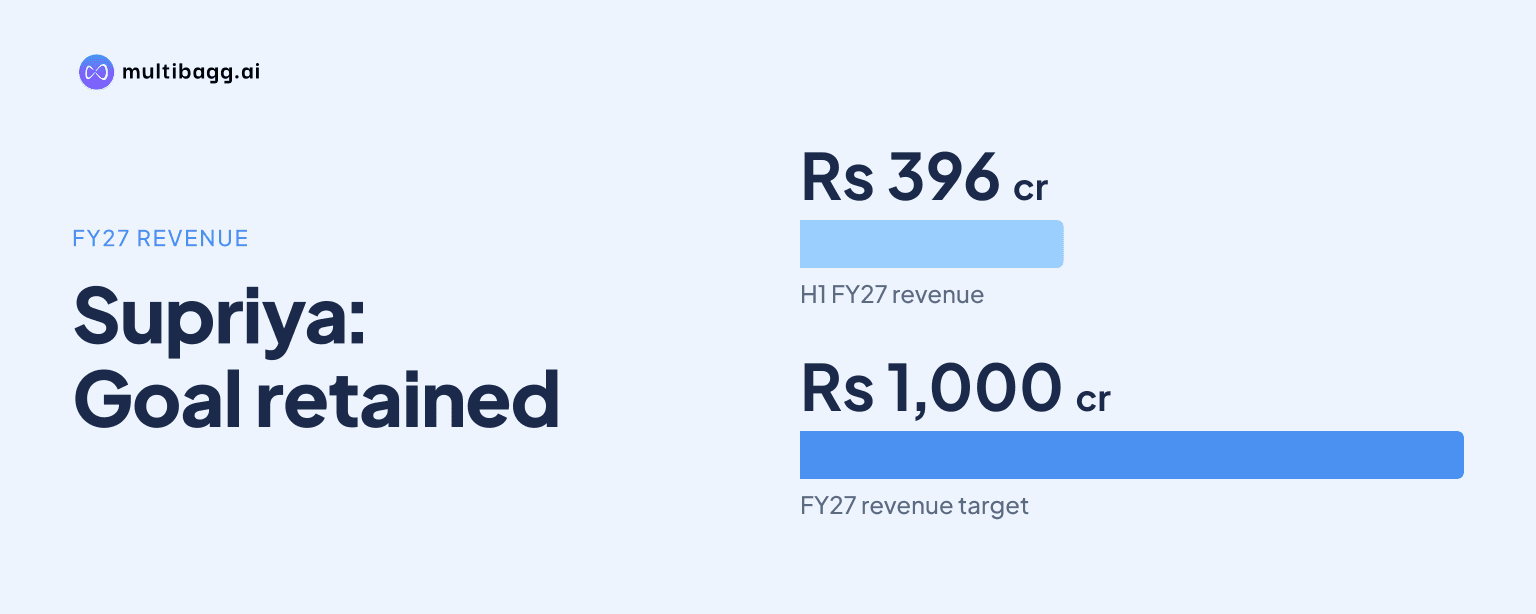
In H1 FY27, Supriya Lifesciences retained its Rs 1,000 crore revenue target after reporting Rs 396 crore of revenue, which requires about Rs 604 crore in H2; management cited Rs 265 crore of inventory, its order book and newer products as support.
Know Supriya Lifescience inside out
Results, valuation, peers and who's buying, in one view.
Why is Supriya maintaining its FY27 revenue target?
Supriya says it remains very confident of delivering Rs 1,000 crore in FY27 revenue despite the H1 FY27 result of Rs 396 crore. The target implies H2 FY27 revenue of about Rs 604 crore, or roughly 1.5 times first-half revenue, making delivery substantially more weighted to the second half.
Management’s stated basis is inventory of about Rs 265 crore and an order book already in place. It also expects newer products to continue scaling in semi-regulated markets, where products launched in recent quarters have shown what management described as good traction. Management did not disclose the order-book value or provide a quarterly H2 revenue forecast.
Supriya launched two anesthetic liquid-inhalation products from its Ambernath facility in Q2 FY27. Those products remain at an early commercialisation stage, while two attention-deficit/hyperactivity disorder, or ADHD, products are in the pipeline. Management also cited anesthetic products, cardiovascular products and advanced intermediates as products that can make up revenue deferred by the Latin America, or LATAM, disruption.
How did Supriya perform in the first half?
Supriya’s H1 FY27 revenue rose 14.8% year on year to Rs 396 crore from Rs 345 crore in H1 FY26, but profitability declined as costs and sales mix changed. Earnings before interest, tax, depreciation and amortisation, or EBITDA, fell 25.3% to Rs 93 crore from Rs 124 crore, while profit after tax declined to Rs 53 crore from Rs 85 crore.
EBITDA margin was 23.4% in H1 FY27, compared with an implied 35.9% in H1 FY26, a decline of 12.5 percentage points. The Q2 FY27 comparison showed the same divergence: revenue increased 3.2% to Rs 206 crore from Rs 200 crore, while EBITDA dropped to Rs 45 crore from Rs 73 crore and profit after tax fell to Rs 29 crore from Rs 50 crore.
Exports accounted for 80% of Q2 FY27 revenue, linking overseas market mix closely to earnings. Europe contributed 43% of exports, Asia 36% and LATAM 12%. Management said LATAM had previously risen from 10% to 21% of business before declining to 12% in the quarter affected by regulatory changes.
What is holding back Supriya’s margins in FY27?
Supriya has reduced its FY27 EBITDA-margin guidance to 23% to 25%, with management indicating the full-year outcome should be around 25%. The company attributed the lower margin profile to Ambernath operating costs, deferred high-margin LATAM shipments and higher prices for raw materials, key starting materials, or KSM, and solvents.
Management quantified Ambernath’s full-year expense at nearly Rs 60 crore, which it estimated accounts for roughly 6 percentage points of the decline from its typical 34% to 35% margin range to about 22% in Q2 FY27. The facility had been expected to begin generating revenue from Q3, but the European Union audit was delayed to November, leaving FY27 revenue from the site potentially close to zero, according to management.
Management attributed roughly 3 percentage points of the margin decline to changed LATAM regulations and product mix, with the remaining roughly 3 percentage points linked to raw-material and solvent costs. These are management estimates rather than separately reported financial line items. Supriya said it had communicated revised prices to customers, but the full effect should emerge over the next two to three quarters because large regulated-market contracts were already in place.
Got a follow-up? Ask IRIS
How are LATAM rules affecting Supriya’s sales mix?
Supriya says the LATAM issue is a timing disruption rather than demand destruction, but it expects the effect to persist through much of the remaining FY27. Authorities in three or four countries, including Colombia, Peru and Uruguay, immediately classified certain high-margin controlled products as controlled substances, requiring customers to secure import authorisations before shipments can resume.
The change came without advance time for customers to build inventory, management said. Although Supriya retains purchase orders and visibility of firm orders, the orders are deferred pending permits. Management now expects permits to take at least four to five months at a broad level, which may prevent a full recovery of those sales within FY27.
The mix effect matters because replacement growth is currently concentrated in semi-regulated markets, where average selling prices are lower than in regulated markets. Management said it can replace the revenue through scaling anesthetic, cardiovascular and advanced-intermediate products, but not necessarily the lost margin from high-margin LATAM products over the next two quarters.
What could support Supriya’s growth after FY27?
Supriya identifies its existing baseline business, new product launches and contract manufacturing as its three main growth drivers, while continuing to guide for revenue growth above 20% over the next three to four years. Management said the baseline business is growing in regulated markets and new products have gained traction in semi-regulated and domestic markets.
A large contract manufacturing organisation, or CMO, opportunity in anesthetics was described as close to signing, though management gave no value or definitive signing date. The initial years of the proposed contract would be focused on active pharmaceutical ingredients, or APIs, for which Supriya already has approvals; finished-formulation supply would follow only after Ambernath receives approvals in multiple markets.
Management said Ambernath is designed to generate at least Rs 450 crore to Rs 500 crore of revenue once it receives European Union approval and contracts begin. The site has injection, tablet, capsule and liquid-inhalation lines. Management said commercialisation immediately after the European Union audit could create upside, but that outcome depends on approvals and subsequent product ramp-up.
Conclusion
Supriya’s retained Rs 1,000 crore FY27 revenue target rests on a pronounced second-half requirement of about Rs 604 crore, backed by inventory, firm orders and products already scaling. The H1 FY27 result showed 14.8% revenue growth, but also a 12.5-percentage-point year-on-year decline in EBITDA margin as Ambernath costs, LATAM disruption and input inflation converged.
The next developments to watch are the November European Union audit at Ambernath, the four-to-five-month process for LATAM customer import permits and the timing of a potential anesthetic CMO contract. Management expects around 25% FY27 EBITDA margin and says margins could normalise after Ambernath contributes sales, LATAM supplies regularise and new products enter regulated markets.