










Supriya Lifescience says Ambernath needs Rs 160-200 crore
Key highlights
- Supriya Lifescience estimates Ambernath needs Rs 160 crore to Rs 200 crore of revenue to break even.
- Ambernath is incurring about Rs 60 crore in annual expenses and may generate revenue close to zero in the current financial year.
- Management said Ambernath accounts for about 6 percentage points of the EBITDA margin impact.
- Management estimated a 1 to 1.5-year ramp-up to meaningful scale after a positive EU audit outcome.
powered by IRIS
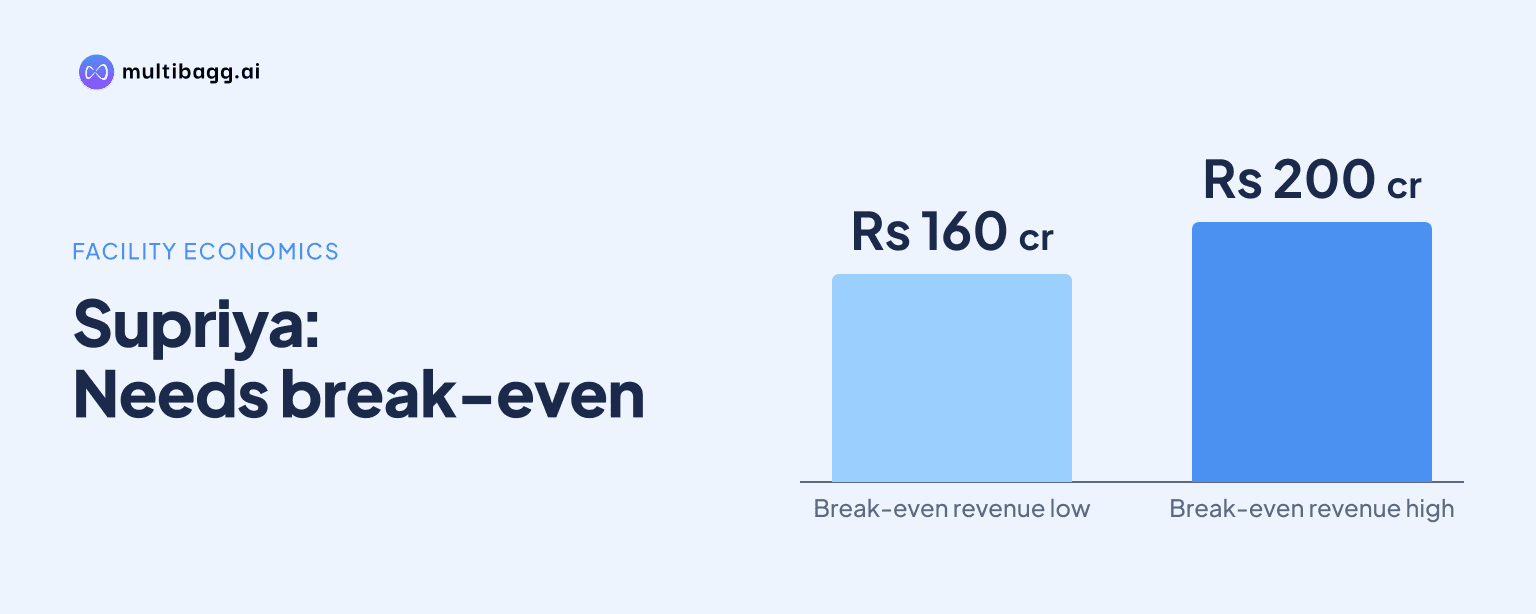
Supriya Lifescience Limited said its Ambernath plant requires about Rs 160 crore to Rs 200 crore of revenue to break even, while it is incurring annual expenses of about Rs 60 crore and may generate revenue close to zero in the current financial year. Management said the plant could take about 1 to 1.5 years to reach a meaningful scale after a positive European Union audit outcome.
Know Supriya Lifescience inside out
Results, valuation, peers and who's buying, in one view.
What sales does Supriya Lifescience need from Ambernath to break even?
Supriya Lifescience needs Ambernath revenue of about Rs 160 crore to Rs 200 crore to reach plant-level break-even, according to Krishna Raghunathan. He called that range the plant’s “sweet spot” and said it would also help the company ramp up its formulation business.
The estimate is materially above the current cost run rate of about Rs 60 crore a year. Raghunathan said the plant would require further research and development spending to improve its formulation portfolio as it scales, which is why management set the break-even range above the existing annual expense level.
The target contrasts with Ambernath’s expected contribution this year. Management had expected revenue generation to begin from the third quarter, but said the European Union, or EU, audit had been deferred and regulatory approvals took longer than expected. Supriya Lifescience did not provide a year-by-year sales forecast for the plant.
Why may Supriya Lifescience receive little Ambernath revenue this year?
Supriya Lifescience may receive revenue close to zero from Ambernath in the current financial year because the EU audit and related regulatory approvals have been delayed. Dr. Saloni Wagh said the audit, initially expected earlier, was scheduled for the following week at the time of the call, effectively removing one quarter of anticipated plant revenue.
Management had previously expected Ambernath to begin generating revenue in the third quarter. Instead, the plant remains an expense-bearing site with no material contribution expected this year, which management identified as a major component of the pressure on its profitability.
A positive audit result would not by itself complete commercialisation. Raghunathan said products would need to be put in place and registrations completed after the audit outcome. He estimated it could take about 1 to 1.5 years for Ambernath to reach a meaningful revenue level after approvals, product registrations and commercial activity progress.
Supriya Lifescience also identified potential sales channels after approvals. Management said the plant could supply rest-of-world markets and that a prospective contract development and manufacturing organisation, or CDMO, contract might include rest-of-world sales. It described a separate rest-of-world contract for the same anesthetic product as small commercially, but a breakthrough into that market.
Got a follow-up? Ask IRIS
How is Ambernath affecting Supriya Lifescience’s EBITDA margin?
Supriya Lifescience said Ambernath’s annual expense contributes about 6 percentage points to its margin impact. Management contrasted its typical earnings before interest, tax, depreciation and amortisation, or EBITDA, margin of 34% to 35% with a 22% margin cited during the call, while linking the plant’s Rs 60 crore annual expense and no revenue contribution to the decline.
Ambernath was one of three factors behind the revised margin outlook. Management also cited higher raw-material and solvent costs, as well as a changed sales and market mix after delayed high-margin sales to Latin America, or LATAM. It said higher input costs could be passed through on some larger contracts only over the next two quarters.
Management revised its full-year EBITDA margin guidance to 25%. It said customers in LATAM could take at least four to five months to obtain import permits following a regulatory change, delaying sales despite the company having purchase orders and visibility of firm demand before the change.
The margin comparison does not isolate Ambernath as the sole cause of the gap from the company’s usual range. Wagh said the result reflected the combined effect of plant expense, lost or deferred LATAM sales, input-cost pressure and changes in product and market mix, rather than any one factor alone.
What must happen before Supriya Lifescience guides Ambernath’s ramp-up?
Supriya Lifescience must first assess the EU audit outcome, product registrations, potential plant sales and required research and development spending before it gives guidance on Ambernath’s ramp-up or the next financial year’s margin profile. Raghunathan said management would review developments over the following couple of weeks before deciding what sales could come from the plant.
The company explicitly declined to guide for the next financial year. Management said the margin profile depends on contingencies including EU approval, the commercial mix possible at Ambernath and the level of research and development investment required to build the plant’s formulation portfolio.
Management said there could be upside to its normalised growth outlook if Ambernath moves into commercialisation immediately after the EU audit. That statement was conditional: commercial output still depends on registrations, product readiness and demand build-up towards the Rs 160 crore to Rs 200 crore break-even range.
The early sales mix could also shape the margin path. An analyst suggested that non-regulated-market sales during the ramp-up may carry lower margins, and management said Ambernath would continue to have some effect until scale builds. It added that rest-of-world sales and a potential CDMO contract could reduce the severity of the current impact, but gave no numerical estimate.
Conclusion
Ambernath has moved from an expected third-quarter revenue contributor to a facility that may produce revenue close to zero in the current financial year while incurring about Rs 60 crore in annual expenses. The Rs 160 crore to Rs 200 crore break-even range indicates the sales scale management believes is needed to absorb those costs and support the formulation business, while the current 25% EBITDA margin guidance also reflects LATAM delays and input-cost pressure.
The next disclosed event is the EU audit, scheduled for the week after the call. Management said a positive outcome would begin the commercial process rather than complete it, with product registrations, portfolio work and ramp-up expected to take about 1 to 1.5 years; it plans to revisit next-year guidance only after assessing those developments.