










Supriya Lifescience cuts FY27 EBITDA-margin outlook to 23%-25%
Key highlights
- Supriya reported Q2 FY27 revenue of Rs 206 crore, up 3.2% year on year, while EBITDA declined 37.5% to Rs 45 crore.
- Supriya revised FY27 EBITDA-margin guidance to 23%-25% after reporting a 22% Q2 FY27 margin.
- Management attributed about 6 percentage points of margin pressure to Ambernath expenses and about 3 percentage points each to LATAM mix changes and input costs.
- Exports were 80% of Q2 FY27 revenue, with Europe at 43%, Asia at 36% and LATAM at 12% of export revenue.
powered by IRIS
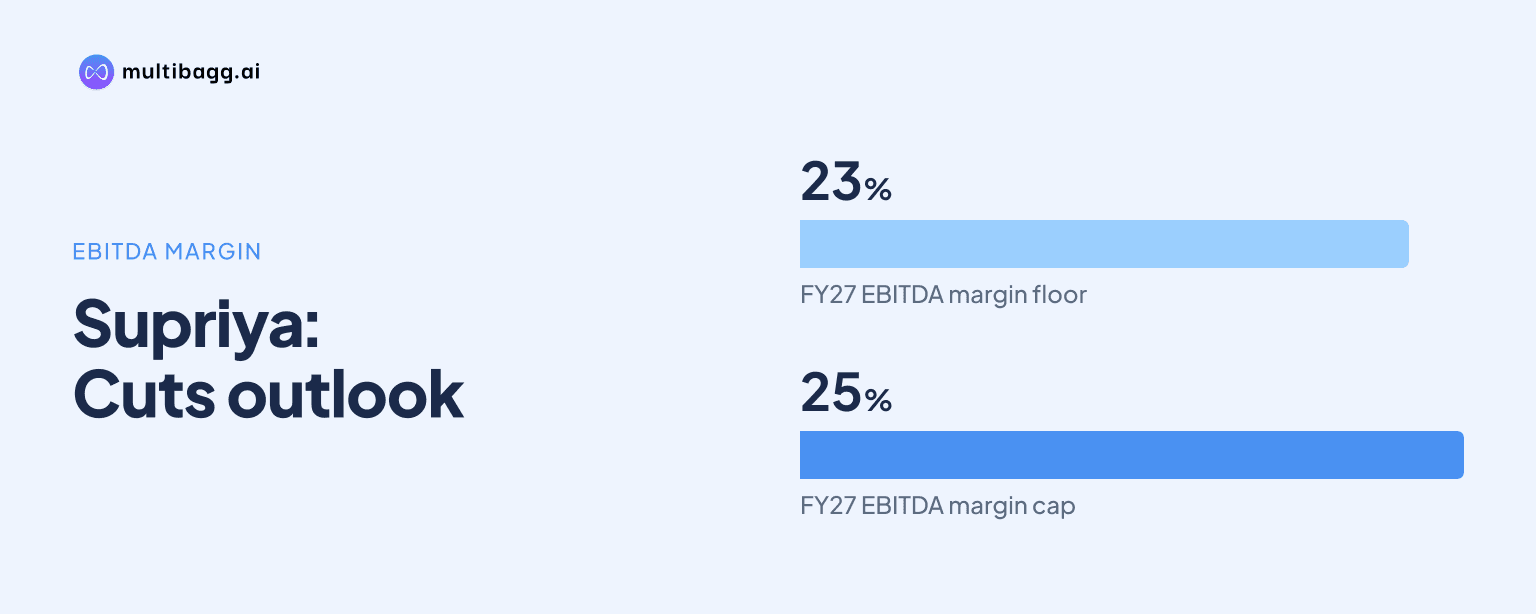
Supriya Lifescience Limited cut its financial year 2027 (FY27) earnings before interest, tax, depreciation and amortisation (EBITDA) margin guidance to 23%-25% after second-quarter FY27 (Q2 FY27) margin fell to 22%. Management cited immediate import-permit changes for higher-margin Latin American (LATAM) products, Ambernath ramp-up costs and elevated raw-material and solvent prices.
Know Supriya Lifescience inside out
Results, valuation, peers and who's buying, in one view.
Why did Supriya Lifescience reduce its FY27 EBITDA-margin guidance?
Supriya reduced its FY27 EBITDA-margin guidance to 23%-25% because its product and geographic sales mix shifted away from higher-margin LATAM products, while Ambernath operating costs and input prices increased. Q2 FY27 EBITDA was Rs 45 crore, down 37.5% year on year from Rs 73 crore, even as revenue increased 3.2% to Rs 206 crore from Rs 200 crore.
Management said controlled products in Colombia, Peru, Uruguay and other LATAM markets were newly classified as controlled substances. Customers that had previously imported those products freely must now obtain import authorisations for each shipment. Authorities implemented the change immediately, without time for customers to build inventory, and management said the approval process typically takes a couple of months.
The revised outlook also reflects Ambernath's cost base while the facility remains in ramp-up. Management expects almost Rs 60 crore of Ambernath expenses for FY27 and said that cost cannot be recovered immediately because the site needs regulatory approvals and product sales to scale. It expects commercial production and sales to improve cost absorption in coming quarters.
How did Supriya Lifescience profitability change in Q2 and H1 FY27?
Supriya's Q2 FY27 EBITDA margin declined to 22% from the 34%-35% typical range cited during the call, while first-half FY27 (H1 FY27) EBITDA margin was 23.4%. The quarterly decline was sharper than the revenue movement: Q2 revenue rose Rs 6 crore year on year, but EBITDA declined Rs 28 crore and profit after tax (PAT) decreased Rs 21 crore.
For H1 FY27, revenue from operations increased 14.8% year on year to Rs 396 crore, but EBITDA fell 25.3% to Rs 93 crore from Rs 124 crore. PAT margin was 13.5% in H1 FY27 and 14.2% in Q2 FY27. The comparison shows that higher sales did not offset the effects of changed mix and operating-cost pressure.
Management broadly attributed the 11 to 12 percentage-point gap between the cited typical margin profile and the current level to three factors. It assigned about 6 percentage points to Ambernath expenses, about 3 percentage points to LATAM regulation-driven product and market mix changes, and about 3 percentage points to higher raw-material and solvent prices.
What changed in Supriya Lifescience's LATAM sales mix?
Supriya said the LATAM restrictions temporarily reduced volumes of high-margin controlled products and increased the relative share of lower-average-selling-price sales in semi-regulated markets. The affected products had been imported into several LATAM countries without permits; they now require customer import authorisation, interrupting shipments while applications are processed.
Exports represented 80% of Q2 FY27 revenue. Within export sales, Europe accounted for 43%, Asia for 36% and LATAM for 12%. Management did not quantify the revenue affected by the permit rules, but said simultaneous changes in three or four countries altered both product mix and market mix during the quarter.
Management described the margin decline as transient and expected it to correct over the next couple of quarters once customer authorisations are received. It also said newer products have gained traction in semi-regulated markets, but their average selling prices are lower than those in regulated markets. That combination supported sales while limiting recovery in the prior margin profile.
Got a follow-up? Ask IRIS
What could improve Supriya Lifescience margins after FY27?
Supriya expects margins to improve as Ambernath obtains approvals, products from the facility generate sales, LATAM shipments normalise and new products enter regulated markets. Management said it was guiding for about 25% margin in the remaining part of FY27, producing a full-year outcome of around 25%, while continuing efforts to reduce raw-material and solvent costs.
The company launched two liquid-inhalation anaesthetic products from Ambernath in Q2 FY27, although both remained at an early commercialisation stage. Management said the products had received a Certificate of Suitability (CEP) and that it was seeking entry into Europe, with United States Drug Master File approval expected soon. Supriya also has two attention-deficit/hyperactivity disorder (ADHD) products in its pipeline.
Management said a European Union (EU) audit of Ambernath was scheduled for November 2026, beginning in the week after the November 6 earnings call. It also cited a potential large contract manufacturing organisation (CMO) opportunity for an anaesthetic project that was close to signing. The initial years would be weighted to active pharmaceutical ingredients (APIs), for which management said it already had approvals, before finished formulations follow approvals in multiple markets.
Can Supriya Lifescience still meet its FY27 revenue target?
Supriya maintained its FY27 revenue target of Rs 1,000 crore despite reporting Rs 396 crore in H1 FY27 revenue. Management said it had inventory of about Rs 265 crore and an order book in place, supporting its confidence in the target, although it reiterated that quarterly growth can be nonlinear as launches scale and markets change.
Reaching Rs 1,000 crore would require roughly Rs 604 crore of H2 FY27 revenue, compared with Rs 396 crore recorded in H1 FY27. Management expects sales from other products to scale in H2, including products already showing traction in semi-regulated markets. It did not provide an H2 gross-margin target, saying it normally does not discuss gross margin.
The company spent Rs 18.8 crore in capital expenditure in Q2 FY27 and Rs 35.4 crore in H1 FY27, mainly for Ambernath, maintenance, the Ribo block and formulation-plant requirements. Management also said it had not used working-capital limits during the year, apart from letters of credit and bank guarantees. Fully backward-integrated products accounted for about 74% of Q2 FY27 revenue.
Conclusion
Supriya's revised 23%-25% FY27 margin outlook follows a Q2 FY27 EBITDA margin of 22%, with management identifying three connected pressures: delayed high-margin LATAM shipments, an almost Rs 60 crore Ambernath expense base and elevated material and solvent costs. Revenue rose 3.2% in Q2 and 14.8% in H1, but EBITDA declined in both comparisons as sales mix and costs changed.
The next markers are customer import authorisations in LATAM, the Ambernath EU audit scheduled for November 2026, commercial scaling of two anaesthetic launches and any announcement of the proposed CMO contract. Management also expects the effect of revised customer pricing for raw materials to become visible over the next two to three quarters, while retaining its Rs 1,000 crore FY27 revenue target.