










Suzlon says commissioning-linked receivables lift working capital
Key highlights
- Suzlon delivered 1,217 MW in the first half, 21% above almost 1,000 MW in the comparable prior-year period.
- Suzlon says 5% to 10% of customer payment can be collected only after project commissioning.
- Management expects the second half to be 1.5 to 1.65 times the first half as inventory supports planned supplies.
- Suzlon reported about Rs 2,300 crore of cash in September, with roughly 40% to 50% estimated to be encumbered.
powered by IRIS
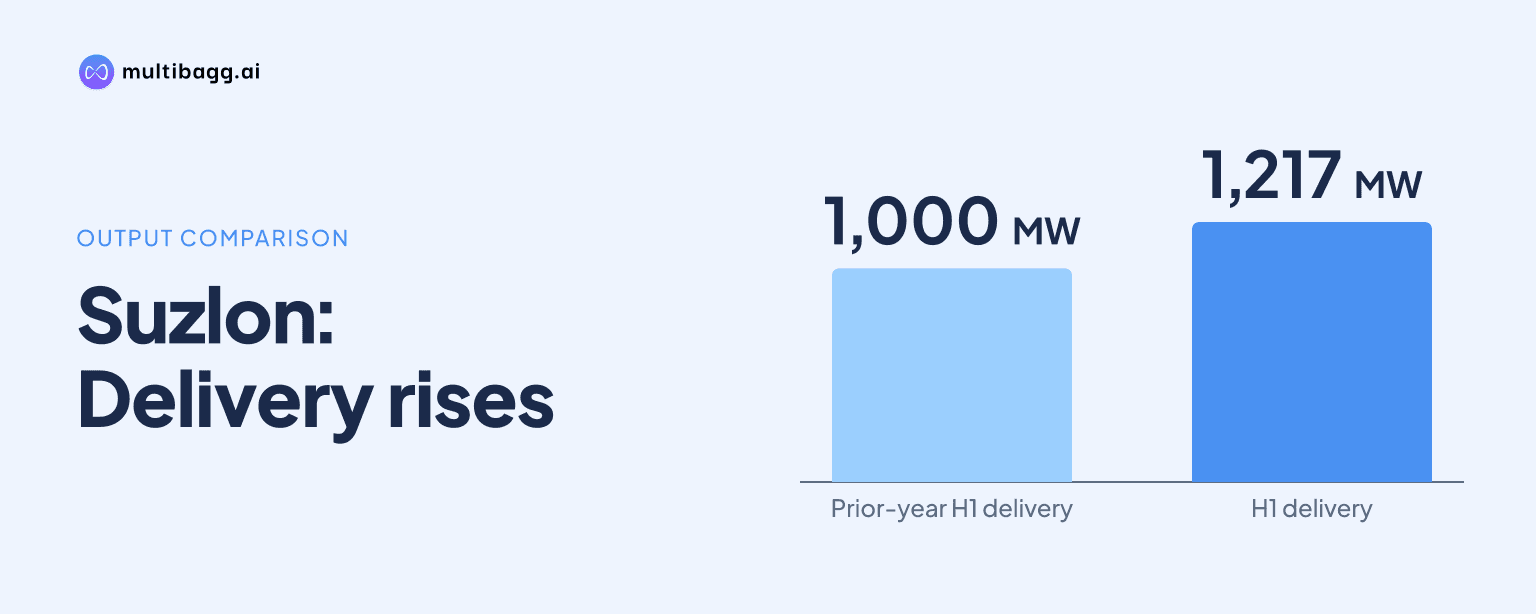
Suzlon says receivables rose because 5% to 10% of some customer payments are collected only after project commissioning, while inventory is being built for a second half expected to be 1.5 to 1.65 times the first half. Suzlon delivered 1,217 megawatts (MW) in the first half, 21% above the comparable prior-year period.
Know Suzlon Energy inside out
Results, valuation, peers and who's buying, in one view.
Why have Suzlon’s receivables increased?
Suzlon says receivables have increased because part of the cash collection is tied to project commissioning rather than turbine delivery. Rahul Jain said the movement also reflects the timing of supplies and project conditions, with certain receivables not yet due because commissioning has not been completed.
The company’s accounting and cash-collection timing are different for these projects. Jain confirmed that Suzlon can recognise revenue before installation is complete, while the associated cash is received when installation is completed. Management said the withheld portion varies by customer but is generally 5% to 10% of the relevant project value, with 7.5% cited as another point within that range.
Suzlon said the receivable increase identified by an analyst on a sequential basis was more pronounced than the inventory build. Management attributed this to supply timing and commissioning-linked amounts, and said cash should be released as commissioning levels improve. The company had delivered 1,217 MW in the first half, so a larger volume of supplied equipment can also create more amounts awaiting the final project milestone.
The execution pipeline illustrates why commissioning matters to collections. Suzlon said about 3,900 MW remained pending installation, including nearly 1,300 MW already erected. Management also cited 725 MW-odd completed in the first half and said the erected base provides visibility for further commissioning, although it did not disclose the rupee value of receivables linked to that process.
How is working capital affecting Suzlon’s finance cost?
Suzlon says additional working-capital deployment is supporting higher delivery volumes, and it did not give a single sustainable working-capital target. An analyst said first-half finance cost had exceeded Rs 250 crore against an estimated full-year figure of about Rs 300 crore. Jain said it would be inappropriate to annualise the first-half amount without accounting for the increase in deliveries and revenue.
Management compared the current period with the corresponding prior-year first half, when deliveries were almost 1,000 MW. Deliveries subsequently reached 1,217 MW, a 21% increase, while revenue was about 24% higher, according to Suzlon. Jain said the higher operating scale naturally requires more working capital, even as interest costs were declining on a like-for-like percentage basis.
Suzlon did not provide a full-year finance-cost forecast or quantify the working capital needed for its planned growth. Instead, Jain said management was deploying somewhat higher working capital to manage growth and was using several levers to improve it. The company expects second-half activity to be 1.5 to 1.65 times first-half activity, which is also a reason for building inventory before later-period deliveries.
Cash is part of the funding position but is not all freely available for use. Suzlon said its September cash balance was about Rs 2,300 crore, compared with the Rs 2,600 crore balance cited by an investor for June 30. Management estimated that about 40% to 50% of the September amount was encumbered, while saying it would need further detail to provide an exact figure and does not separately disclose that number.
Got a follow-up? Ask IRIS
Why is Suzlon building inventory ahead of the second half?
Suzlon says it is carrying somewhat higher inventory to meet planned second-half supplies. Jain said the wind business has a seasonal pattern, making it unsuitable to assess cash conversion simply as a percentage of trailing 12-month revenue. The inventory build is intended to support a second half management expects to be 1.5 to 1.65 times the first half.
Management said the historical split between the two halves has ranged from 40%-60% to 35%-65%. That pattern means inventory and working capital can rise in the first half before the larger delivery period. Suzlon therefore distinguished its inventory planning from the separate sequential increase in receivable days, which it linked more directly to commissioning-related collection timing.
The expected second-half volume is supported by the order pipeline disclosed on the call. Suzlon said it had an order book of more than 6 gigawatts (GW) after first-half deliveries of about 1,200 MW, and it had won 1,500 MW of new orders during the first half. Management said the existing order book gives solid visibility for the next 18 months.
Higher volume could also affect profitability through operating leverage, according to management. Ajay Kapur said a second half at 1.5 to 1.65 times the first half would normally provide close to 100 basis points of leverage. He stated a margin expectation of 15.1% plus 1%, while noting that commodity costs and other factors continued to affect the current period.
Is Suzlon’s DevCo model causing higher working capital?
Suzlon says the DevCo model is not the main cause of the current working-capital intensity. Jain said capital committed to DevCo does enter working capital, but rejected a direct link between DevCo and the present increase. Management instead cited growth, inventory preparation for the second half and commissioning-linked cash collections.
Suzlon has set a total DevCo allocation framework of about Rs 500 crore. Net deployment stood at Rs 125 crore to Rs 130 crore because some assets developed through the model had been sold, management said. Nearly 900 MW of the order book has come through DevCo, but Suzlon did not disclose the working-capital requirement attached to those orders.
The announced DevCo orders are near-term projects rather than the longer-dated opportunities under discussion. Kapur said the roughly 900 MW already announced have commercial operation dates within the next 18 months and have land available. He described discussions for years three, four and five as potential business for financial years 2028 through 2031, with announcements to follow when appropriate.
Suzlon also said it had made no capital expenditure on solar, battery energy storage systems or firm and dispatchable renewable energy offerings. Management described those activities as asset-light while teams are built and negotiations progress over the next couple of quarters. Separately, Suzlon has appointed three regional chief project officers and expects sharper commissioning over a 12-to-18-month, more likely 18-month, period.
Conclusion
Suzlon’s explanation is that higher receivables principally reflect the gap between revenue recognition and final cash collection: 5% to 10% of payment can remain linked to commissioning. Combined with inventory for a second half projected at 1.5 to 1.65 times first-half activity, that mechanism explains why working-capital deployment has drawn attention even as first-half deliveries rose to 1,217 MW.
The next test is whether commissioning converts retained receivables into cash. Investors can watch progress on the nearly 1,300 MW already erected, execution against the projected second-half delivery increase, and management’s stated 18-month path toward sharper commissioning after the regional project-management reorganisation.