










Suzlon has 1.25 GW erected turbines awaiting commissioning
Key highlights
- Suzlon installed 723 MW in H1 FY27, up 168% from 270 MW in H1 FY26.
- Suzlon had 1.25 GW of erected turbines in its pipeline for future commissioning at H1 FY27.
- Q2 FY27 installations rose more than 69% year on year to 454 MW.
- Suzlon delivered 1,217 MW in H1 FY27, up 21% year on year.
powered by IRIS
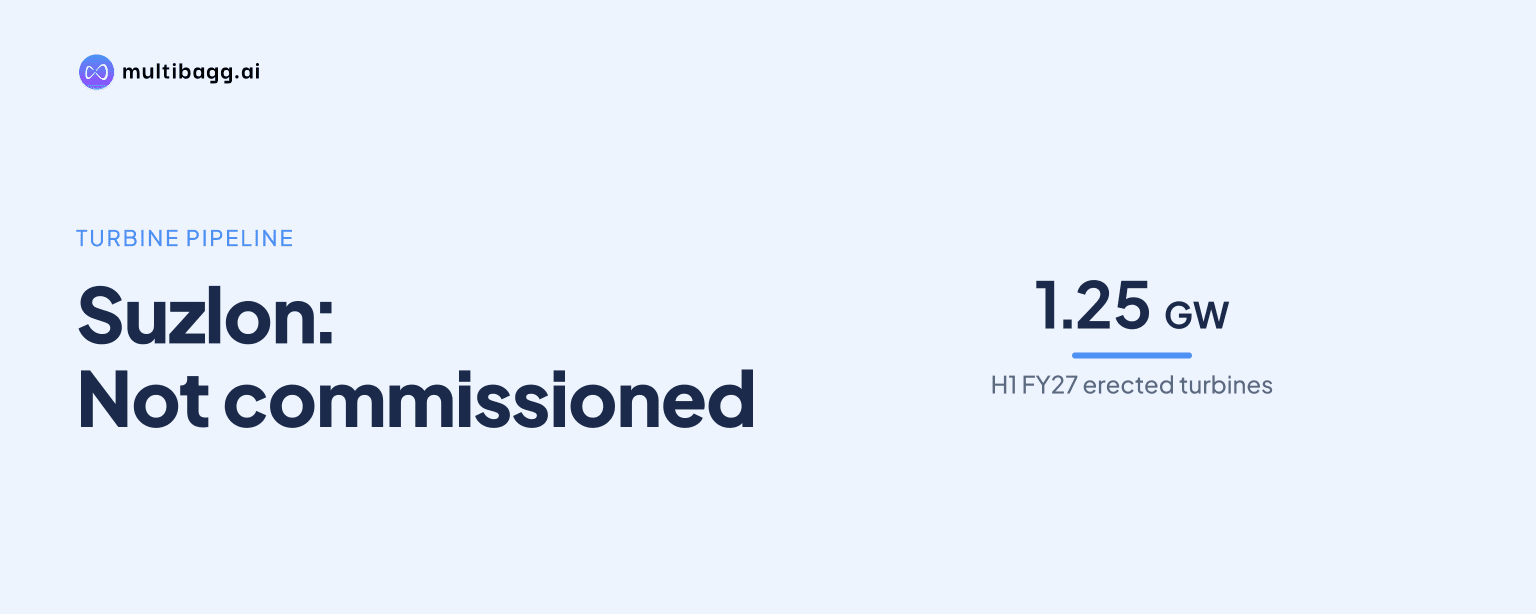
Suzlon Energy Limited said on October 29, 2026 that 1.25 GW of erected turbines was in its pipeline for future commissioning after installations reached 723 MW in H1 FY27, up 168% from 270 MW a year earlier. Suzlon is reorganising project execution through three regional project chiefs to accelerate conversion of the erected pipeline.
Know Suzlon Energy inside out
Results, valuation, peers and who's buying, in one view.
How large is Suzlon’s turbine commissioning pipeline?
Suzlon’s disclosed erected-turbine pipeline was 1.25 GW at H1 FY27, which management said would support an uptick in commissioning. In a later answer on the same call, management described the erected stock as close to 1,300 MW within about 3,900 MW pending installation, indicating that the 1.25 GW figure is an approximate operational measure rather than a project-by-project schedule.
The distinction matters because an erected turbine has reached a late construction stage but is not yet commissioned. Management linked part of its receivables to commissioning: depending on the customer, 5% to 10% of payment may be retained until installation is completed. Group Chief Financial Officer Rahul Jain said cash is received when installation is completed, although revenue is recognised earlier under the company’s accounting process.
The gap between deliveries and commissioning is central to Suzlon’s near-term execution. H1 FY27 deliveries were 1,217 MW while installations were 723 MW, leaving installations below the delivery pace during the six-month period. Management attributed higher working capital partly to preparation for H2 and said certain receivables should turn into cash as commissioning levels improve.
Did Suzlon set a record for H1 installations?
Yes, Suzlon said its 723 MW of H1 FY27 installations was its highest on-ground execution for a half year, compared with 270 MW in H1 FY26 and about 750 MW for the whole of the prior year. The company therefore installed almost as much in the first six months of FY27 as it did over all of the preceding financial year.
The quarterly acceleration was also pronounced. Suzlon installed 454 MW in Q2 FY27, compared with 269 MW in Q2 FY26, a rise of more than 69%, even though management characterised the monsoon quarter as seasonally lean. It delivered 710 MW in Q2 FY27, up 40% quarter on quarter, which it called its highest-ever second-quarter India delivery level.
Higher volume was reflected in financial results, although commissioning is not the same as revenue recognition. H1 FY27 revenue increased 24% year on year to Rs 8,688 crore, while earnings before interest, tax, depreciation and amortisation, or EBITDA, were Rs 1,315 crore and profit after tax was Rs 699 crore. Management said year-on-year profit after tax was not directly comparable because the previous year contained significant deferred tax asset recognition, whereas FY27 included deferred tax asset reversals.
What is Suzlon changing to speed up commissioning?
Suzlon has replaced a single group chief project officer structure with three regional chief project officers, each supported by an independent team. Group Chief Executive Officer Ajay Kapur said the organisational change was already generating efficiencies and was intended to improve the pace of project commissioning across India.
Management did not provide an immediate conversion date for the entire 1.25 GW erected stock. Instead, Kapur said the company expected a 12-to-18-month journey, “more like” 18 months, before sharper commissioning became visible on the ground. This makes the disclosed pipeline an execution visibility measure rather than a formal commissioning forecast for a specific quarter.
Suzlon also expects the second half to carry a larger share of annual activity. Management said H2 is normally 1.5 to 1.65 times H1, and it expected that pattern to recur in FY27. The company said inventory was being built for H2 deliveries, while receivables had risen partly because some payment positions were associated with commissioning and were not yet due.
Got a follow-up? Ask IRIS
What supports Suzlon’s ability to execute this pipeline?
Suzlon said it had 4.5 GW of manufacturing capacity fully operational and an order book of 6 GW, providing about 18 months of coverage at the current execution run rate. It booked 1.5 GW of new orders in H1 FY27, while management said demand and its developer-led DevCo model meant the order book was not the company’s principal constraint.
The mix of orders provides context for project execution. Management said about 78% of the order book was in commercial and industrial customers and public-sector or utility-scale projects. It also said 900 MW of orders booked in H1 FY27 came through the DevCo model, with those announced orders carrying commercial operation dates within the next 18 months and land already available.
Suzlon’s financial capacity was also part of management’s case for execution. As of September 2026, consolidated net worth was Rs 10,277 crore and net cash was Rs 2,048 crore, according to prepared remarks. In the question session, Jain referred to about Rs 2,300 crore of cash and said roughly 40% to 50% was encumbered, while adding that the company did not separately disclose an exact encumbered amount.
What could affect conversion of Suzlon’s erected turbines into cash?
Commissioning progress, customer-specific payment milestones and project timing could affect conversion of Suzlon’s erected turbine pipeline into cash. Jain said that a 5% to 10% customer holdback can remain until installation is complete, while some receivables are tied to commissioning. Faster on-ground completion would therefore affect both project status and cash collection.
Margins and working capital are separate but related execution considerations. Q2 FY27 revenue rose 27% sequentially to Rs 4,869 crore and EBITDA rose 21% to Rs 720 crore, yet consolidated EBITDA margin was 14.8%. Management cited customer and scope mix, higher wind-turbine revenue mix, commodity and foreign-exchange volatility, and about Rs 50 crore of Suzlon 2.0 branding, travel and selling, general and administrative costs.
Management expects wind turbine generator contribution margins to remain in the 22% to 23% range for FY27, subject to external conditions. It said commodity and foreign-exchange effects together reduced margin by about 50 basis points, while the non-recurring Suzlon 2.0 costs reduced EBITDA margin by about 100 basis points. Steel is largely passed through in contracts, management said, but commodities such as copper, aluminium and carbon generally must be absorbed.
Conclusion
Suzlon’s 1.25 GW erected-turbine pipeline is the operational bridge between its record H1 FY27 installation base and future commissioning. Installations rose to 723 MW from 270 MW a year earlier, while H1 deliveries reached 1,217 MW. The company’s regional project structure and the timing of customer commissioning milestones will determine how quickly that pipeline becomes operating projects and cash collections.
The next measure to watch is H2 FY27 execution, given management’s expectation that the period will be 1.5 to 1.65 times H1 and its statement that the project reorganisation needs up to 18 months to produce sharper commissioning. Progress on the 900 MW of DevCo orders scheduled for commercial operation within 18 months, alongside receivables linked to commissioning, will also be relevant.