










Suzlon cuts FY27 EBITDA-margin outlook to 15.1% plus 1%
Key highlights
- Suzlon guided for FY27 EBITDA margin of 15.1% plus 1%, following a 15.1% H1 FY27 margin.
- Q2 FY27 EBITDA margin was 14.8%, compared with 18.8% in Q2 FY26.
- WTG contribution margin declined to 21.2% in Q2 FY27 from 26.9% a year earlier.
- H1 FY27 deliveries increased 21% to 1,217 megawatts and revenue rose 24% to Rs 8,688 crore.
powered by IRIS
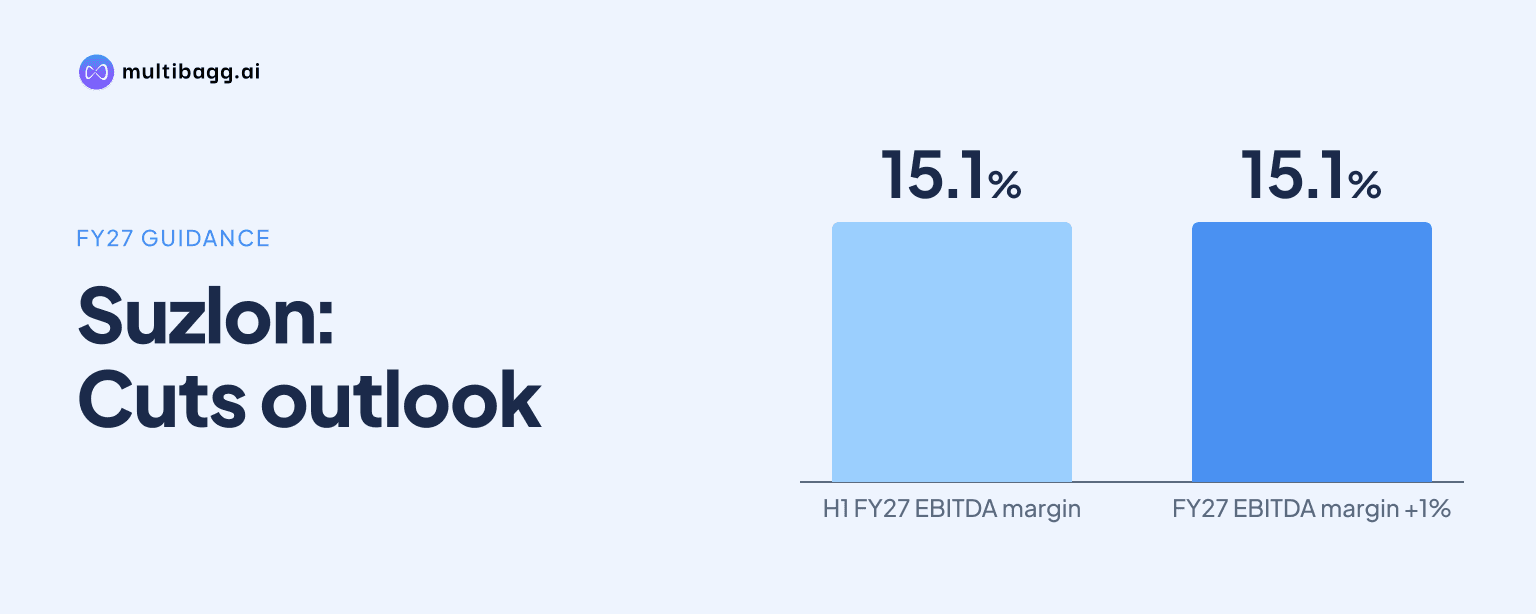
Suzlon Energy Limited has cut its FY27 earnings before interest, tax, depreciation and amortisation (EBITDA) margin outlook to 15.1% plus 1%, after reporting a 15.1% margin in H1 FY27 and a 14.8% margin in Q2 FY27, as customer and scope mix, commodity and foreign-exchange volatility, and Suzlon 2.0 costs reduced profitability.
Know Suzlon Energy inside out
Results, valuation, peers and who's buying, in one view.
Why did Suzlon cut its FY27 EBITDA-margin outlook?
Suzlon cut its FY27 outlook because management now expects a 15.1% EBITDA margin plus 1% from second-half operating leverage, rather than the approximately 17% expectation discussed in the Q1 FY27 call. Group Chief Executive Officer Ajay Kapur said the 15.1% base represented H1 FY27 performance, while the additional 1 percentage point depended on higher H2 volumes.
The revision followed a 14.8% consolidated EBITDA margin in Q2 FY27, down from 18.8% in Q2 FY26. Management allocated about 150 to 180 basis points of the decline to customer and scope mix, around 50 basis points to the changing mix between wind turbine generator, or WTG, activity and service operations, and about 50 basis points to commodities and foreign exchange.
A further roughly 100 basis points came from non-recurring operating expenditure associated with Suzlon 2.0, management said. Suzlon reported about Rs 50 crore of branding, travel and selling, general and administrative expenses within an approximately Rs 80 crore year-on-year increase in Q2 operating expenses. Group Chief Financial Officer Rahul Jain said the Suzlon 2.0 expense was expected to phase down in subsequent quarters.
What reduced Suzlon's Q2 FY27 margin?
Suzlon said WTG contribution margin declined to 21.2% in Q2 FY27 from 26.9% a year earlier, principally because of customer, segment and scope mix, alongside foreign-exchange and commodity volatility. Jain said commodities and foreign exchange combined reduced margin by about 50 basis points, linking that pressure largely to the West Asia crisis.
Management did not attribute the margin movement to a reduction in turbine prices. Kapur said certain customer orders in the prior-year period carried higher margins but also affected working capital, while site availability can cause some projects to advance faster than others during a quarter. Those execution differences can change quarterly customer and scope mix even when annual delivery plans remain in place.
Suzlon said steel is largely passed through under its contracts, but it absorbs exposure to commodities including copper, aluminium and carbon. Management said it was accelerating cost-of-goods-sold, or COGS, programmes to offset part of the exposure, but did not put a value or timeline on prospective savings. It also said the timing of any normalisation in the West Asia situation was difficult to predict.
Can H2 volumes lift Suzlon's FY27 margin?
Suzlon expects higher H2 volumes to add close to 100 basis points of operating leverage, which underpins management's FY27 formulation of 15.1% plus 1%. Kapur said H2 is normally 1.5 to 1.65 times H1 and management expected that seasonal pattern to recur in FY27, making this an outlook rather than a reported result.
H1 FY27 deliveries rose 21% year on year to 1,217 megawatts from 1,009 megawatts, while installations increased 168% to 723 megawatts from 270 megawatts. Revenue grew 24% to Rs 8,688 crore and EBITDA reached Rs 1,315 crore. Profit after tax was Rs 699 crore, although management said it was not directly comparable with the prior year because FY26 included deferred-tax-asset recognition benefits and FY27 included non-cash reversals.
Q2 revenue increased 27% sequentially to Rs 4,869 crore from Rs 3,819 crore in Q1 FY27. EBITDA rose 21% sequentially to Rs 720 crore and profit after tax increased 29% to Rs 394 crore. Deliveries reached 710 megawatts, 40% above the preceding quarter, despite management describing Q2 as seasonally lean because of the monsoon.
Got a follow-up? Ask IRIS
Has Suzlon reduced wind-turbine prices?
Suzlon said it has not reduced prices, and management described Q2 FY27 average selling price of about Rs 5.9 crore per megawatt as a function of business mix. The Q2 FY27 figure was above Rs 5.7 crore per megawatt in Q2 FY26, though an analyst noted it was below a roughly Rs 6 crore per megawatt run rate.
Jain said quarterly revenue per megawatt can move according to the timing and composition of turbine supply, balance-of-plant work, project services, stubs and other supplies. Management therefore did not present the Q2 average as a change in contracted turbine pricing. Its stated margin pressures were customer mix, project scope, business-segment mix and exposure to selected inputs and currencies.
The service operation has a materially different margin profile from WTG activity. Suzlon said its renewable energy asset-management-services business had an installed base above 16.5 gigawatts and EBITDA margins above 40%, while WTG contribution margins were expected to remain in the 22% to 23% range in FY27. A larger WTG revenue share can therefore reduce consolidated EBITDA margin even if service margins remain above 40%.
What execution factors could affect Suzlon's FY27 outcome?
Suzlon entered H2 with a 6-gigawatt order book, which management said offered 18 months of coverage, and 1.25 gigawatts of erected turbines awaiting future commissioning. It secured 1.5 gigawatts of orders in H1 FY27, including 900 megawatts through its development company, or DevCo, model. These order and erection figures support the delivery volume expected to generate H2 operating leverage.
Working capital could remain elevated as Suzlon prepares for the larger H2 delivery period. Management said the company was building inventory for H2 and that historical activity splits have ranged from 40%-60% to 35%-65% between H1 and H2. As of September 2026, Suzlon reported consolidated net worth of Rs 10,277 crore and net cash of Rs 2,048 crore.
Suzlon has set a total DevCo capital-allocation plan of about Rs 500 crore, with net deployment at around Rs 125 crore to Rs 130 crore as of the call after sales of some developed assets. No capital expenditure had been made for solar and battery energy storage system activity. Management said it was pursuing an asset-light model, building teams and progressing negotiations, with potential capital expenditure only after the next couple of quarters.
Conclusion
Suzlon's FY27 margin reset reflects identifiable cost and mix factors rather than a disclosed turbine-price reduction. The 14.8% Q2 FY27 margin and 15.1% H1 FY27 margin incorporated lower WTG contribution, customer and scope changes, about 50 basis points of commodity and foreign-exchange effects, and approximately 1 percentage point of Suzlon 2.0 expenditure. Revenue of Rs 4,869 crore in Q2 and H1 deliveries of 1,217 megawatts show that the revision occurred alongside rising activity.
The next disclosed test is whether H2 activity reaches 1.5 to 1.65 times H1, which management expects would provide close to 100 basis points of operating leverage. Other factors to watch are the phase-down of Suzlon 2.0 costs, progress in COGS programmes, commodity and currency conditions, and conversion of the 6-gigawatt order book and 1.25-gigawatt erected pipeline into deliveries and commissioning.