










Swiss Military Targets March 2027 for Exclusive Store Rollout
Key highlights
- Swiss Military management targets March 2027 to complete phase one of its EBO rollout.
- Alpine Club will target the value segment with PP luggage, bags and accessories for Tier II and III markets.
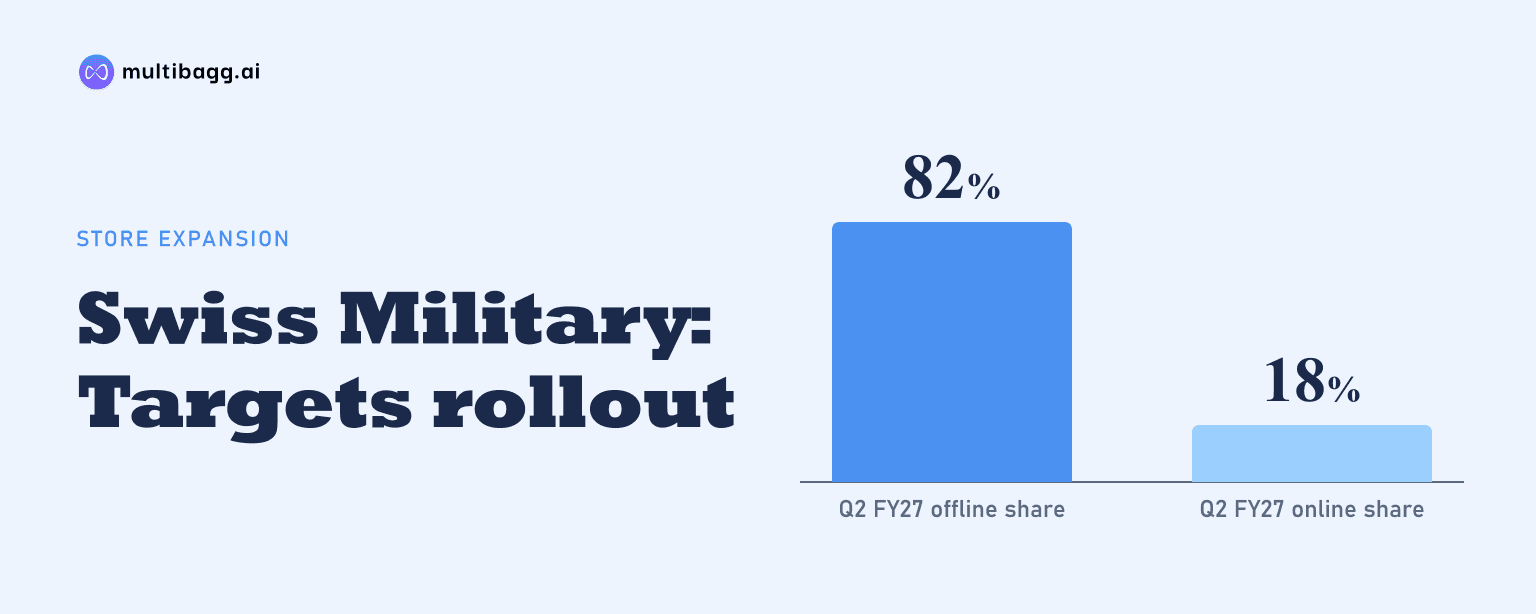
- Swiss Military reported 82% offline and 18% online channel contribution in Q2 FY27.
- Swiss Military launched 36 new products during FY27 and has a network of more than 3,000 outlets.
powered by IRIS
Swiss Military Consumer Goods Limited is targeting completion of the first phase of its exclusive-brand-outlet rollout by March 2027, while adding the Alpine Club value sub-brand for Tier II and III markets. The plan combines 200–800 sq. ft. stores, shop-in-shop expansion and a distribution network already spanning more than 3,000 outlets.
Know Swiss Military Consumer Goods inside out
Results, valuation, peers and who's buying, in one view.
What does Alpine Club add to Swiss Military’s brand architecture?
Alpine Club adds a value-focused product proposition to Swiss Military’s portfolio, aimed at expanding access to Tier II and III markets. The new sub-brand will offer polypropylene, or PP, luggage as well as backpacks, duffle bags, messenger bags and accessories. The presentation describes this as part of a two-brand architecture intended to let individual offerings address distinct consumer segments while protecting the equity of the core Swiss Military brand.
At the higher end of the range, the Black Gold Collection is positioned as an ultra-premium tier for sophisticated urban consumers, with elevated design, materials and specifications. This creates a stated separation between premium and value propositions: Black Gold Collection targets the ultra-premium tier, while Alpine Club is intended for the value segment. Swiss Military is using different product propositions to address more than one consumer segment.
Swiss Military is also widening its product basket beyond luggage and bags. Its newer accessory divisions include leather wallets and belts, luggage covers, neck pillows and Transportation Security Administration, or TSA, locks. Swiss Military says these categories are intended to lift average order value and support cross-selling across its distribution footprint of more than 3,000 outlets.
How will Swiss Military roll out exclusive brand outlets?
Swiss Military plans to roll out Exclusive Brand Outlets, or EBOs, in priority markets, with management targeting completion of phase one by March 2027. The named regions are Delhi NCR, Gujarat, South India and Bihar/Jharkhand. The disclosed timeline is a phase-one target rather than a reported count of stores opened, and the presentation does not state how many EBOs will be included in that phase.
The EBO plan uses store sizes ranging from 200 sq. ft. to 800 sq. ft., with formats tailored to local market potential and consumer needs. This size range shows that Swiss Military is not presenting one standard store template for every location. The company frames the programme as a shift away from merely widening distribution and toward controlling the consumer experience at the point of sale.
The owned-brand-store programme sits alongside an expansion of shop-in-shop, or SIS, formats with leading retail partners across India. Swiss Military says dedicated SIS spaces are intended to improve product visibility, visual identity and the breadth of the portfolio customers can see. Its broader channel plan also includes large-format retail, specialty stores and multi-brand outlets, with expansion cited across North, Central and Western India as it works toward nationwide retail coverage.
What is Swiss Military’s current channel mix?
Offline channels accounted for 82% of Swiss Military’s channel contribution in Q2 FY27, compared with 18% from online channels. The 64-percentage-point difference shows that physical retail remains the company’s larger route to customers while it builds direct retail formats. Its products were also available on more than 20 e-commerce platforms during the quarter, giving the 18% online contribution a broad marketplace base.
The contrast between the 82% offline and 18% online shares is central to the retail strategy. EBOs and SIS spaces could change the composition of the offline business because they seek stronger presentation and consumer engagement rather than simply more points of sale. However, Swiss Military has not disclosed a target channel mix for March 2027, so the presentation does not quantify how much EBOs are expected to change the 82% offline share.
During Q2 FY27, Swiss Military also ran its “Rise Above The Rush” campaign across digital, print and outdoor channels. The campaign was designed to deepen engagement with Gen Z and the modern mobile consumer, while a Gen Z-focused integrated campaign was cited separately as supporting brand relevance and recall. These marketing activities span physical and digital touchpoints, matching a distribution model that includes more than 3,000 outlets and more than 20 e-commerce platforms.
Got a follow-up? Ask IRIS
How does the expansion fit Swiss Military’s FY27 product strategy?
Swiss Military reported 36 new products launched during FY27, linking retail expansion to a broader product-refresh programme. The additions come as the company emphasises high-margin products with stronger value potential and market acceptance. Alpine Club’s PP luggage and bag categories, the Black Gold Collection and accessory divisions provide different product tiers and use cases for the EBO, SIS and multi-brand retail formats described in the presentation.
The expansion plan follows a difficult quarter marked by higher polycarbonate and polypropylene resin prices, broader input-cost inflation and aggressive industry discounting. Swiss Military said it did not pursue unprofitable volumes or pricing actions that could dilute brand equity or affect channel-partner health. Instead, it focused on products contributing higher margins, while noting that cost pressure restricted the industry’s ability to pass through higher inputs immediately.
Swiss Military identifies rising owned-manufacturing mix, better capacity utilisation and operating leverage as mechanisms that should support margin recovery when volumes scale and market pricing realigns with costs. Those are conditional factors rather than reported results. The planned retail programme complements that operating approach by seeking more control over consumer-facing execution, but Swiss Military has not supplied expected revenue, margin or capital-expenditure figures for the EBO rollout.
What market opportunity is Swiss Military targeting?
Swiss Military is targeting travel-gear demand that its presentation links to domestic tourism and a larger luggage market. It cites expected domestic tourism visits of 5.2 billion by 2030 and an estimated Indian luggage market of Rs 26,700 crore by 2028. The cited market outlook also projects a 12% compound annual growth rate, or CAGR, through 2028, providing context for its wider retail presence and new value offering.
Swiss Military also identifies India’s Gen Z population as a relevant consumer group, citing 377 million people and collective current spending power of US$860 billion. Its presentation says Gen Z represents 26% of the workforce and projects US$2 trillion of spending by 2035. Swiss Military’s Gen Z campaigns, accessible Alpine Club proposition and wider accessory basket are disclosed commercial responses to that consumer focus, rather than quantified sales forecasts from the group.
Conclusion
Swiss Military is combining a value-tier brand launch with a more controlled retail model. Alpine Club is designed for Tier II and III markets with PP luggage, bags and accessories, while Black Gold Collection remains in the ultra-premium tier. The 82% offline contribution in Q2 FY27 and more than 3,000 outlets give Swiss Military an existing physical base from which to develop EBO and SIS formats.
The next disclosed milestone is management’s March 2027 target for completion of EBO phase one across priority markets including Delhi NCR, Gujarat, South India and Bihar/Jharkhand. The presentation does not disclose the number of EBOs, opening pace, capital commitment or a target change in the reported 82% offline and 18% online channel mix.