










Swiss Military reports 24.95% margin despite resin inflation
Key highlights
- Swiss Military reported a 24.95% gross margin in Q2FY27, up 750 basis points from 17.47% in Q2FY26.
- Swiss Military reported Q2FY27 PAT of Rs 2.0749 crore, up 52% quarter on quarter, with a 3.41% PAT margin.
- Swiss Military launched 36 products during FY27 and reported an 82% offline and 18% online channel mix.
- Swiss Military targets completion of Phase 1 of its EBO rollout by March 2027.
powered by IRIS
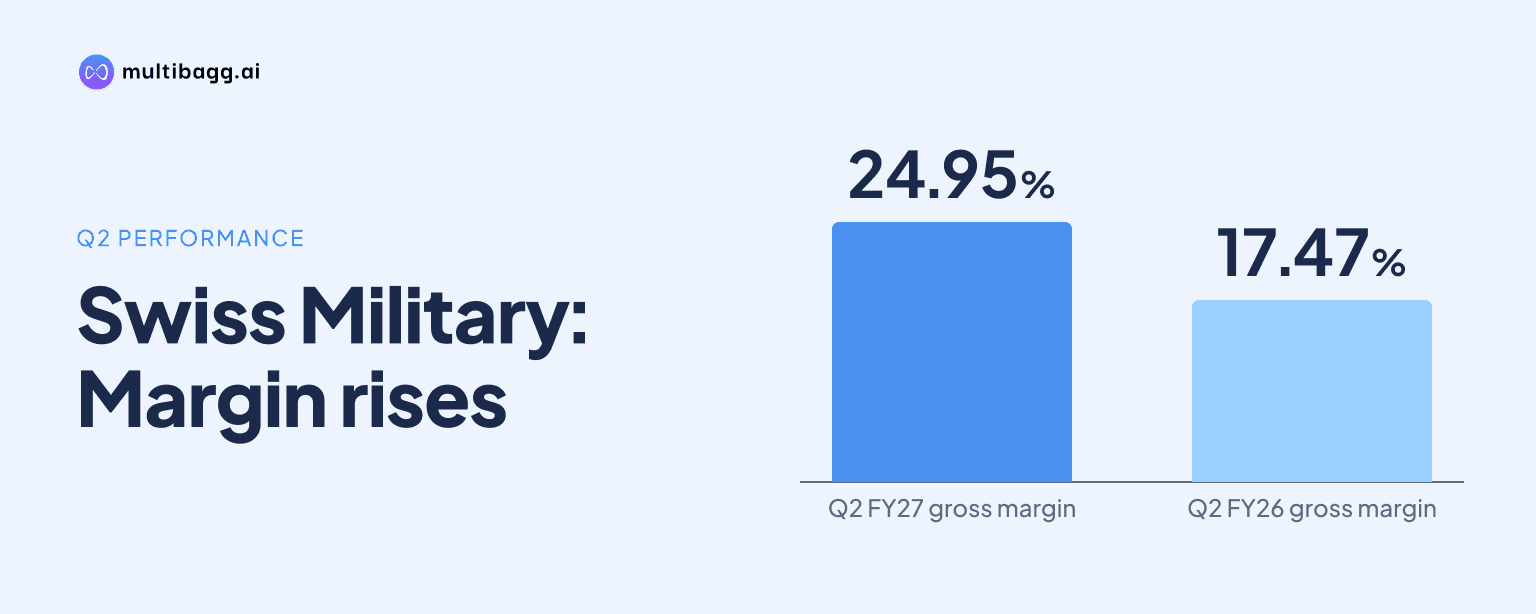
Swiss Military Consumer Goods Limited reported a 24.95% gross margin in Q2FY27, up 750 basis points from 17.47% in Q2FY26, after prioritising higher-margin products and pricing discipline amid higher polycarbonate and polypropylene resin costs and aggressive industry discounting.
Know Swiss Military Consumer Goods inside out
Results, valuation, peers and who's buying, in one view.
Why did Swiss Military avoid aggressive discounting?
Swiss Military avoided aggressive discounting in Q2FY27 because it said unprofitable volume growth and lower pricing could dilute brand equity and hurt channel-partner health. The company described unusually aggressive discounting by listed and unlisted players at a time when higher raw-material costs limited the industry’s ability to immediately pass those costs through to customers.
The pressure centred on plastic inputs across Swiss Military’s portfolio, particularly polycarbonate and polypropylene resins. The company also cited supply-chain disruption from geopolitical conflicts and political uncertainty, while subdued travel activity affected category demand. Its stated response was to protect margins and sustain business momentum rather than pursue price-led volumes.
Swiss Military said it sharpened product mix towards offerings with higher margins, stronger value potential and market acceptance. The presentation does not disclose the level of resin-price increases, the value of discounts avoided, volumes forgone, or the individual contribution of product mix, sourcing and pricing to the Q2FY27 margin result.
How did Swiss Military's gross margin change in Q2FY27?
Swiss Military’s gross margin rose to 24.95% in Q2FY27 from 17.47% in Q2FY26, a 750-basis-point increase. Management attributed the year-on-year movement to better product mix, sourcing efficiencies and pricing discipline, and said the result was achieved while input and raw-material costs were increasing.
The sequential comparison also changed materially. Gross margin increased by 247 basis points from 22.48% in Q1FY27 to 24.95% in Q2FY27, while net sales rose from Rs 12.0574 crore to Rs 15.1627 crore. Swiss Military described the improvement since Q1FY27 as structural rather than one-off, which is management’s assessment rather than a quantified target.
The longer five-quarter series shows that gross margin was 17.66% in Q3FY26 and 17.61% in Q4FY26, before reaching 22.48% in Q1FY27 and 24.95% in Q2FY27. This means the reported margin percentage rose across the two most recent quarters even though the company continued to identify resin inflation and industry discounting as constraints.
What is Swiss Military's stated route to margin recovery?
Swiss Military says that a higher owned-manufacturing mix, better capacity utilisation and operating leverage should support margin recovery as volumes scale and market pricing realigns with cost structures. The company did not disclose a target owned-manufacturing share, a capacity figure, a date for market-pricing realignment or a numerical margin-recovery objective.
Owned manufacturing is the first of the company’s stated mechanisms because it can alter the share of production controlled internally. Better capacity utilisation is the second, while operating leverage is the third: fixed costs may be spread over more units as volume grows. Swiss Military linked all three mechanisms to volume scaling after a period in which cost inflation and discounting constrained immediate pass-through.
Swiss Military is supporting its volume plans with product additions and a wider consumer offering. It reported 36 new products launched during FY27, including the ultra-premium Black Gold Collection and Alpine Club, a new value-segment sub-brand offering polypropylene luggage, backpacks, duffle and messenger bags, and accessories for Tier II and Tier III markets.
The company has also introduced accessory divisions covering leather wallets and belts, luggage covers, neck pillows and Transportation Security Administration, or TSA, locks. Swiss Military said these products are intended to increase average order value and cross-selling, although it did not report sales, margin or unit-volume figures for the individual collections or accessory categories.
Got a follow-up? Ask IRIS
Did the higher gross margin improve Swiss Military's profit?
Swiss Military reported that the gross-margin improvement reached the bottom line in Q2FY27, when profit after tax, or PAT, increased 52% quarter on quarter to Rs 2.0749 crore and PAT margin reached 3.41%. The company said this occurred despite higher spending on advertising and brand building.
Q2FY27 PAT margin of 3.41% was the highest in the five quarters presented, compared with 2.54% in Q1FY27 and 3.36% in Q2FY26. PAT declined from Rs 2.2566 crore in Q2FY26 to Rs 1.3744 crore in Q4FY26, then recovered to Rs 2.0749 crore in Q2FY27.
Earnings before interest, tax, depreciation and amortisation, or EBITDA, margin was 5.65% in Q2FY27, compared with 5.29% in Q1FY27 and 3.37% in Q4FY26. Swiss Military said it reinvested a significant part of its gross-margin gain in advertising and brand building, including a Gen Z-focused campaign across digital, print and outdoor media, while still reporting its highest EBITDA margin in five quarters.
How does retail expansion fit Swiss Military's recovery plan?
Swiss Military reported that offline channels accounted for 82% of its business and online channels for 18%, with products available on more than 20 e-commerce platforms. The channel mix places physical retail at the centre of its planned volume expansion while the company broadens digital availability.
Swiss Military said its products were present in more than 3,000 outlets and that it is rolling out Exclusive Brand Outlets, or EBOs, in priority markets including Delhi NCR, Gujarat, South India and Bihar/Jharkhand. The planned EBO formats measure 200 to 800 square feet, and Phase 1 is targeted for completion by March 2027.
The company is also expanding Shop-In-Shop, or SIS, formats with retail partners across India. Swiss Military said dedicated brand spaces are intended to provide greater product visibility, a wider portfolio experience and a more consistent visual identity, while it expands across large-format retail, specialty stores and multi-brand outlets.
The retail programme is therefore connected to Swiss Military’s stated recovery mechanisms through volume scaling, not through a disclosed margin target. Whether expanded EBO and SIS formats raise utilisation or improve the owned-manufacturing mix cannot be established from the presentation, which provides the March 2027 Phase 1 target but no store-count target or retail investment amount.
Conclusion
Swiss Military’s reported Q2FY27 performance combines pricing restraint with a higher-margin product mix: gross margin reached 24.95%, PAT reached Rs 2.0749 crore and PAT margin reached 3.41%. The figures followed a period of resin-cost inflation, supply-chain disruption, subdued travel activity and aggressive discounting, conditions in which the company said it chose margin and channel health over unprofitable volume.
The next disclosed milestone is completion of Phase 1 of the EBO rollout by March 2027, alongside continued SIS expansion and the FY27 launch of 36 products. Swiss Military’s stated recovery path depends on market pricing realigning with costs, a higher owned-manufacturing mix, improved capacity utilisation and operating leverage as volumes scale, while the timing of those developments remains undisclosed.