










Tamil Nadu Newsprint and Papers Returns to Profit in Q2 FY26
Key highlights
- Tamil Nadu Newsprint and Papers reported Q2 FY26 net profit of ₹8.10 crore versus a ₹7.41 crore loss in Q1 FY26.
- Revenue from operations rose 21.5% year-on-year to ₹1,110.15 crore in Q2 FY26.
- EBITDA margin declined 248 basis points year-on-year to 11.09% in Q2 FY26.
- Packaging board production increased to 50,360 metric tonnes from 44,884 metric tonnes a year earlier.
powered by IRIS
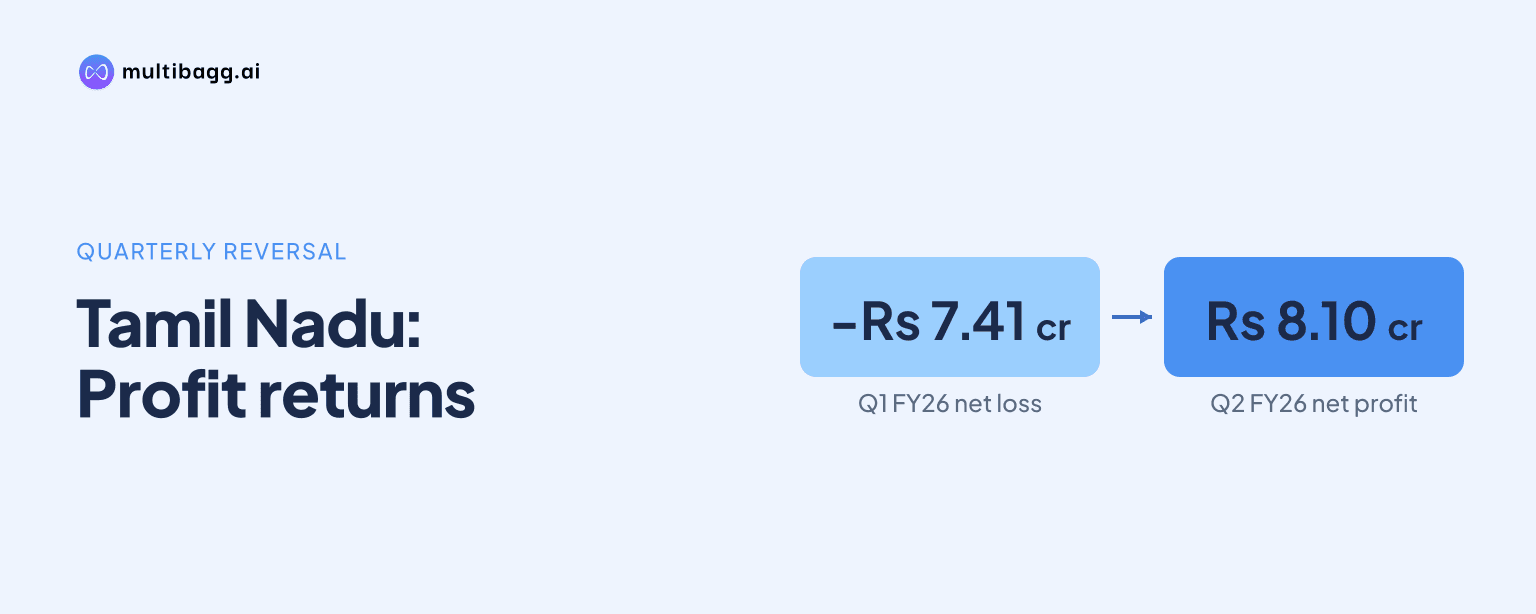
Tamil Nadu Newsprint and Papers Limited returned to profit in Q2 FY26, reporting net profit of ₹8.10 crore for the quarter ended September 30, 2025, against a ₹7.41 crore loss in the preceding quarter. Revenue from operations rose 21.5% year-on-year to ₹1,110.15 crore, although it declined 2.8% sequentially.
Know Tamil Nadu Newsprint & Papers inside out
Results, valuation, peers and who's buying, in one view.
What did Tamil Nadu Newsprint and Papers report for Q2 FY26?
Tamil Nadu Newsprint and Papers reported a standalone net profit of ₹8.10 crore in Q2 FY26, compared with a net loss of ₹7.41 crore in Q1 FY26 and a profit of ₹2.59 crore in Q2 FY25. Earnings per share improved to ₹1.17 from a loss per share of ₹1.07 in the June quarter and ₹0.37 a year earlier.
Revenue from operations reached ₹1,110.15 crore, up from ₹913.71 crore in Q2 FY25. Total income was ₹1,128.39 crore, 21.6% higher than ₹927.87 crore a year earlier. However, total income was 2.3% below the ₹1,154.55 crore reported in the preceding quarter, indicating that the return to profit came despite a sequential moderation in income.
How did TNPL move from a loss to a profit?
TNPL's profit recovery was supported by lower expenses on a sequential basis. Total expenditure declined to ₹1,115.46 crore in Q2 FY26 from ₹1,166.37 crore in Q1 FY26. The reduction helped profit before tax turn positive at ₹12.93 crore, compared with a pre-tax loss of ₹11.82 crore in the June quarter.
The company also recorded a lower tax outgo. Tax expense stood at ₹0.77 crore, compared with ₹2.97 crore in Q2 FY25. On a year-on-year basis, profit before tax rose from ₹5.05 crore, while net profit increased from ₹2.59 crore.
Operating conditions remained demanding despite the improvement. Total expenditure was still 25% higher than ₹789.69 crore in Q2 FY25. Raw-material costs rose 13.8% year-on-year to ₹567.05 crore, while employee benefit expenses increased 2.3% to ₹115.46 crore. Finance costs, however, declined 12.6% to ₹50.02 crore from ₹57.24 crore a year earlier.
What happened to TNPL's margins and operating performance?
TNPL reported EBITDA of ₹123.13 crore in Q2 FY26, marginally lower than ₹124.02 crore in Q2 FY25, even as revenue increased. This meant EBITDA margin compressed to 11.09% from 13.57%, a decline of 248 basis points.
The figures show that higher sales did not translate proportionately into operating profit. While the company benefited from a sequential easing in expenditure, year-on-year cost growth remained faster than the movement in operating earnings. The reported net-profit margin was also thin, with net profit of ₹8.10 crore against total income of ₹1,128.39 crore.
For investors, the quarter therefore reflects both a recovery from the June-quarter loss and continued pressure on profitability. The financial result was stronger at the profit-before-tax and net-profit levels than in Q1 FY26, but operating margin data points to a cost-sensitive business environment.
Got a follow-up? Ask IRIS
What were TNPL's production trends and market conditions?
TNPL produced 107,094 metric tonnes of paper during Q2 FY26, compared with 106,143 metric tonnes in Q2 FY25. Packaging board production increased to 50,360 metric tonnes from 44,884 metric tonnes in the corresponding quarter, showing higher output in that category.
For the first half of FY26, paper production was 213,469 metric tonnes, lower than 215,522 metric tonnes a year earlier. Packaging board output for the half year rose to 100,042 metric tonnes from 89,615 metric tonnes. The contrasting production data indicates that growth in packaging board partly offset a marginal decline in half-year paper output.
The company cited subdued market demand, imports of paper at lower prices, and uncertainty around GST 2.0 rate changes as factors affecting the paper industry. TNPL said it expected market conditions to stabilise gradually, but the reported quarter did not provide a timetable or financial target for that stabilisation.
How did the market respond to TNPL's September-quarter result?
TNPL shares rose 4.40% to ₹161.20 after the September 2025 quarterly result was reported. The market response followed the shift from a loss in Q1 FY26 to a profit in Q2 FY26 and the 212.74% year-on-year increase in net profit from the low base of ₹2.59 crore.
The stock movement came alongside revenue growth and the recovery in profit before tax. However, the quarterly disclosures also showed that revenue declined sequentially and EBITDA was broadly flat year-on-year. These details are relevant for investors assessing whether the improvement in net profit can be sustained amid weaker demand and low-priced imports.
TNPL's half-year revenue from operations rose 10.9% to ₹2,252.25 crore from ₹2,030.28 crore in the corresponding prior-year period. Total income for the first half was ₹2,282.94 crore, compared with ₹2,057.71 crore a year earlier, providing context for the company's higher year-on-year sales base.
Conclusion
Tamil Nadu Newsprint and Papers returned to profitability in Q2 FY26 through a combination of higher year-on-year revenue, lower sequential expenditure, and a lower tax charge. Its ₹8.10 crore net profit marked a clear improvement from the ₹7.41 crore loss in the prior quarter, though EBITDA margin compression and a sequential revenue decline show that operating conditions remain constrained.
The next areas to watch are demand conditions in the paper market, the effect of lower-priced imports, GST 2.0-related uncertainty, and the company's stated expectation of gradual market stabilisation. Production trends in paper and packaging board, along with the movement in raw-material and finance costs, will remain important indicators in subsequent results.