










TCPL Packaging Limited Targets ₹2,000 Crore Battery Film Revenue
Key highlights
- TCPL Packaging plans to invest ₹125 crore in battery separator films over 18 months.
- The initial facility is designed for 70 million square metres of annual separator-film capacity.
- Initial capacity could support 6-8 GWh of lithium-ion battery cell production annually.
- TCPL Packaging is targeting up to ₹2,000 crore in annual revenue at full scale.
powered by IRIS
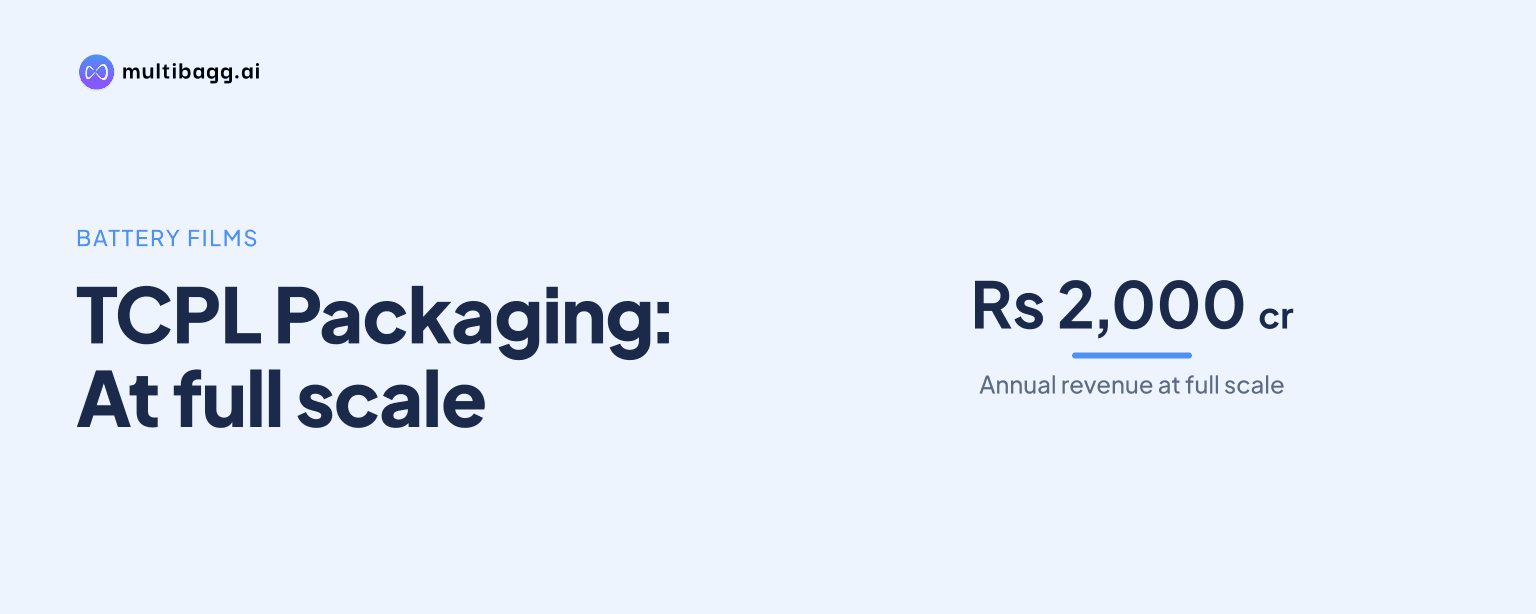
TCPL Packaging Limited is targeting up to ₹2,000 crore in annual revenue from lithium-ion battery separator films at full scale, following an initial ₹125 crore investment planned over 18 months. The packaging manufacturer is entering the Advanced Chemistry Cell supply chain through a wholly owned subsidiary, with commercial production targeted for Q4 FY2028.
Know TCPL Packaging inside out
Results, valuation, peers and who's buying, in one view.
Why is TCPL Packaging entering the battery separator film business?
TCPL Packaging is entering the business to diversify beyond packaging and build a long-term growth platform in lithium-ion battery materials. The company said separator films will be used in applications including electric mobility, grid-scale energy storage and other battery-based uses.
The venture is being undertaken through TCPL Energy Materials Limited, a wholly owned subsidiary incorporated on September 24, 2026. TCPL Packaging had announced on August 11, 2026 that it would enter the battery materials business through a subsidiary to manufacture lithium-ion battery separator films.
At its Q2 FY27 earnings call on November 6, Executive Director Akshay Kanoria said the company was taking a first step with land and infrastructure available for future expansion. He said the initial project could create revenue of up to ₹200 crore, while the business could eventually reach a revenue range of ₹1,000 crore to ₹2,000 crore.
What is TCPL Packaging's investment and production plan?
TCPL Packaging plans to invest approximately ₹125 crore in the project over the next 18 months, funded through a mix of internal accruals and debt. The company has maintained its target of starting commercial production in Q4 FY2028.
The initial facility is planned to produce 70 million square metres of separator film annually. According to TCPL Packaging, this capacity would support lithium-ion battery cell production of 6 GWh to 8 GWh a year.
The initial phase will focus on building manufacturing infrastructure, product development and validation, customer qualification, and relationships with battery-cell manufacturers. The company has stated that it will initially use water-based coating machines before adding polyethylene film extrusion.
How could the battery materials business scale over time?
TCPL Packaging envisages scaling separator film production to about 500 million square metres annually over a five-to-seven-year expansion period. The company estimates that this capacity could support around 50 GWh of annual lithium-ion battery cell manufacturing capacity in India.
Management has indicated that the initial investment is intended as a starting point rather than the final scale of the business. The long-term revenue potential of ₹1,000 crore to ₹2,000 crore depends on the venture reaching fuller operational capacity over the planned expansion horizon.
The scale-up plan is linked to domestic demand for lithium-ion batteries and the development of India's Advanced Chemistry Cell manufacturing ecosystem. TCPL Packaging has also cited potential opportunities in domestic and export markets, though it has not disclosed specific customers, supply agreements or order commitments for the new business.
Got a follow-up? Ask IRIS
What experience does TCPL Packaging bring to separator films?
TCPL Packaging said the new business can draw on its existing capabilities in polymer processing, precision manufacturing and barrier film technology. These capabilities are relevant to separator-film production, although battery materials involve separate product validation and customer-qualification requirements.
The company is primarily a manufacturer of folding cartons, flexible packaging and litho-laminated packaging. It serves consumer-goods customers from facilities in India and overseas and is listed on the BSE and NSE.
TCPL Packaging has previously expanded its packaging portfolio and manufacturing footprint, including a Chennai facility focused on paperboard cartons. Its battery separator project represents a move into a different end market, while retaining a manufacturing process focus that the company says is supported by its existing technical base.
What does the venture mean for TCPL Packaging investors and operations?
The project adds a new capital expenditure programme and introduces TCPL Packaging to the battery materials supply chain. The company has not disclosed the location of the separator-film facility, project-level profitability expectations, or the share of funding to be met through internal accruals and debt.
For investors, the near-term reference point is the ₹125 crore outlay and the Q4 FY2028 production target. Revenue of up to ₹200 crore is the stated potential for the initial investment, while the ₹2,000 crore figure is a long-term management target rather than current business revenue.
TCPL Packaging reported revenue of ₹564.6 crore for Q2 FY27, up 20% year on year, and net profit of ₹45.3 crore, up 58%, according to the information released with its second-quarter results on November 5, 2026. These reported packaging-business results provide context for the size of the proposed battery-materials opportunity, but the company has not provided separate financial guidance for the new subsidiary.
What needs to happen before commercial production begins?
TCPL Packaging must establish the facility, develop and validate its products, complete customer qualification processes and build relationships with cell manufacturers before commercial production begins. These steps are part of the company's disclosed 18-month implementation plan.
The project is also tied to the pace at which Indian lithium-ion cell manufacturing capacity develops. TCPL Packaging's capacity estimates are expressed in terms of the battery-cell production that its separator films could support, rather than confirmed customer demand or contracted supply volumes.
Management reconfirmed during the November 2026 earnings discussion that commercialization remains on track for Q4 FY2028. The next material updates will be disclosures on project execution, manufacturing readiness, customer qualification and progress toward the initial 70 million square metre annual capacity.
Conclusion
TCPL Packaging is using a ₹125 crore initial investment to enter lithium-ion battery separator films through TCPL Energy Materials Limited. The project broadens the company's manufacturing portfolio beyond packaging, with an initial revenue potential of up to ₹200 crore and a longer-term target of up to ₹2,000 crore if the planned scale-up is achieved.
Investors will watch the project's progress toward commercial production in Q4 FY2028, including the development and validation of separator films, cell-maker qualification and the funding of the expansion. The company has outlined a five-to-seven-year path to 500 million square metres of annual capacity, but has not yet disclosed customer contracts or project-level profitability.