










Technocraft Industries expects elevated volumes to persist in US
Key highlights
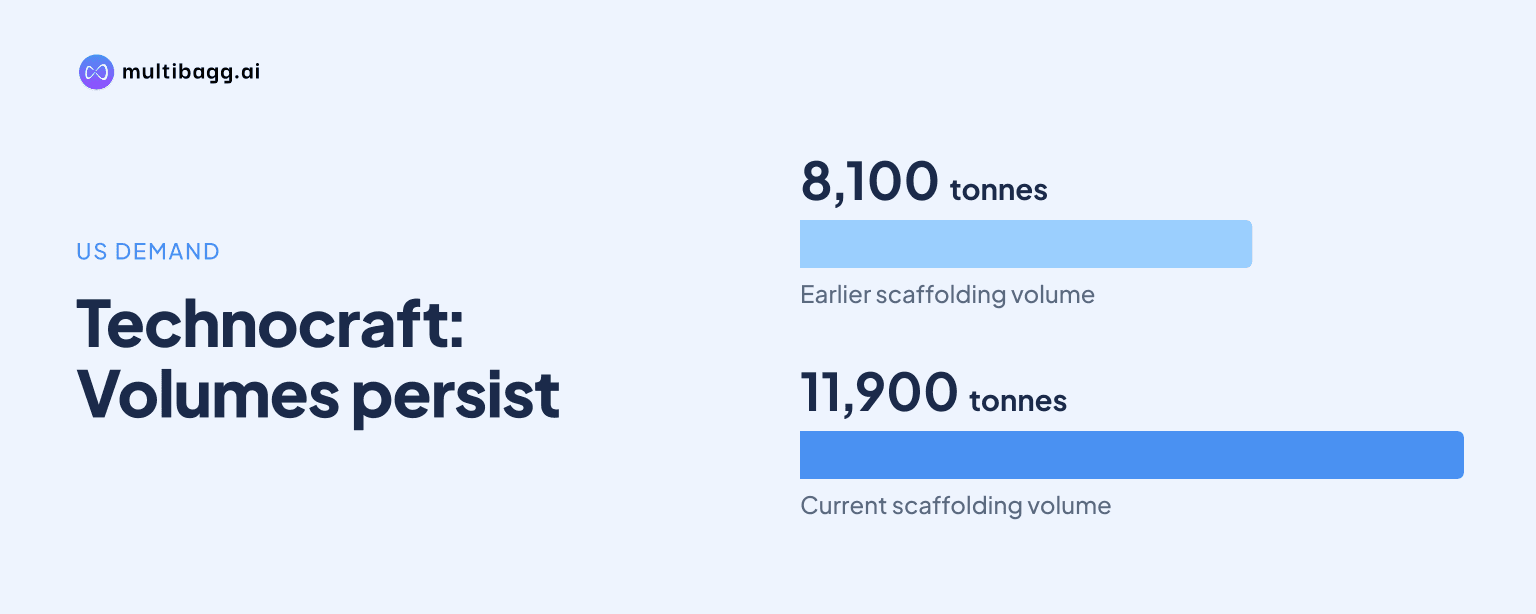
- Technocraft Industries cited scaffolding volumes of about 11,900 tonnes versus an earlier average of about 8,100 tonnes.
- Drum-closure volumes were cited at about 220 lakh sets versus a historical level of about 180 lakh sets.
- Management said launched US projects provided a 15-to-18-month scaffolding demand window.
- Technocraft Industries said existing plants can support about Rs 2,500 crore of revenue with minimal capacity additions.
powered by IRIS
Technocraft Industries (India) Limited said on November 16, 2026, that launched US projects provide a 15-to-18-month scaffolding demand window, supporting its expectation that elevated volumes can continue in the near term. Technocraft Industries also cited drum-closure volumes of nearly 230 lakh sets a quarter, with demand firm outside Europe.
Know Technocraft Industries (India) inside out
Results, valuation, peers and who's buying, in one view.
What volume improvement has Technocraft Industries reported?
Technocraft Industries has seen a substantial increase in scaffolding and drum-closure volumes during the two quarters discussed on the call. GreenEdge Wealth analyst Digant Haria cited scaffolding volume of about 11,900 tonnes, against an average of about 8,100 tonnes over the preceding eight or nine quarters. He also cited drum-closure volume of about 220 lakh sets, compared with a historical level of about 180 lakh sets.
Management agreed that both segments had recorded higher volumes over the two quarters and attributed the change mainly to demand in key markets. Chief Executive Officer Navneet Kumar Saraf said Technocraft Industries was confident it could sustain the higher levels through ensuing quarters, subject to unforeseen upheavals. The company did not attribute the increase to a one-time operating event.
Why does Technocraft Industries expect drum-closure demand to continue?
Technocraft Industries expects drum-closure demand to continue because the US, Asia Pacific and China have supported orders, while Europe is the regional exception. Management described the US as one of its biggest drum-closure markets and said demand there had increased alongside a strong local economy. It also said Asia Pacific was an important contributor and that demand in China was strong.
Drum closures have exposure to several end-user industries because Technocraft Industries sells first to drum producers. Those drum producers serve petrochemical, food, pharmaceutical and industrial-chemical customers, according to management. This end-market mix means the segment is not dependent solely on petrochemical or oil-related demand.
Management said customers had accepted drum-closure price increases without pushback. It said volumes of almost 230 lakh sets a quarter had delivered margins of close to 40% in the first two quarters, and that 35% to 40% was a reasonable range at those volumes. Management added that gains from rupee depreciation could lessen if the rupee appreciates over the next couple of quarters.
How long can Technocraft Industries sustain scaffolding demand?
Technocraft Industries said its scaffolding pipeline supports demand for at least 12 to 15 months, with projects already launched providing a 15-to-18-month demand window. The US is the company’s biggest scaffolding market, and management linked construction demand there to investment in data centres, chip-manufacturing plants and energy plants.
Management made a clear distinction between existing projects and possible future launches. Saraf said projects launched in the preceding six months were continuing according to plan, with no change in the demand Technocraft Industries was seeing from them. He said the pace of new project launches was harder to assess because there were differing views on whether future construction activity would stay stable or slow.
Europe provides a contrast to the US scaffolding market. Technocraft Industries has held European scaffolding certification for more than a year and has made sales there, but management said regional demand remained muted. It reported some improvement in Central Europe, particularly Poland, but gave no volume target or timetable for a broader European ramp-up.
Got a follow-up? Ask IRIS
Does Technocraft Industries have capacity for sustained demand?
Technocraft Industries said its existing plants can support about Rs 2,500 crore of revenue with minimal additional capacity, limiting the need for major immediate capital expenditure. Management said it had created formwork capacity at Aurangabad and added scaffolding capacity at Murbad. For drum closures, it is continuously debottlenecking facilities in India and China.
The company estimated Q2 FY27 revenue from its formwork-and-scaffolding segment at Rs 502 crore. Management put scaffolding revenue at about Rs 260 crore to Rs 270 crore and formwork revenue at about Rs 240 crore, indicating a broadly even split between the two businesses. The comparison shows that US-led scaffolding demand sits alongside a sizeable formwork operation serving India.
Technocraft Industries plans the second phase of its aluminium-extrusion expansion at Aurangabad for the latter part of FY28. Management estimated capital expenditure of about Rs 120 crore and said land was already available for the project. It said the expansion would backward integrate incremental capacity, rather than representing a separately disclosed large expansion for drum closures or scaffolding.
What could alter Technocraft Industries' volume outlook?
Technocraft Industries said unforeseen upheavals could affect its ability to maintain near-term volumes. For scaffolding, the key unresolved factor is the level of US project launches after the current 15-to-18-month window from projects already underway. Management’s visibility is based on launched data-centre, chip-manufacturing and energy projects, not on an assumption that all future projects will proceed at the same pace.
For drum closures, Europe remains the gap in management’s otherwise positive assessment of the US, Asia Pacific and China. Management did not disclose regional volume contributions, so the effect of any change in demand by geography cannot be quantified from the call. A reduction from the nearly 230 lakh-set quarterly run-rate would also be relevant to management’s stated 35% to 40% margin range.
Mach One formwork has a different execution constraint from export scaffolding. Management said its order book was strong but quarterly offtake could vary with customer readiness and site readiness in India. Technocraft Industries said it was deliberately prioritising customers ready to use aluminium formwork instead of accepting orders from every developer, because it sought to protect production efficiency.
Conclusion
Technocraft Industries’ outlook relies on two disclosed demand supports: US construction projects already launched for scaffolding and broad drum demand across the US, Asia Pacific and China. The comparison of about 11,900 tonnes of scaffolding against an earlier 8,100-tonne average, and about 220 lakh drum-closure sets against 180 lakh sets, supports management’s view that the recent increase can persist near term.
The next disclosed investment milestone is the second phase of aluminium-extrusion expansion in the latter part of FY28, involving about Rs 120 crore of capital expenditure. Before then, the relevant developments are whether launched US projects sustain the stated 15-to-18-month scaffolding window, whether European demand improves, and whether drum closures remain near the quarterly run-rate of almost 230 lakh sets.