










Technocraft Industries (India) Q2 Net Profit Rises 50.4%
Key highlights
- Technocraft reported Q2 FY27 revenue of ₹935.2 crore, up 28.9% year on year.
- Q2 FY27 net profit rose 50.4% year on year to ₹119.1 crore.
- Drum-closure volume reached 226 lakh sets, compared with an average of about 180 lakh sets.
- Mach 1 has a 4.5 lakh square metre order book and is poised for revenue of over ₹900 crore in FY27.
powered by IRIS
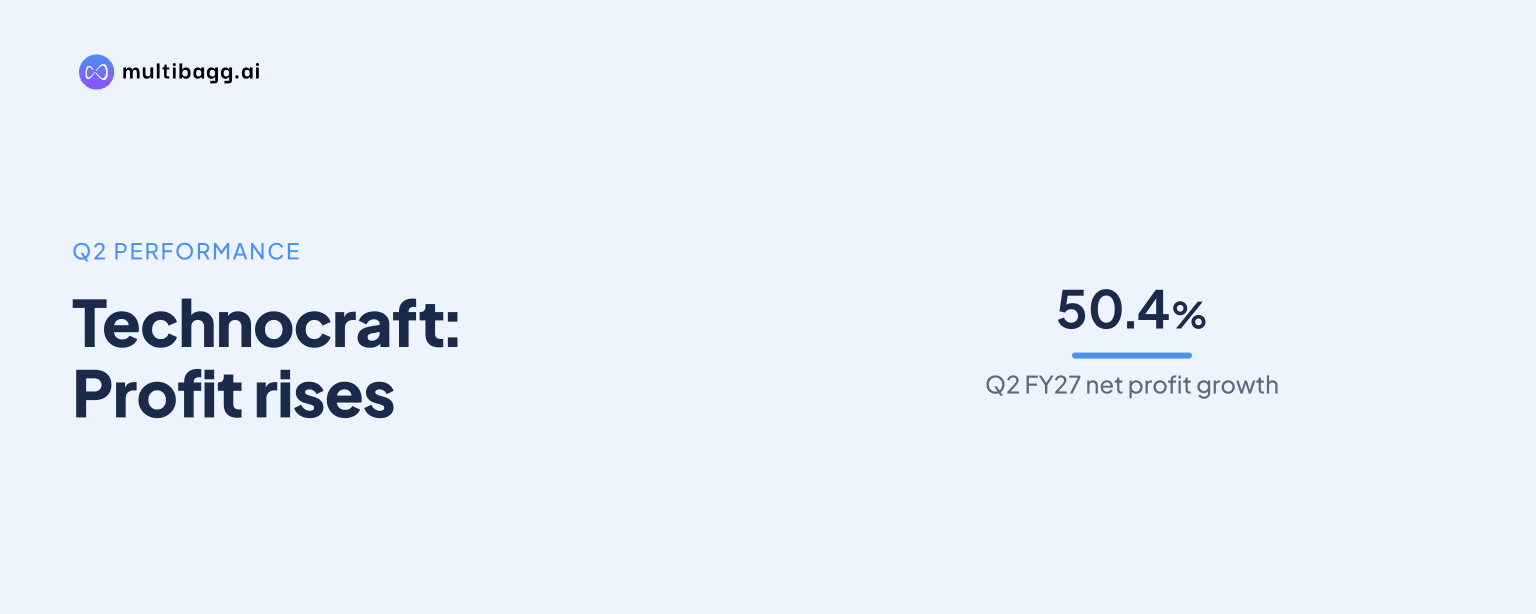
Technocraft Industries (India) Ltd reported Q2 FY27 net profit of ₹119.1 crore, up 50.4% year on year, as revenue from operations rose 28.9% to ₹935.2 crore on stronger scaffolding and drum-closure volumes. The September-quarter performance points to higher operating activity across key overseas markets, particularly the US and Asia Pacific.
Know Technocraft Industries (India) inside out
Results, valuation, peers and who's buying, in one view.
What were Technocraft's Q2 FY27 financial results?
Technocraft posted consolidated operating revenue of ₹935.2 crore for Q2 FY27, compared with ₹725.4 crore in the corresponding quarter a year earlier. EBITDA increased to about ₹201 crore, representing a 21% margin, while profit before tax rose 55% year on year to ₹157 crore.
Net profit rose to ₹119.1 crore, with the company attributing the quarter's performance to volume growth in its main industrial businesses. The results were discussed in the company's investor presentation on November 13, 2026, followed by an earnings call on November 16. The reporting period covered the quarter ended September 30, 2026.
Why did scaffolding and drum closures drive the quarter?
Higher sales volumes in scaffolding and drum closures were the main drivers of Technocraft's revenue growth. Drum-closure volume reached 226 lakh sets during the quarter, compared with an average of about 180 lakh sets, while scaffolding volume was 11,900 tonnes against an average of 8,100 tonnes cited by management.
Management said demand was robust in key markets including the US and Asia Pacific. The company distributes scaffolding through its own warehouses in the US, a model that requires inventory build-up, especially when new warehouses are opened. This working-capital requirement can cause cash-flow timing to differ from reported profit and EBIT.
Drum-closure margins were reported at about 35% to 40%, supported by higher volumes and better absorption of fixed costs. Management also cited rupee depreciation as a benefit during the period. It said the recent appreciation of the rupee could moderate this currency tailwind, but described the 35% to 40% margin range as a reasonable expectation in the near term.
What is Technocraft's capacity and expansion plan?
Technocraft said its existing capacity can support revenue of ₹2,500 crore with minimal additional capital expenditure. Management said capacity has been built continuously at Aurangabad for scaffolding and formwork, and at Murbad for scaffolding, reducing the immediate need for major new capacity additions.
The disclosed expansion plan is a second phase of aluminium extrusion capacity at Aurangabad in FY28. Management indicated that the project is expected to begin in the latter part of FY28, with planned capital expenditure of about ₹120 crore. Land for the expansion is already available, and the project is intended to provide backward integration for incremental capacity.
The Mach 1 aluminium-formwork business remains an important part of the company's operating plan. Management said the segment is poised to generate more than ₹900 crore of revenue in FY27 and has an order book of 4.5 lakh square metres to be executed over the next four to five months. It also said Mach 1 is on track to triple revenue over three to four years, though the investor presentation did not provide explicit consolidated forward guidance.
Got a follow-up? Ask IRIS
How do the results affect Technocraft's investors and operations?
For investors, the quarter shows that profit growth exceeded revenue growth, supported by the increase in EBITDA and the higher operating margin profile of drum closures. The reported 21% EBITDA margin and 50.4% rise in net profit provide context for the impact of volume growth and fixed-cost absorption during the quarter.
The result also highlights the importance of overseas operations to Technocraft's financial performance. US warehousing supports the scaffolding distribution model but requires inventory investment. In addition, the US entity follows a January-December accounting year while the Indian entity follows April-March, which management said can create timing differences in consolidated cash flow and reported earnings.
Management said there was no significant customer pushback on drum-closure pricing. At quarterly volumes of roughly 230 lakh sets, it said pricing had been accepted by customers. This is relevant to the division's margin performance, although currency movements and sales mix remain factors cited by the company.
What does the segment mix indicate about business momentum?
Technocraft said revenue from scaffolding and formwork was nearly evenly split within a total segment revenue base of ₹502 crore. Management indicated that scaffolding contributed roughly ₹260 crore to ₹270 crore, while formwork accounted for about ₹240 crore during the period discussed on the call.
The split indicates that the quarter was not dependent on one business alone. Scaffolding benefited from demand and distribution activity in overseas markets, while formwork was supported by the Mach 1 order book. Drum closures added a separate source of volume and margin support, giving the company exposure to multiple industrial product lines.
No share-price movement or valuation data was disclosed in the company materials. As a result, the financial update should be assessed through the reported revenue, profitability, volume data, capacity plans and order-book disclosures rather than by inferring a market-price reaction from the available information.
Conclusion
Technocraft delivered a stronger Q2 FY27, with revenue rising 28.9% to ₹935.2 crore and net profit increasing 50.4% to ₹119.1 crore. Higher scaffolding and drum-closure volumes, supported by US and Asia Pacific demand, were central to the performance, while drum-closure margins benefited from operating leverage and currency conditions.
The next disclosed operational milestone is the planned second phase of aluminium extrusion expansion in the latter part of FY28, involving about ₹120 crore of capital expenditure. Investors will also track execution of the 4.5 lakh square metre Mach 1 order book, the business's stated FY27 revenue ambition of more than ₹900 crore, and the effect of currency movements on drum-closure margins.