










Technocrats Plasma says in-house shift could lift margins
Key highlights
- Technocrats Plasma plans to begin commercial production at a 20,000-square-foot rented facility in December 2026.
- The replacement facility is five times the 4,000-square-foot rented site that Technocrats Plasma plans to surrender.
- Management cited 40%-50% margins for factory work versus 15%-20% for outside customer-site projects.
- Technocrats Plasma reported H1 FY27 revenue of Rs 103.551 crore, up 97.4% year on year.
powered by IRIS
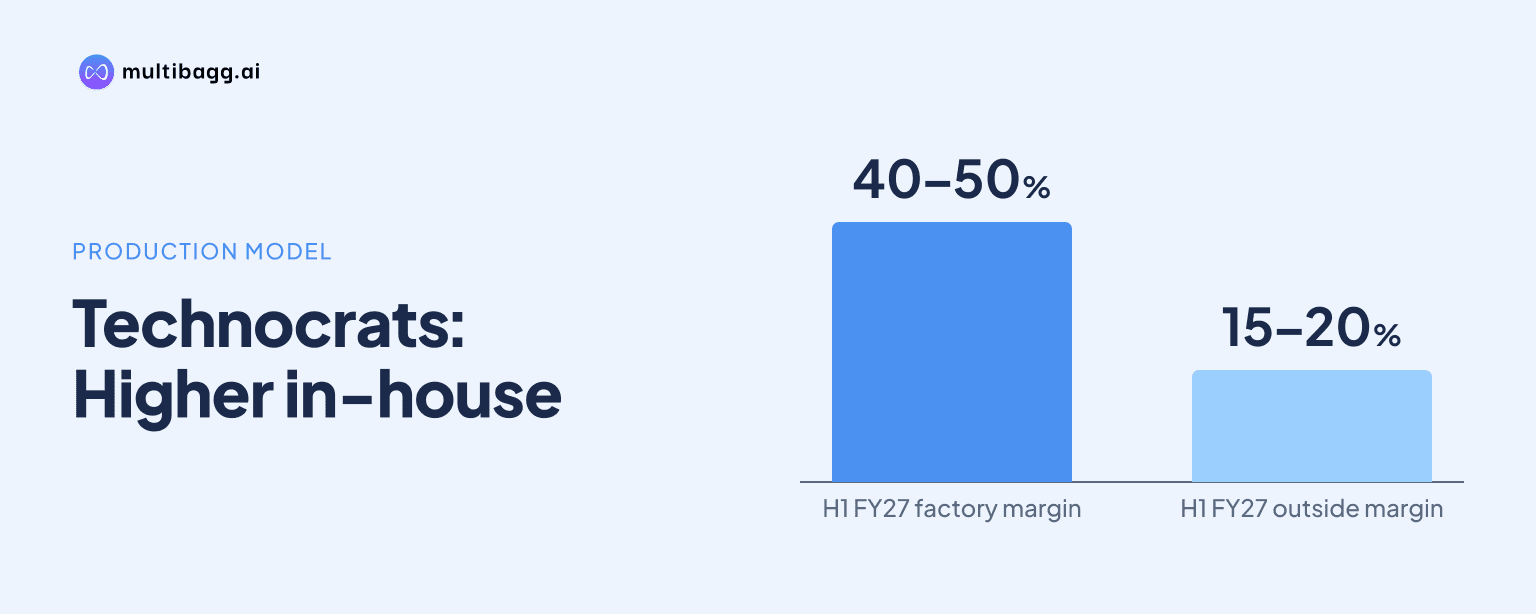
Technocrats Plasma Systems Limited says its December 2026 move to a 20,000-square-foot rented facility could lift project economics by moving customised automation work in-house, where management cited margins of 40%-50%, compared with 15%-20% for customer-site jobs. The company will surrender its existing 4,000-square-foot rented location during December 2026.
Know Technocrats Plasma Systems inside out
Results, valuation, peers and who's buying, in one view.
What will Technocrats Plasma's new rented facility change?
Technocrats Plasma says the 20,000-square-foot site will allow it to execute more specialised automation projects internally rather than at customer locations. Commercial production is scheduled to start in December 2026, alongside the surrender of the present 4,000-square-foot rented facility, making the replacement site five times larger by area.
Management said the additional space provides the high ceiling and lateral ground-level area required for certain projects that are currently undertaken outside its facilities. The company reported about 75% capacity utilisation in H1 FY27 and served 95 customers across its end markets, making the shift an execution change within its existing cutting, welding and automation operations.
The expansion is not a direct formula for a fivefold rise in revenue. When an analyst asked whether the 20,000-square-foot facility could support Rs 500 crore to Rs 600 crore of revenue, Managing Director Arun Kumar said floor area had “no relation at all” to revenue potential. Management instead presented the site as a way to bring higher-value customised work inside the factory.
The rented facility is also separate from Technocrats Plasma's proposed longer-term manufacturing site. Management said it remains in the land-identification stage for that project and intends eventually to consolidate a significant majority of manufacturing activities under one roof. It disclosed no location, capital expenditure or completion date for the permanent facility.
Why does Technocrats Plasma expect factory work to raise margins?
Technocrats Plasma expects a better execution mix to raise profitability because management cited 40%-50% margins for jobs completed in its own factory, compared with 15%-20% for jobs performed at customer sites. The stated difference relates to specialised, customised automation work, not to a forecast for the company's consolidated earnings margin.
The company reported an earnings before interest, tax, depreciation and amortisation margin of 16.5% in H1 FY27, on revenue from operations of Rs 103.551 crore. That reported company-wide margin is different from management's project-level ranges, which were cited to explain why bringing more automation work in-house may alter the economics of similar turnover.
Customised work was already a substantial part of H1 FY27 revenue. Lifecycle support for supplied equipment contributed 35.3%, customisation and retrofit solutions contributed 34.8%, machines with automation accounted for 22.5%, and machines without automation represented 7.5%. Management linked the new site specifically to manufacturing more specialised automation products internally rather than forecasting a change in every revenue category.
Technocrats Plasma recorded earnings before interest, tax, depreciation and amortisation of Rs 17.039 crore in H1 FY27, up 78% year on year, while profit after tax rose 58% to Rs 11.948 crore. Both results preceded the planned December 2026 production start, so the facility's eventual effect will depend on how much site-based work actually moves inside and the projects selected for the site.
Got a follow-up? Ask IRIS
How could the new facility change Technocrats Plasma's cash cycle?
Technocrats Plasma says factory-based production can reduce the collection period attached to outside projects. Management said customer-site jobs can take 90 to 120 days, or at times four to five months, whereas factory production operates on a maximum 60-day cycle and typically receives advances, milestone payments and 90% payment before dispatch.
The cash-conversion case is therefore based on billing and collection terms, rather than a disclosed target for total working capital. Management said it wants to move more external work in-house, where it expects cash to be received sooner. It did not quantify the share of current sales performed at customer sites or specify the amount of working capital that could be released after December 2026.
The issue is material to the company's H1 FY27 working-capital position discussed on the call. An analyst cited trade receivables rising from Rs 21 crore to almost Rs 68 crore and inventories rising from Rs 33 crore to Rs 53 crore, alongside negative operating cash flow of around Rs 50 crore. Kumar attributed the position to the collection cycle of site projects and said much of the inventory was ready stock awaiting billing.
Technocrats Plasma raised approximately Rs 60.98 crore in its small and medium enterprises initial public offering. Management said approximately Rs 14.74 crore had been used for working capital and Rs 21.2 lakh for capital expenditure, while approximately Rs 34 crore remained to be deployed according to the presentation. The stated use of proceeds included manufacturing capabilities, long-term working-capital requirements and general corporate purposes.
What supports Technocrats Plasma's FY27 execution plan?
Technocrats Plasma is targeting FY27 revenue growth of approximately 45% to 50% over FY26, and management said an order position of approximately Rs 60 crore could be executed in H2 FY27. Management also agreed that the second half is generally better than the first half for the company, although it did not provide quarterly revenue guidance.
H1 FY27 revenue from operations was Rs 103.551 crore, up 97.4% year on year, and the reported profit-after-tax margin was 11.5%. The 45%-50% figure is management's full-year growth aim, not a reported result, while the Rs 60 crore order position was identified as executable in the second half.
Technocrats Plasma is also advancing technology-transfer work that is distinct from the rented-facility move. Its Raja Ramanna Centre for Advanced Technology initiative concerns indigenous fibre-laser-source technology for initial defence applications, while the Bhabha Atomic Research Centre initiative concerns plasma gasification for e-waste, municipal solid waste and coal gasification applications.
Management said it had identified a PhD-level engineer to lead the Raja Ramanna Centre for Advanced Technology project, with main assembly and engineering work expected to start from the following month. It said the niche defence-related laser business could begin after about two years, while a plasma-gasification sample order of Rs 5 crore to Rs 6 crore was expected in FY27. These initiatives were not included in the disclosed Rs 60 crore order position.
Conclusion
The 20,000-square-foot rented facility is intended to change where Technocrats Plasma executes customised automation projects rather than mechanically increase revenue through larger floor area. Management's cited 40%-50% factory margin range versus 15%-20% for site work, together with shorter stated collection terms for in-house production, explains the expected benefit to project profitability and cash conversion.
The next disclosed milestone is the December 2026 start of commercial production and surrender of the 4,000-square-foot rented site. Investors can also watch execution of the approximately Rs 60 crore H2 FY27 order position against management's 45%-50% FY27 growth aim, while the larger permanent manufacturing project remains at the land-identification stage.