










Texmaco's Rs 8,000 crore backlog supports FY28 execution
Key highlights
- Texmaco said Rs 8,000 crore of freight rolling-stock orders is executable in FY27 and FY28.
- Private and export customers account for about 80% to 85% of Texmaco's relevant core-business order book.
- Q2 FY27 standalone revenue was Rs 863 crore, up 15% sequentially but below almost Rs 1,250 crore in Q2 FY26.
- Freight cars represented 62.3% of Q2 FY27 turnover, down from 74.7% a year earlier.
powered by IRIS
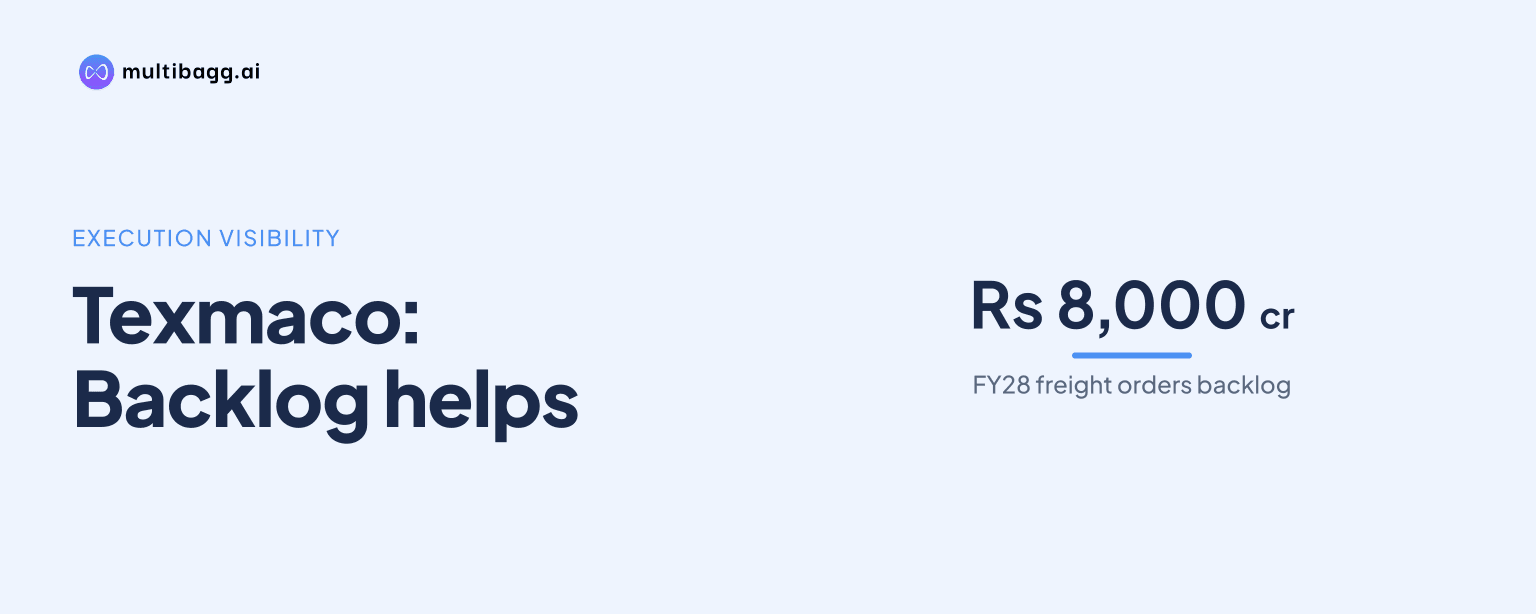
Texmaco Rail & Engineering Limited said on November 11, 2026 that its Rs 8,000 crore freight rolling-stock order book is executable in FY27 and FY28, providing a pipeline despite lower Indian Railways freight-car orders. Management said private-sector and export contracts account for about 80% to 85% of the relevant core-business order book.
Know Texmaco Rail & Engineering inside out
Results, valuation, peers and who's buying, in one view.
How long can Texmaco's freight rolling-stock backlog support execution?
Texmaco said its Rs 8,000 crore freight rolling-stock order book is deliverable during the current year and the next financial year, which places execution across FY27 and FY28 from the timing of the Q2 FY27 call. Managing Director Sudipta Mukherjee said the company had a clear execution path even if fresh railway orders remained limited.
The freight pipeline is supplemented by Rs 3,000 crore to Rs 3,500 crore of infrastructure and component-business orders that management said were also executable in FY27 and FY28. Management did not state a consolidated order-book total, but identified both freight rolling stock and the other-business orders as active delivery work over the two financial years.
Management said the Rs 8,000 crore backlog contains a much larger private and export share than Indian Railways work. It put private and export contracts at about 80% to 85% of the relevant order mix, while Indian Railways accounted for around 15% to 16%, reducing reliance on fresh government tenders for the disclosed execution period.
Why is Texmaco increasing private and export wagon work?
Texmaco said the shift to private and export customers was deliberate diversification, with an internal aim that no single customer or domain should account for more than 40% of its portfolio. Management said it remains a major supplier to Indian Railways while also pursuing domestic private and overseas contracts.
The new work differs from the commodity wagons produced for Indian Railways. Management said private and export contracts require different designs, supply chains and manufacturing inputs, meaning wagon volumes cannot be directly compared with the unit output generated during earlier commodity-wagon order cycles.
The turnover mix shows the change in Q2 FY27. Freight cars contributed 62.3% of standalone turnover, down from 68.8% in Q1 FY27 and 74.7% in Q2 FY26; businesses outside freight cars consequently represented 37.7%, compared with 25.3% a year earlier.
Infra electrical accounted for 27.8% of Q2 FY27 standalone turnover. Management also said rail infrastructure revenue rose around 41% to 42% quarter on quarter and electrical infrastructure revenue increased 38%, broadening the revenue base beyond freight cars.
Got a follow-up? Ask IRIS
What changed in Texmaco's Q2 FY27 performance?
Texmaco reported standalone revenue from operations of Rs 863 crore in Q2 FY27, up 15% from the preceding quarter, with earnings before interest, tax, depreciation and amortisation, or EBITDA, of Rs 88 crore and a 10.2% margin. The company delivered 1,106 wagons and produced 6,468 metric tonnes from its foundry in the quarter.
The sequential increase followed a weaker year-on-year comparison. Management said income from operations was about Rs 860 crore in Q2 FY27 versus Rs 753 crore in Q1 FY27, but below almost Rs 1,250 crore in Q2 FY26, primarily because freight-car business declined as Indian Railways orders were lower.
Profit before tax rose to Rs 51.2 crore in Q2 FY27 from Rs 44.1 crore in Q1 FY27. The reported EBITDA margin was 10.2%, compared with 10.8% in Q1 FY27, although management said adjusted EBITDA margin was about 70 basis points higher sequentially after removing non-repeatable other-income items from the preceding quarter.
Management attributed its margin approach to waste reduction, raw-material procurement work, power and fuel measures, freight negotiations and lower finance costs. It also said export business carries higher margins, but did not provide a numerical margin target for FY28.
How is Texmaco managing payment and capital requirements?
Texmaco said delayed customer payments were not a material current trend because it works with established customers. Management said contracts include significant advance consideration before manufacturing or raw-material procurement, alongside milestone-based payments that enable substantial revenue realisation by delivery.
For export contracts, Texmaco said it aims for most payments to be supported by letters of credit. The combination of advances, milestones and letters of credit is management's stated mechanism to limit working-capital exposure as private and export work becomes a larger part of the order book.
The company said debt was declining every quarter and near-term growth and maintenance capital expenditure could be funded from operating surpluses. Management said it had executed almost 40% of its capital-expenditure plan for the year, without giving the annual total, and separately disclosed around Rs 200 crore earmarked for defence-business capital expenditure.
Texmaco said CRISIL upgraded its long-term rating to A+ from A. Management linked the rating change to lower finance costs and said the core freight-wagon business did not require major new capital expenditure because existing infrastructure was being utilised more intensively.
Conclusion
Texmaco's Rs 8,000 crore freight rolling-stock backlog gives the company a stated execution base through FY28 while Q2 FY27 revenue remained below the prior-year period due to lower Indian Railways freight-car orders. The material change is the order mix, with management putting private and export work at 80% to 85% of the relevant book and freight cars at 62.3% of Q2 FY27 turnover, down from 74.7% a year earlier.
The next evidence point is whether private domestic and export inflows begin from November 2026 as management expected, and whether second-half FY27 output rebounds. Management also said the South African wagon and locomotive contract is scheduled across FY27, FY28 and one additional quarter, with locomotive manufacturing arrangements and further growth-capital plans still to be disclosed.