










Texmaco outlines Rs 4,000-5,000 crore core revenue plan
Key highlights
- Texmaco seeks Rs 4,000-5,000 crore of revenue from its core manufacturing businesses.
- Texmaco intends to create Rs 5,000-6,000 crore of revenue from wheels, passenger mobility, defence and renewables.
- Private and export orders form about 80%-85% of Texmaco’s freight rolling-stock and foundry orders, versus 90%-95% railway contracts in 2022-23 and earlier.
- Texmaco has earmarked around Rs 200 crore for defence and executed almost 40% of its evolving capital-expenditure plan.
powered by IRIS
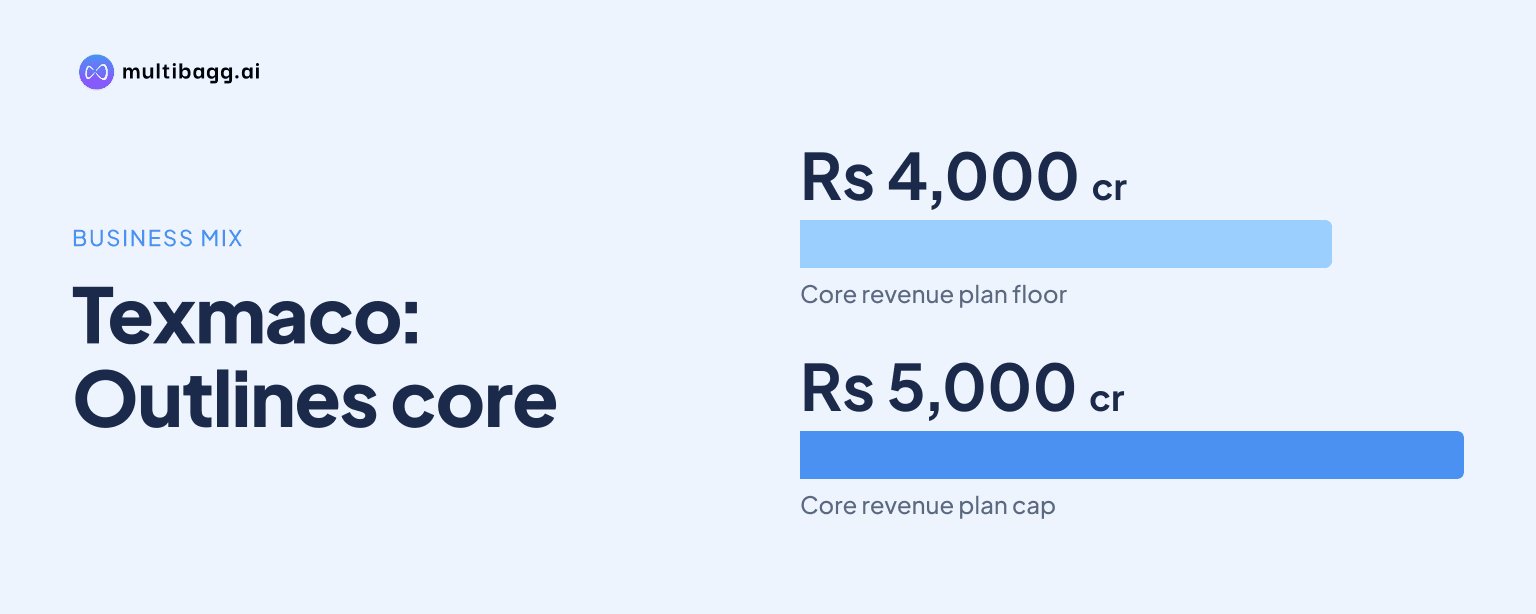
On its earnings call, Texmaco Rail & Engineering Limited said it aims for Rs 4,000-5,000 crore of revenue from core manufacturing businesses and seeks Rs 5,000-6,000 crore from newer growth areas. Management said private and export orders now account for about 80%-85% of freight rolling-stock and foundry orders.
Know Texmaco Rail & Engineering inside out
Results, valuation, peers and who's buying, in one view.
What revenue mix is Texmaco targeting?
Texmaco is targeting Rs 4,000-5,000 crore of sustainable revenue from its core business and intends to create Rs 5,000-6,000 crore from adjacent and breakaway businesses. Management described the core pool as freight rolling stock, foundry operations and niche components, while the newer pool includes wheels, passenger mobility, defence and renewables.
The Rs 9,000-11,000 crore total is the arithmetic sum of the two ranges, not a separately stated revenue forecast. Management placed the plan under its published Vision 2030, also called Texmaco 2.0, and said it had focused on building capabilities for more than 3.5 years, particularly over the past 2.5 years.
Which businesses will create Texmaco’s new revenue pool?
Texmaco identified wheels, passenger-mobility components, passenger trains, defence and renewables as the businesses intended to supplement its established rail manufacturing activities. Management said the strategy is designed to retain the company’s manufacturing focus while reducing dependence on a single customer or market category.
The wheel business remains under development. Texmaco said it had signed a memorandum of understanding for a wheel joint venture and was actively working on the opportunity, with products intended to align with heavy-haul and high-speed rail requirements. Management did not disclose the venture’s investment, plant capacity, commissioning date or revenue target.
Passenger rolling stock has a route through the Nymwag joint venture in India. Texmaco said Nymwag has received initial G-105 approval from the Research Designs and Standards Organization, or RDSO, but must build a prototype or begin manufacturing before moving forward. The plant is almost production-ready, and the venture has sought railway orders to begin the prototype process.
Defence is the only quantified new-business capital allocation disclosed in the call. Texmaco has earmarked around Rs 200 crore for defence, while management said further investment details would be disclosed as plans take shape. It said acquisitions could form part of the strategy only if the acquired business earns money from day one and meets its criteria on earnings before interest, taxes, depreciation and amortisation, sustainability and technology.
How has Texmaco reduced its railway-order dependence?
Texmaco said private-sector and export orders now account for about 80%-85% of orders in freight rolling stock and foundry, compared with 90%-95% railway contracts in 2022-23 and earlier. Management presented that shift as evidence of its effort to diversify while continuing to supply Indian Railways and pursue exports made in India.
The wagon order book reflects the changed mix. Management cited about 7,200 pending wagons after the second quarter, split 85%-15% between private customers and Indian Railways. It also said all rolling-stock orders were executable over the next 10 quarters, giving a stated delivery window for this part of the business.
Foundry capacity has risen from roughly 20,000-25,000 metric tonnes a couple of years ago to 60,000 metric tonnes across two foundries. Management estimated deliveries of around 35,000-40,000 metric tonnes, depending on wagon volumes and incoming orders, with exports expected to represent at least 25%-30% of the volume.
Texmaco said a recent government wagon-option allocation reflected performance under a specific earlier contract rather than a capacity constraint. Management said it has approaches pending with the ministry relating to coal and power-generation wagons, but gave neither an expected award date nor a value.
Got a follow-up? Ask IRIS
What supports Texmaco’s near-term execution plan?
Texmaco’s disclosed execution base includes rolling-stock orders due over 10 quarters and an electrical-business backlog of around Rs 1,600 crore. Management said that electrical backlog is expected to be executed within the current financial year and the next four quarters.
The electrical business generated almost Rs 250 crore in one quarter, according to management. It said an annualised run rate at that level could take the segment into four-figure revenue, but described this as a possibility rather than formal guidance. Texmaco is also participating in electrical tenders beyond railway electrification.
South African locomotive-order revenue is expected from the next fiscal year rather than the current fiscal year. Management said Texmaco will establish a facility in South Africa for maintenance and a larger share of business, while locomotives are expected to be supplied mostly from India, subject to the final supply mechanism.
The South African contract includes 15 years of maintenance for wagons and locomotives, management said. Texmaco did not disclose the order value, the maintenance share or its revenue-recognition schedule, so the timing and scale of the service contribution remain unspecified.
How will Texmaco fund diversification?
Texmaco said it had executed almost 40% of its evolving capital-expenditure plan and expects to fund growth and maintenance spending from operational surpluses in the short term. Management said debt has declined each quarter and that it does not currently see a short-term need for additional borrowing.
Management said it does not plan capital expenditure in the core business because it expects existing infrastructure to support growth. New capital is intended for growth businesses, with the Rs 200 crore defence earmark the first disclosed allocation. That approach means the Rs 4,000-5,000 crore core-revenue ambition is intended to rely on using existing assets.
Texmaco said diversification may use both organic and inorganic routes. Management did not disclose a total investment budget, acquisition targets or a timetable for investments beyond defence, saying it would provide details when plans are shaped.
Conclusion
Texmaco’s plan is to retain a Rs 4,000-5,000 crore manufacturing base while developing a Rs 5,000-6,000 crore growth-business pool. The change in the freight rolling-stock and foundry order mix, from 90%-95% railway contracts in 2022-23 and earlier to 80%-85% private and export orders now, is the main disclosed measure of diversification already achieved.
The next milestones are execution of rolling-stock orders over 10 quarters, delivery of the Rs 1,600 crore electrical backlog within the current financial year and the following four quarters, and the start of South African-order revenue in the next fiscal year. Management also said it would provide further details on wheel, defence and other growth-business investments as they develop.