










Thomas Cook (India) Limited DEI loss narrows to Rs 1.2 crore
Key highlights
- Thomas Cook DEI reduced its EBIT loss from Rs 15.2 crore in Q1 FY27 to Rs 1.2 crore in Q2 FY27.
- DEI Q2 FY27 revenue was Rs 147.4 crore, down 25% year on year but up from Rs 130.7 crore in Q1 FY27.
- Thomas Cook’s DEI site-rationalisation graphic shows 33 selected non-profitable sites closed, reducing the footprint from 262 to 229.
- DEI signed 5 new partnerships, renewed 20 and operationally launched 3 in Q2 FY27.
powered by IRIS
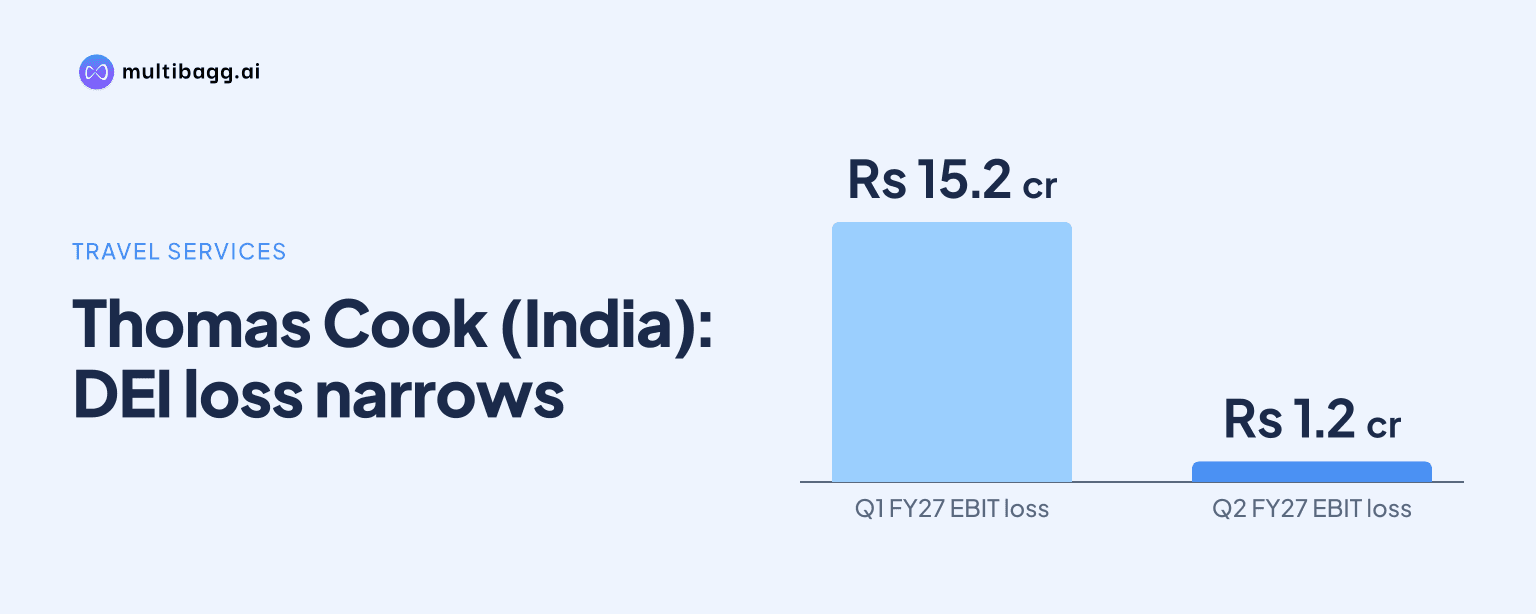
Thomas Cook (India) Limited reduced its Digital Imaging Solutions, or DEI, EBIT loss to Rs 1.2 crore in Q2 FY27 from Rs 15.2 crore in Q1 FY27 after site rationalisation and lower personnel and operating overheads. Q2 FY27 revenue recovered sequentially to Rs 147.4 crore, but remained 25% below Q2 FY26.
Know Thomas Cook (India) inside out
Results, valuation, peers and who's buying, in one view.
Why did Thomas Cook’s DEI loss narrow in Q2 FY27?
Thomas Cook’s DEI narrowed its earnings before interest and tax, or EBIT, loss by Rs 14 crore quarter on quarter, from Rs 15.2 crore in Q1 FY27 to Rs 1.2 crore in Q2 FY27. The presentation links the improvement to cost initiatives begun from Q1 FY27, including site rationalisation and optimisation of personnel costs and operating overheads. It describes Q1 FY27 as the trough, when revenue was Rs 130.7 crore and EBIT was negative Rs 15.2 crore.
The recovery did not restore DEI to the prior year’s profitability. Q2 FY27 EBIT remained a Rs 1.2 crore loss, compared with an EBIT profit of Rs 2.3 crore in Q2 FY26. The Q2 loss was also smaller than the Rs 10.2 crore loss in Q4 FY26, when geopolitical conflict affected United Arab Emirates operations during the peak season. The quarterly sequence shows that costs declined while revenue remained below its earlier levels.
What happened to Thomas Cook DEI revenue after the disruption?
Thomas Cook’s DEI recorded Q2 FY27 revenue of Rs 147.4 crore, up Rs 16.7 crore from Rs 130.7 crore in Q1 FY27 but down Rs 48.4 crore, or 25%, from Rs 195.8 crore in Q2 FY26. The presentation identifies geopolitical conflict as the factor that affected United Arab Emirates operations in Q4 FY26. It then records a 38% year-on-year revenue decline in Q1 FY27 before the sequential Q2 increase.
The half-year comparison shows that the revenue gap persisted despite the Q2 recovery. H1 FY27 revenue was Rs 278.1 crore, against Rs 405.5 crore in H1 FY26, a 31% decline. Captures, defined by the presentation as the number of digital images taken, fell to 38 million from 49 million. DEI’s H1 EBIT moved to a Rs 16.4 crore loss from a Rs 12.9 crore profit, while its EBIT margin changed to negative 5.9% from positive 3.2%.
Q2 FY27 revenue also remained below the Rs 194 crore recorded in Q4 FY26 and the Rs 236.5 crore recorded in Q3 FY26. This comparison matters because the EBIT loss narrowed while DEI operated at lower revenue than in each of Q2 FY26, Q3 FY26 and Q4 FY26. The presentation does not disclose a target date for revenue to return to those levels.
Got a follow-up? Ask IRIS
How much did Thomas Cook reduce its DEI footprint?
Thomas Cook’s site-rationalisation graphic shows DEI sites falling from 262 to 229 after selected non-profitable locations were closed, a reduction of 33 sites. The operating summary reports 229 sites in Q2 FY27, while the longer-term trajectory records 256 sites at September 2025 and 229 at September 2026. That September-to-September comparison represents a reduction of 27 sites, or 11%.
The partnership network declined alongside the site base. DEI had 104 partners at September 2026, down from 119 at September 2025, a 13% decrease, while sites declined from 256 to 229. DEI had operated 264 sites and held 125 partnerships in FY26. The lower footprint therefore reflects an operating reset during the conflict-related disruption rather than network expansion.
The presentation does not quantify savings from individual closures or separate the effect of site rationalisation from lower personnel and operating overheads. It states that initiatives begun in Q1 FY27 had a direct benefit visible in Q2 FY27. The EBIT improvement from a Rs 15.2 crore loss to a Rs 1.2 crore loss occurred while Q2 revenue of Rs 147.4 crore remained below Rs 195.8 crore in Q2 FY26.
What is Thomas Cook doing to rebuild DEI partnerships?
Thomas Cook signed five new DEI partnerships in Q2 FY27 across Malaysia, Maldives, Singapore and India, renewed 20 key partnerships, and operationally launched three partnerships in Indonesia, China and Maldives. The renewals covered Maldives, Indonesia, Malaysia, United Arab Emirates, Singapore, Egypt and India. These activities followed the reported fall in the partner count to 104 at September 2026.
The partnership activity follows a decline from DEI’s FY25 peak in several operating measures. Captures reached 130 million in FY25, fell to 108 million in FY26 and were 38 million in H1 FY27, compared with 49 million in H1 FY26. Revenue from operations declined from Rs 842.3 crore in FY25 to Rs 836 crore in FY26 and Rs 278.1 crore in H1 FY27. The new, renewed and launched partnerships are part of the stated recovery path, rather than evidence that previous volumes have been restored.
DEI’s historical profitability provides further context for the Q2 result. EBIT was Rs 54.4 crore in FY24, Rs 26.8 crore in FY25 and Rs 11 crore in FY26, before turning to a Rs 16.4 crore loss in H1 FY27. EBIT margin declined from 5.9% in FY24 to 3.2% in FY25 and 1.3% in FY26, then moved to negative 5.9% in H1 FY27. The Q2 FY27 loss reduction is therefore a quarterly improvement within a longer decline in profitability.
Conclusion
Thomas Cook’s Q2 FY27 DEI performance indicates that the cost response reduced the quarterly loss after the disruption to United Arab Emirates operations, while the smaller operating footprint reduced overheads. However, H1 FY27 revenue was Rs 127.4 crore below H1 FY26 and captures fell by 11 million, leaving the business below its earlier scale and still loss-making for the half year.
The next reported DEI figures will show whether the five new Q2 FY27 partnerships, 20 renewals and three operational launches convert into higher captures and revenue. Thomas Cook reports a base of 229 sites and more than 100 partnerships, but the presentation provides no profitability target or timetable for a return to prior revenue levels.