










Thomas Cook travel EBIT falls 30% as quarterly revenue declines
Key highlights
- Thomas Cook Travel & Related Services EBIT fell 30% year on year to Rs 45.5 crore in Q2 FY27.
- Travel revenue declined 7% to Rs 1,568.3 crore, while EBIT margin fell to 2.9% from 3.9%.
- Desert Adventures revenue fell 67% year on year as Middle East disruption reduced demand.
- Corporate travel revenue grew 11% to Rs 44.6 crore and gross turnover increased 19% to Rs 800 crore.
powered by IRIS
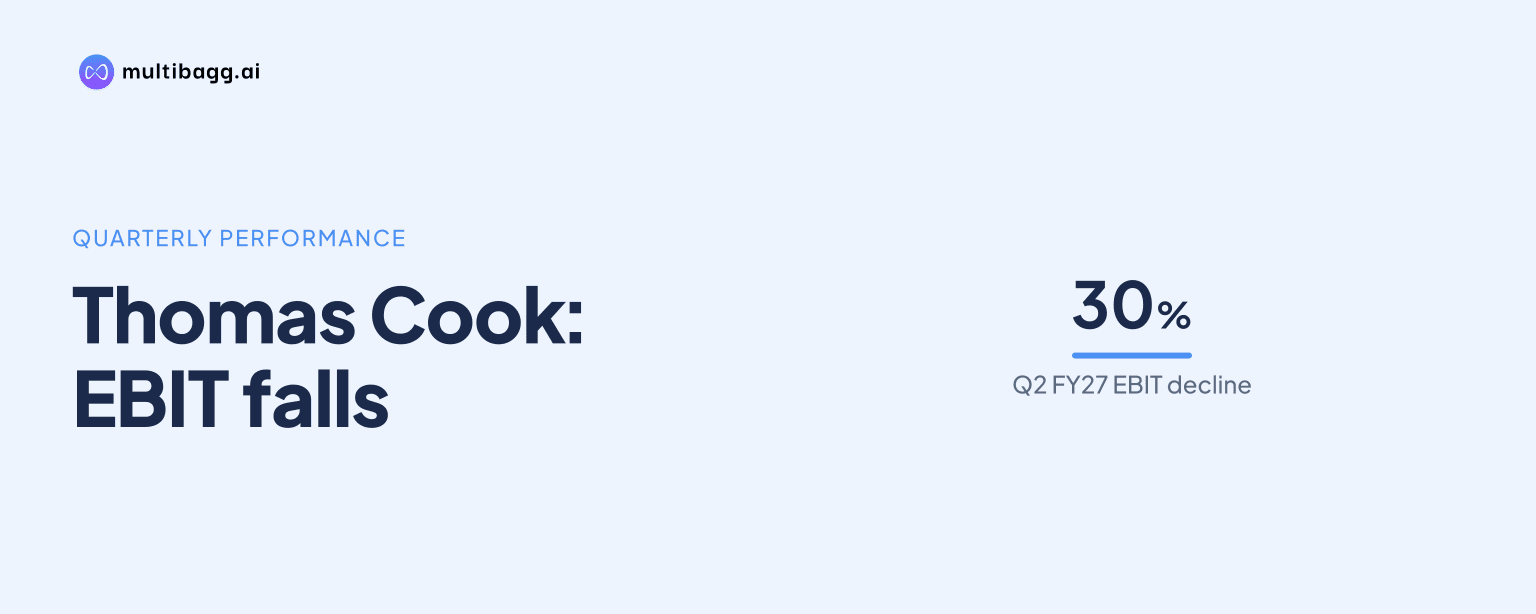
Thomas Cook’s Travel & Related Services earnings before interest and tax (EBIT) fell 30% year on year to Rs 45.5 crore in Q2 FY27, as revenue declined 7% to Rs 1,568.3 crore. Lower outbound leisure travel and destination management services, including disruption in the Middle East and softer US inbound tourism, drove the decline.
Know Thomas Cook (India) inside out
Results, valuation, peers and who's buying, in one view.
Why did Thomas Cook travel EBIT fall in Q2 FY27?
Thomas Cook’s travel EBIT fell because revenue declined and the operating margin narrowed to 2.9% in Q2 FY27 from 3.9% a year earlier. EBIT was Rs 45.5 crore, compared with Rs 65.1 crore in Q2 FY26, while revenue decreased by Rs 120.8 crore from Rs 1,689.1 crore. The margin contracted by 100 basis points, where one basis point is one-hundredth of a percentage point.
The quarter was not the segment’s lowest recent earnings point, but it remained below the prior-year result. EBIT was Rs 23.9 crore in Q4 FY26, rose to Rs 40.5 crore in Q1 FY27 and reached Rs 45.5 crore in Q2 FY27. Revenue moved from Rs 1,356.9 crore in Q4 FY26 to Rs 1,710.6 crore in Q1 FY27 before declining to Rs 1,568.3 crore in Q2 FY27.
Which Thomas Cook travel businesses drove the revenue decline?
Thomas Cook’s business-to-consumer leisure revenue fell 17% to Rs 357.7 crore in Q2 FY27, making it the larger percentage decline among the two principal travel channels. Outbound leisure revenue declined 18% to Rs 337.2 crore, while domestic leisure revenue increased 8% to Rs 20.5 crore. Long-haul travel was the principal outbound drag, falling 22% to Rs 251.7 crore from Rs 324 crore.
Business-to-business revenue was more stable, falling 3% to Rs 1,276.7 crore from Rs 1,316.4 crore. Destination management services (DMS) declined 6% to Rs 785.1 crore, whereas meetings, incentives, conferences and exhibitions (MICE) increased 1% to Rs 447 crore. Corporate travel revenue, reported on a net basis, grew 11% to Rs 44.6 crore, providing an offset within the business-to-business operation.
Inter-segment eliminations increased to Rs 66.1 crore in Q2 FY27 from Rs 58.3 crore a year earlier. After those eliminations, total segment revenue was Rs 1,568.3 crore. The mix shows that the 17% fall in business-to-consumer leisure was sharper than the 3% decline in business-to-business revenue, while DMS supplied most of the pressure within the latter.
How did Middle East disruption affect Thomas Cook DMS operations?
Thomas Cook said geopolitical disruption in the Middle East significantly affected Desert Adventures, its Middle East DMS business, whose revenue fell 67% year on year in Q2 FY27. The company reported an early recovery in September and described forward bookings as encouraging, but it did not disclose a revenue target or timetable for a full recovery.
The impact was not uniform across DMS operations. India DMS grew 16% in a seasonally softer quarter to Rs 59.7 crore, supported by inflows from the United Kingdom, Germany, France, Portugal and Japan. Asian Trails, serving Asia Pacific, increased revenue 9%, while Private Safaris operations grew 31% in Southern Africa and 14% in East Africa.
Overseas DMS revenue nevertheless declined 7% to Rs 725.4 crore, compared with Rs 782.7 crore a year earlier. Allied T Pro in the United States recorded a 22% decline as US inbound tourism remained weak, although Thomas Cook said the decline moderated quarter on quarter. Total DMS revenue therefore fell 6% despite growth in India and African operations.
Got a follow-up? Ask IRIS
What happened in Thomas Cook’s leisure travel business?
Thomas Cook’s long-haul leisure revenue declined 22% to Rs 251.7 crore in Q2 FY27, while short-haul revenue decreased 3% to Rs 85.6 crore. The company identified high China visa rejection rates as a constraint on departures, preventing a large share of bookings from converting into travel despite what it described as strong demand.
China visa constraints also affected domestic business through cancellations of Kailash Mansarovar yatras. Domestic revenue still rose 8% to Rs 20.5 crore from Rs 18.9 crore, but Thomas Cook said growth would otherwise have been meaningfully higher. Short-haul travel excluding the Middle East rose 3% to Rs 81.7 crore, indicating that the total short-haul decline was concentrated in the Middle East-related component.
Thomas Cook reported a gradual recovery in its India travel businesses in July and August, followed by accelerated momentum in September. For Q3 FY27, it reported forward bookings of 30% for India leisure travel despite elevated airfares and other input costs. This disclosed booking measure is not a revenue forecast.
What businesses cushioned Thomas Cook’s travel disruption?
Thomas Cook’s corporate travel business cushioned the decline with revenue growth of 11% to Rs 44.6 crore and gross turnover growth of 19% to Rs 800 crore in Q2 FY27. Air transaction volume rose 18.2%, led by 22.7% growth in India and 15.3% internationally. Hotel volumes increased 81.8%, while hotel transactions rose 36.5% as corporate clients adopted managed accommodation programmes.
MICE revenue held broadly steady at Rs 447 crore, up 1% from Rs 442.1 crore. Thomas Cook managed more than 176 groups during the quarter, with group sizes ranging from 50 to 7,000 delegates. One movement in Bangkok involved 7,000 delegates from an Indian pharmaceutical company, while destinations included Switzerland, Japan, Thailand, South Africa and several Indian locations.
On the supply and product side, Thomas Cook added Bengaluru-Lakshadweep and Mumbai-Bhutan charter departures, and partnered with Abu Dhabi DCT on complimentary UAE visas for eligible packages. It also integrated DynaPack into its artificial intelligence chatbot for real-time itinerary customisation and dynamic pricing. The presentation does not quantify the Q2 FY27 revenue contribution of these product and distribution initiatives.
Conclusion
Thomas Cook’s Q2 FY27 travel result shows that the 30% EBIT decline was tied to a 7% revenue fall and a 100-basis-point margin contraction. Long-haul outbound leisure, Desert Adventures in the Middle East and Allied T Pro in the United States weighed on the segment, while domestic travel, India DMS, African safaris, corporate travel and MICE limited the decline.
The next disclosed indicators to watch are the 30% forward-booking level for India leisure travel in Q3 FY27, the September recovery and forward bookings at Desert Adventures, and whether China visa rejection rates continue to restrict conversions for Kailash Mansarovar and short-haul travel. Thomas Cook also identified elevated airfares and other input costs as factors affecting the near-term leisure environment.