










Timken India Bharuch utilisation hits 60%, targets 75%
Key highlights
- Timken India’s Bharuch plant operated at about 60% utilisation in Q2 FY27 ended September 30, 2026.
- Timken India said Bharuch generated about Rs 75 crore of revenue in Q2 FY27.
- Timken India’s SRB lines reached 70% utilisation, while CRB lines remained below 60% in Q2 FY27.
- Timken India management expects Bharuch utilisation of 70% to 75% after FY27 ends.
powered by IRIS
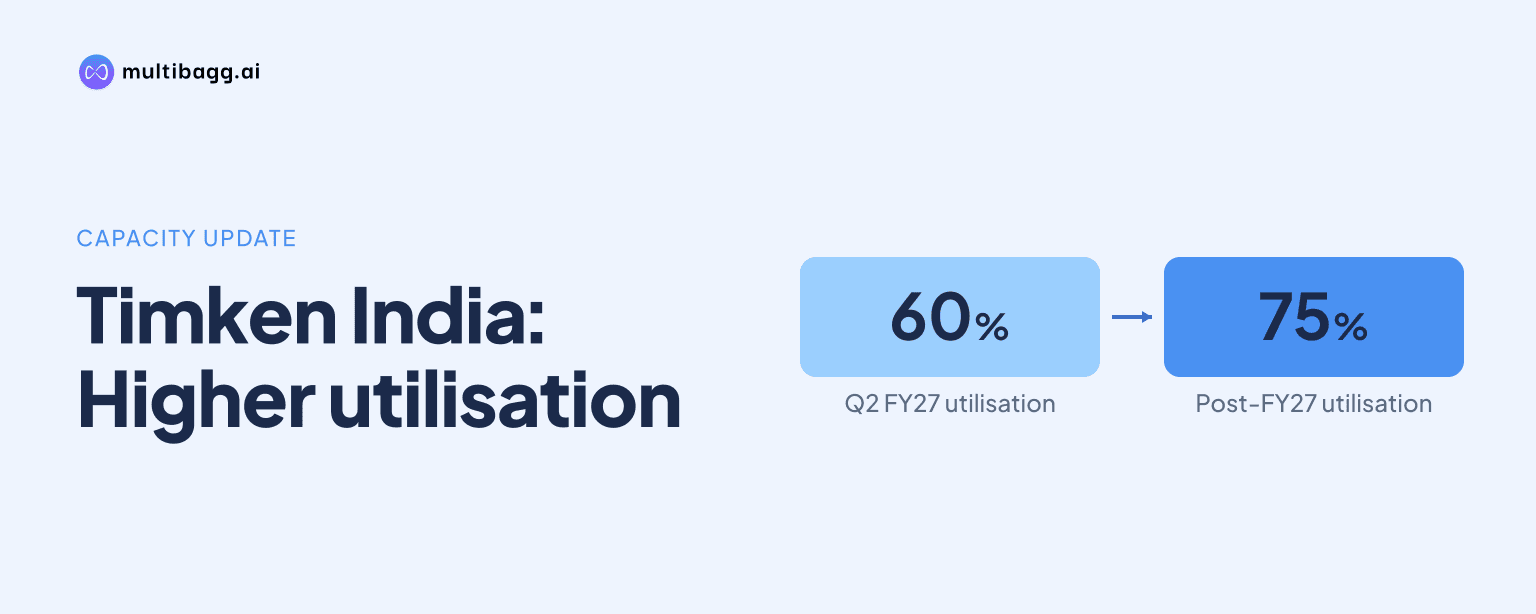
Timken India Limited said its Bharuch plant operated at about 60% utilisation in Q2 FY27 ended September 30, 2026, and generated about Rs 75 crore of revenue. Management said spherical roller bearing lines reached 70% utilisation, while cylindrical roller bearing lines remained below 60%, leaving the plant short of its earlier 70% September objective.
Know Timken India inside out
Results, valuation, peers and who's buying, in one view.
What was Timken India’s Bharuch utilisation in Q2 FY27?
Timken India’s Bharuch plant operated at about 60% utilisation in Q2 FY27, compared with the 70% level previously discussed for September. Management said the plant’s lines had been capitalised and were progressing through ramp-up, but customer certifications and material approvals continued to determine the pace at which production could move to Bharuch.
The performance differed between the plant’s two principal bearing lines in the quarter ended September 30, 2026. Spherical roller bearing, or SRB, lines reached 70% utilisation, meeting the target management had cited in the previous quarter. Cylindrical roller bearing, or CRB, lines were below 60%, which reduced the overall Bharuch average to about 60%.
Management said the qualification process matters because customers had previously been supplied from different plants. The remaining work involves material approvals and customer-side conversion of sales to Bharuch-made products. That mechanism explains why installed and capitalised lines had not yet translated into the 70% overall utilisation level during Q2 FY27.
How much revenue did Timken India’s Bharuch plant generate?
Timken India said Bharuch generated about Rs 75 crore of revenue in Q2 FY27, with sales heavily tilted toward exports and intercompany business. Management did not disclose Bharuch’s separate profitability, saying the company does not monitor or report margins at the plant level because it remains one operating segment.
The Rs 75 crore contribution came within standalone revenue from operations of Rs 969.3 crore in Q2 FY27. Total standalone revenue rose 25.4% year on year and 4.3% from Q1 FY27, while Bharuch was still operating at around 60% utilisation. Timken India did not provide a Bharuch revenue comparison for Q1 FY27 or Q2 FY26.
Exports were Timken India’s largest disclosed front-end category in Q2 FY27 at Rs 262.7 crore, or 27% of Rs 969.3 crore revenue. Mobile and other contributed Rs 204 crore, process industries Rs 190.9 crore, rail Rs 156.7 crore and distribution Rs 148.8 crore. Management said Bharuch’s current export orientation reflects ongoing domestic product approvals.
When does Timken India expect Bharuch to reach 70%-75% utilisation?
Timken India expects overall Bharuch utilisation to reach 70% to 75% when it discusses FY27 results after the financial year ends. This was management’s response to an analyst question on the October 30, 2026 earnings call, rather than a commitment to reach 80% to 85%, the higher range raised by the analyst.
Management’s path to the 70%-75% range relies on CRB improvement from its then roughly 50%-60% level, while SRB lines retain their stronger 70% utilisation. Management said SRB lines were gaining more traction, but it did not give a specific utilisation objective for Q3 FY27 or a quarterly target for CRB.
The FY27 target also incorporates export seasonality in the final quarter of the calendar year. The chief financial officer said exports normally soften around the December year-end, which needs to be considered when calculating capacity utilisation. Consequently, the ramp depends on commercial demand as well as production-line readiness and customer qualification.
Got a follow-up? Ask IRIS
What could higher Bharuch utilisation mean for Timken India’s margins?
Timken India said higher Bharuch utilisation should improve margins as capacity absorption rises, although management gave no numerical margin estimate. It said SRB and CRB products largely serve industrial customers, and described industrial business as having better overall margin behaviour than automotive business without publishing plant-level or product-level margins.
Timken India reported a standalone earnings before interest, tax, depreciation and amortisation margin of about 19.2% in Q2 FY27. Its profit-before-tax margin was 16.1%, up 50 basis points from 15.6% in Q2 FY26. A basis point is one-hundredth of a percentage point, and these company-wide measures do not isolate Bharuch’s financial contribution.
Costs remained a countervailing factor during Q2 FY27. Management said a 130-basis-point quarter-on-quarter gross-margin movement was about 50% due to unfavourable sales mix and 50% due to the timing gap between input costs and selling-price changes. It cited steel, gases, fuel and labour as cost pressures, while noting that lower rail sales after a delayed tender contributed to the mix effect.
How do exports and industrial demand support the Bharuch ramp?
Timken India said Bharuch’s Q2 FY27 sales were primarily exports and intercompany business, and management expects bearing-export momentum to remain healthy in coming quarters. It also identified North American rail as an opportunity that could gain traction over coming quarters as Timken Company aligns with customer purchasing behaviour, without disclosing an order value or delivery timetable.
In industrial markets, management said wind was performing well within process industries, which generated Rs 190.9 crore in Q2 FY27. It said Chinese and other manufacturers were moving more gearbox production to India. Timken India said it serves gearbox applications and is concentrating on carrier taper bearings, which management expects to remain relevant in larger 5-megawatt and 6-megawatt gearboxes.
The company also disclosed a separate Bharuch investment programme for plain bearings under the GGB brand. Management said the investment in fibre-reinforced composite and metal-polymer products totalled Rs 70 crore, split as Rs 35 crore for each category. Machines had arrived but had not yet been capitalised, while Timken India was already selling imported GGB-branded products.
Conclusion
Bharuch is already contributing about Rs 75 crore of quarterly revenue, but its 60% Q2 FY27 utilisation shows that the ramp remains incomplete. SRB lines at 70% demonstrate greater commercial traction, whereas CRB lines below 60% and continuing customer qualification requirements held the overall plant below the earlier September utilisation objective.
The next disclosed checkpoint is management’s 70%-75% overall utilisation expectation when FY27 results are discussed after the year ends. Investors can also watch whether CRB approvals and domestic sales conversion progress, how December export seasonality affects demand, and whether the planned November-December trial runs for the Rs 120 crore Jamshedpur rail expansion lead into customer qualification activity.