










Timken India says delayed rail tender hurt Q2 sales mix
Key highlights
- Timken India’s rail revenue was Rs 156.7 crore, or 16% of Q2 FY27 standalone revenue.
- Timken India attributed about half of a 130-basis-point gross-margin impact to unfavorable sales mix.
- Timken India expects rail-line trial runs in November and December, followed by PPAPs and qualification.
- Timken India reported Q2 FY27 standalone revenue growth of 25.4% year on year to Rs 969.3 crore.
powered by IRIS
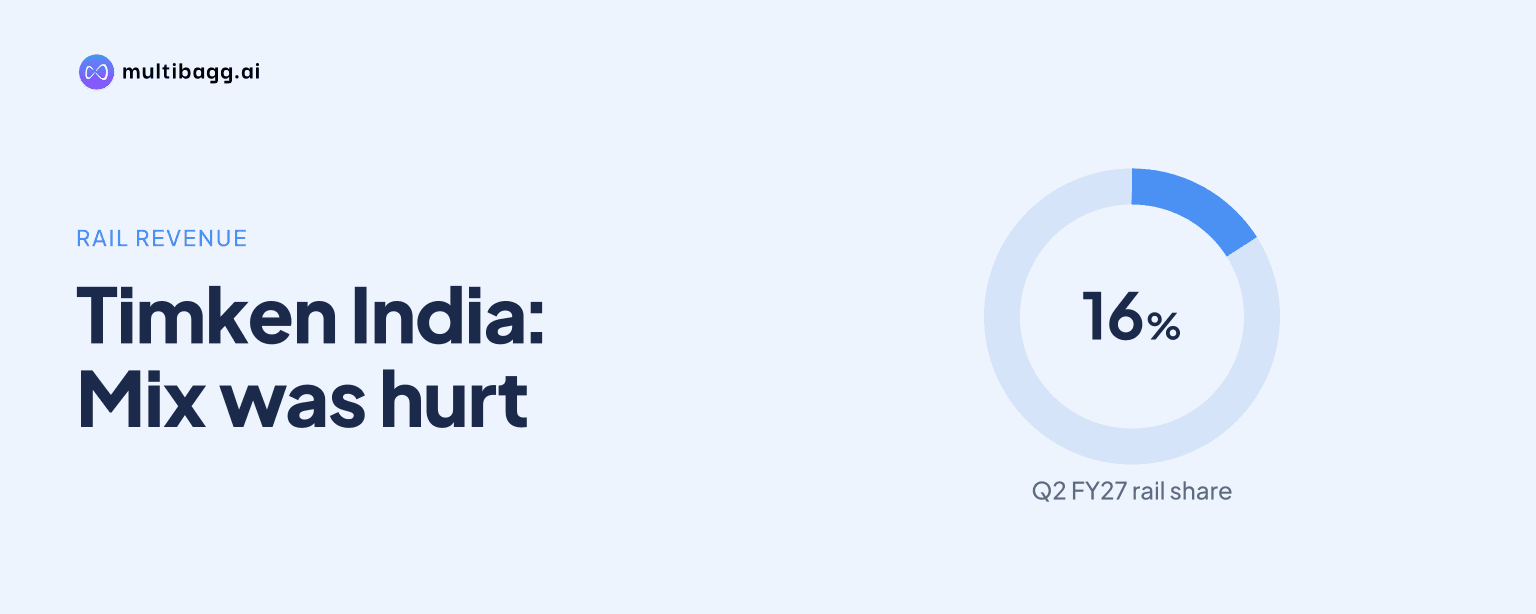
In the second quarter of financial year 2027 (Q2 FY27), Timken India Limited said a delayed global rail tender held rail at 16% of its Rs 969.3 crore standalone revenue and caused roughly half of a 130-basis-point gross-margin impact; the company said its new rail line remains scheduled for trial runs in November and December.
Know Timken India inside out
Results, valuation, peers and who's buying, in one view.
Why did Timken India’s Q2 sales mix turn unfavorable?
Timken India said its adverse Q2 FY27 mix principally reflected lower rail sales after a global rail tender was delayed. Chairman and Managing Director Sanjay Koul said rail was low in the quarter because of the tender delay, while Chief Financial Officer Sujit Kumar Pattanaik said unfavorable mix accounted for about half of the 130-basis-point gross-margin impact compared with Q1 FY27.
The remaining half of the gross-margin impact reflected the timing difference between higher input costs and selling prices, according to Pattanaik. Management cited increases in carbide, steel, fuel, gas and labour costs, and said its objective was to recover sustained cost increases through customer pricing, although automotive customers can delay such recoveries.
Timken India nevertheless reported 25.4% year-on-year growth in Q2 FY27 standalone revenue and 4.3% growth from Q1 FY27. Profit before tax rose 29.5% year on year to Rs 156 crore, while the profit-before-tax margin increased by 50 basis points to 16.1% from 15.6% in Q2 FY26.
How important was rail to Timken India’s Q2 FY27 revenue?
Rail generated Rs 156.7 crore, or 16%, of Timken India’s Rs 969.3 crore Q2 FY27 standalone revenue. It trailed exports at 27% of revenue, while mobile and other applications accounted for 21% and process industries contributed 20%, showing that rail was a meaningful but not the largest sales category in the quarter.
Exports helped support total sales during the rail tender delay. An analyst said exports rose 60% year on year and 30% sequentially in Q2 FY27, and Koul said bearing exports should remain healthy in coming quarters. He added that North American rail demand could provide more export traction over coming quarters, rather than immediately, as the wider Timken organisation aligns with customer buying behaviour.
When will Timken India’s new rail line be ready?
Timken India expects its new rail line to start trial runs in November and December, followed by Production Part Approval Process (PPAP) work and line qualification. Koul said the timeline for the rail expansion at Jamshedpur remained on target, but management did not state a commercial-production date or quantify the line’s prospective revenue contribution.
An analyst described the rail expansion as a Rs 120 crore project and asked whether commercial production would begin by December. Management’s reply was narrower: November and December are intended for trials, after which PPAPs and qualifications will begin. Customer supply therefore depends on successful approval and qualification processes, rather than on the start of trial runs alone.
The rail expansion is separate from Timken India’s Bharuch ramp-up. Bharuch operated at about 60% overall utilisation in Q2 FY27, with spherical roller bearing lines at 70% and cylindrical roller bearing lines below 60%; the plant generated close to Rs 75 crore in quarterly revenue. Management said it expected overall Bharuch utilisation of 70% to 75% by the end of FY27, while noting that the December quarter is typically softer for exports.
Got a follow-up? Ask IRIS
Are delayed rail tenders becoming Timken India orders?
Timken India said the delayed tender process should advance once the relevant committee is established, which Koul expected within the following two to three weeks. Management described the tender as delayed, not cancelled, but did not disclose its value, the potential order value, an award date or the number of wagons covered.
During the exchange, analyst Varun Jain said interim orders had been placed on wagon builders and that wagon activity was gaining traction. That observation came from the analyst, rather than a separately quantified management confirmation, so the transcript does not establish the value, timing or customer allocation of any wagon-related orders for Timken India.
Timken India’s disclosed route to a higher rail contribution has two elements: progress in the tender process within weeks and trial runs on the new line in November and December. Neither establishes booked rail revenue in Q2 FY27, when rail contributed Rs 156.7 crore, but both are operational milestones that could affect the sales mix after tender resolution and line qualification.
What could a rail recovery mean for Timken India’s margins?
A higher rail contribution could remove one identified source of Q2 FY27 mix pressure because management directly linked unfavorable mix to lower rail sales. Pattanaik attributed about half of the 130-basis-point gross-margin impact to mix and the other half to input-cost inflation and pricing timing, meaning a rail recovery would not by itself resolve the entire margin movement.
Management said industrial business has a better overall margin profile than automotive business, without putting a number on the difference. Bharuch’s spherical and cylindrical roller bearings are mainly directed to industrial applications, and Koul said attaining critical mass at those lines should have a positive effect, though the scale will depend on utilisation and the domestic-export mix.
Q2 FY27 results distinguish reported profitability from the gross-margin pressure discussed on the call. Timken India reported an earnings before interest, tax, depreciation and amortisation margin of about 19.2%, while net profit rose 29.7% year on year to Rs 116 crore. The company did not disclose a rail-specific margin or say what profitability future tender orders would carry.
Conclusion
Timken India’s Q2 FY27 rail issue was a sales-mix effect tied to a delayed tender, rather than a disclosed decline in company-wide revenue. Rail supplied 16% of Rs 969.3 crore in standalone revenue, while exports supplied 27% and helped support 25.4% year-on-year revenue growth. Management’s assessment that mix explained half of the 130-basis-point gross-margin impact shows why a normalisation in rail activity matters alongside cost recovery.
The next disclosed milestones are expected movement in the tender process within two to three weeks and trial runs for the Jamshedpur rail line in November and December, followed by PPAPs and qualification. Investors can also watch whether Bharuch utilisation progresses from about 60% in Q2 FY27 toward management’s 70% to 75% FY27 expectation, while accounting for seasonally softer exports in the December quarter.