










Timken India plans cost pass-through after 130-bp Q2 margin hit
Key highlights
- Timken India said 130 basis points of Q2 FY27 gross-margin pressure was split roughly equally between mix and cost-price timing.
- Management said carbide costs had risen 200%, alongside increases in steel, gases, fuel and labour.
- Rail revenue was Rs 156.7 crore, or 16% of Q2 FY27 standalone revenue of Rs 969.3 crore.
- Bharuch generated close to Rs 75 crore of Q2 FY27 revenue, with overall utilisation near 60%.
powered by IRIS
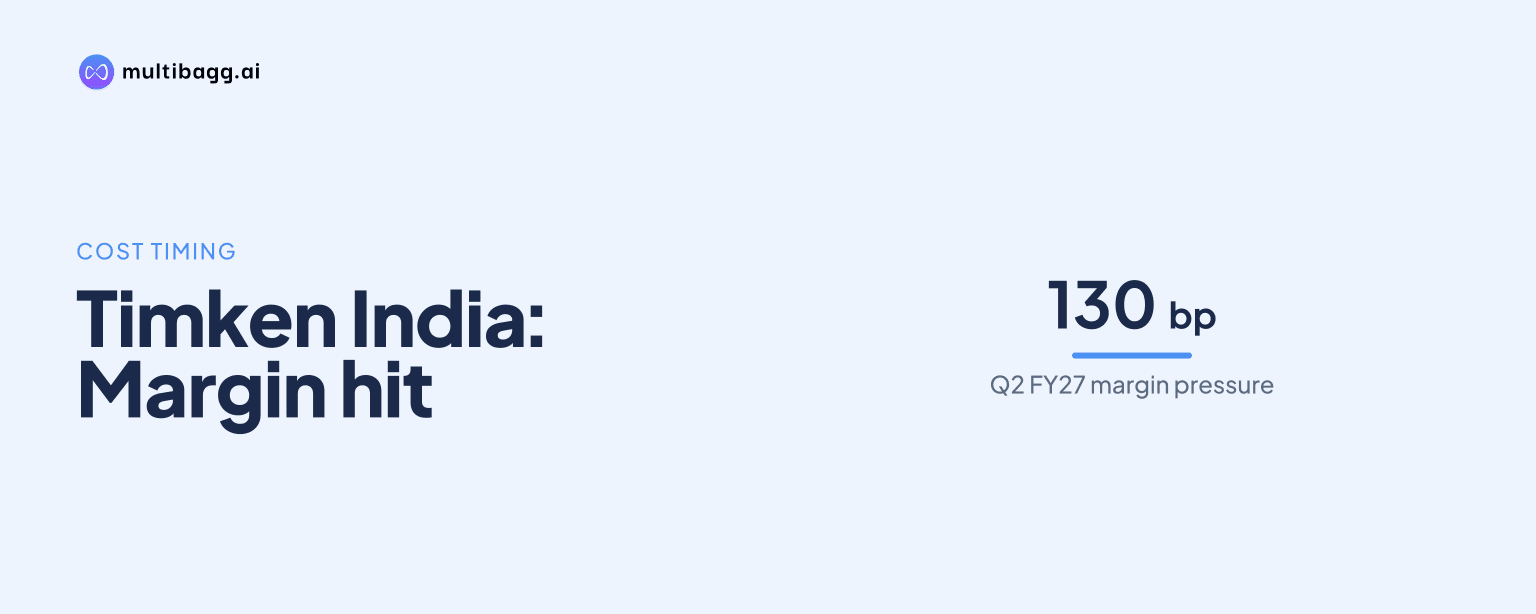
Timken India Limited plans to recover higher input costs from customers after Q2 FY27 gross margin faced 130 basis points of pressure, with management attributing about half to unfavourable sales mix and about half to cost-price timing. Carbide costs had risen 200%, while steel, gases, fuel and labour were also increasing.
Know Timken India inside out
Results, valuation, peers and who's buying, in one view.
Why did Timken India’s gross margin face pressure in Q2 FY27?
Timken India said Q2 FY27 gross margin faced 130 basis points of quarter-on-quarter pressure, split roughly equally between an unfavourable sales mix and input-cost inflation combined with price-recovery timing. Chief Financial Officer Sujit Kumar Pattanaik said the cost component was not solely an input-price effect because selling-price changes can lag higher costs.
The mix effect principally reflected lower rail sales after a global rail tender was delayed. Rail contributed Rs 156.7 crore, or 16%, of Q2 FY27 standalone revenue of Rs 969.3 crore, while exports contributed Rs 262.7 crore, or 27%. Management specifically identified rail’s lower contribution as the adverse mix factor, without quantifying margin differences between front-end units.
The gross-margin movement occurred alongside higher reported profit. Q2 FY27 standalone revenue increased 25.4% year on year to Rs 969 crore, while profit before tax rose 29.5% to Rs 156 crore. Profit-before-tax margin increased 50 basis points to 16.1% from 15.6% in Q2 FY26, and earnings before interest, tax, depreciation and amortisation margin was about 19.2%.
Which costs does Timken India plan to recover from customers?
Timken India said it intends to seek customer recovery for increases in carbide, steel, gases, fuel and labour rather than absorb them permanently. Chairman and Managing Director Sanjay Koul said carbide costs had increased 200%, while the other named input and operating costs were also rising. He said continuous-improvement efforts can address only part of this cost movement.
Management’s position was that bearing manufacturers may absorb cost increases for a limited period, potentially a quarter, but cannot do so on a sustained basis. Timken India’s sales teams are therefore pursuing price recovery across automotive and non-automotive customers. The company did not disclose the value of costs recovered in Q2 FY27 or a timetable for completing negotiations.
Pricing timing differs by customer group, according to management. Koul said major customers understand the increase and are passing it through, while automotive customers can delay adjustments. He said recovery from industrial customers is progressing, making the price-cost lag a key mechanism behind the portion of the 130-basis-point pressure not caused by sales mix.
Got a follow-up? Ask IRIS
How did rail delays affect Timken India’s sales mix?
Timken India said the delayed global rail tender reduced rail’s Q2 FY27 contribution to Rs 156.7 crore and created the unfavourable mix effect. Management said the tender committee had not been set up as of the October 30, 2026 earnings call, but expected the next procedural steps within two to three weeks. It also referred to interim orders placed with wagon builders.
The company’s Rs 120 crore rail expansion at Jamshedpur remained on schedule, management said. The new line was expected to begin trial runs in November and December, followed by production part approval process, or PPAP, work and customer qualification. Management did not describe commercial production as immediate, and conversion of the delayed tender into orders remained unresolved.
The rail delay did not coincide with a broad sales slowdown in management’s commentary. In the analyst’s question, exports were described as up 60% year on year and 30% quarter on quarter, while management said bearing-export momentum should remain healthy in coming quarters. Management also said North American rail could gain traction over coming quarters as Timken Company aligns with customer buying behaviour, rather than immediately.
Can Bharuch utilisation improve Timken India’s margin mix?
Timken India said its Bharuch plant generated close to Rs 75 crore of revenue in Q2 FY27, with overall capacity utilisation near 60%. Spherical roller bearing, or SRB, lines reached 70% utilisation during the quarter, while cylindrical roller bearing, or CRB, lines remained below 60%. Management linked the gap to certifications, material approvals and customer-side requirements.
Bharuch sales were heavily tilted toward intercompany exports in Q2 FY27, while domestic PPAP work was under way. Timken India does not disclose or monitor plant-level margins separately. Koul said SRB and CRB products generally serve industrial customers, and industrial business has better overall margin behaviour than automotive business, but did not provide a basis-point comparison.
Management expects overall Bharuch utilisation to reach 70% to 75% by the financial year-end investor call, compared with about 60% in Q2 FY27. It said margin should improve as utilisation increases, while Pattanaik noted that the final calendar quarter is typically softer for exports because of the December year-end. That seasonality could affect the utilisation path even as the plant ramps up.
Conclusion
Timken India delivered higher Q2 FY27 revenue and profit despite 130 basis points of gross-margin pressure from rail-related mix and cost-price timing. Its stated response is to pursue customer price increases for carbide, steel, gases, fuel and labour while raising Bharuch output. The 16.1% profit-before-tax margin was 50 basis points above Q2 FY26, showing that reported profitability improved even with the gross-margin pressure.
The next disclosed markers are the expected November and December trial runs at the Rs 120 crore Jamshedpur rail line, progress in the delayed rail tender process and Bharuch utilisation toward management’s 70% to 75% financial year-end range. Management also identified automotive pricing delays and final-calendar-quarter export seasonality as factors that could affect the pace of cost recovery and capacity ramp-up.